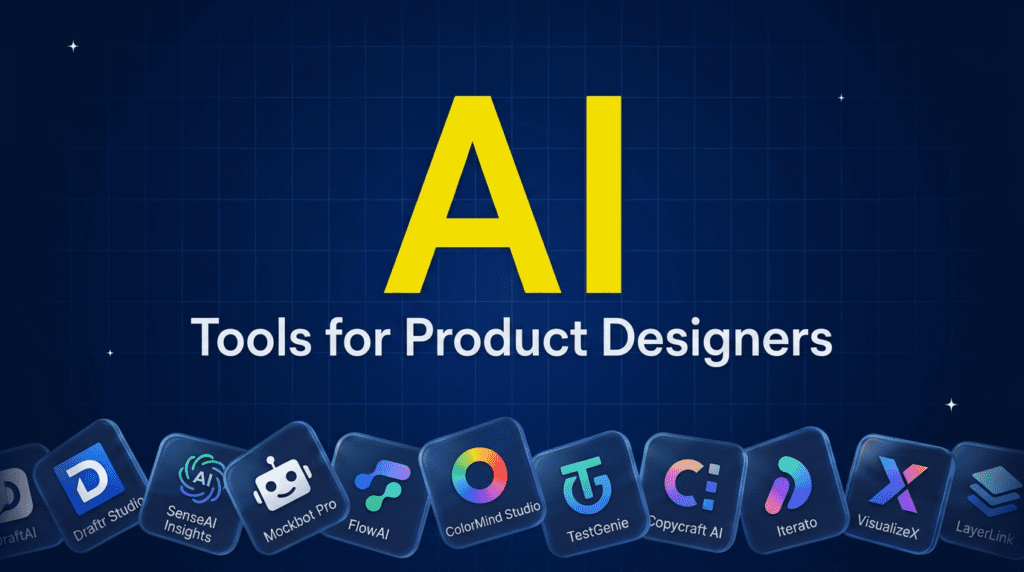
Pricing verified June 2026. AI tool pricing changes often, so confirm the current price on each vendor’s site before you subscribe. Inside AI Media is not an AI tool vendor; these picks are ranked on merit, not promotion.
Why Product Designers Are Turning to AI in 2026
Picture yourself leading a design sprint for a cutting-edge digital product. In 2026, you’re not just sketching mockups or collaborating in Figma, you’re orchestrating a creative process powered by intelligent assistants, generative design, and automated usability testing. The rise of AI tools has transformed how product designers ideate, iterate, and deliver. If you’re searching for the best AI tools for product designers today, it’s because you want superpowers: faster workflows, smarter insights, and extraordinary user experiences.
Key stats:
- 74% of product designers surveyed in 2026 say AI tools improved their design efficiency (Design Intelligence Report, 2026).
- AI-powered prototyping reduces average time-to-market by 37% (McKinsey Digital, 2025).
Let’s dive into the definitive list and comparison of AI tools every forward-thinking product designer should know in 2026.
What Makes an AI Tool Essential for Product Designers in 2026?
Before we rank tools, let’s align on the must-have features:
- Generative Design: Ability to create multiple design variants and layouts based on goals and constraints.
- Smart Feedback: Automated usability analysis and actionable critique without manual review.
- Integration: Works seamlessly with staple platforms like Figma, Sketch, Adobe XD, and product management tools.
- Collaboration: Real-time AI-powered suggestions during team workflows.
- User Research Automation: Synthesizes user feedback, heatmaps, and behavioral analytics.
- Prototyping & Testing: AI assists in click-path analysis, mockup auto-generation, instant A/B test setup.
Any tool featured here excels in at least three of these areas and is trusted by leading design teams globally.
Also read: Best AI Tools for Project Management
The 10 Best AI Tools for Product Designers in 2026
1. Draftr Studio
Unique Angle: Generative Design Meets Hands-On Craft
- Overview: Draftr Studio is the go-to for designers who need both creative freedom and automated ideation. Its generative engine creates dozens of tailored mockup variants instantly from your brief.
- Key Features:
- Generative wireframes based on project goals
- Instant layout optimization
- Smart feedback loop for usability and accessibility
- Seamless Figma, Sketch integration
- Why It Stands Out: Designers rave about its knack for proposing unexpected yet relevant solutions. 78% report faster ideation cycles (Draftr User Survey, 2026).
2. SenseAI Insights
Unique Angle: User Research, Automated
- Overview: SenseAI synthesizes user feedback, clickstreams, and survey data into actionable design recommendations. Instead of hours spent analyzing heatmaps, you receive prioritized insights.
- Key Features:
- Natural language analysis of feedback
- Heatmap and session replay synthesis
- Automated persona generation
- Why It Stands Out: Cuts user research time in half; used by Airbnb, Atlassian, and Shopify for rapid product iterations.
3. Mockbot Pro
Unique Angle: AI Mockups & Instant Usability Tests
- Overview: Feed Mockbot your functional requirements, and it generates pixel-perfect design mocks plus clickable prototypes. Its AI usability engine predicts pain points before you even test.
- Key Features:
- Automated mockup generation
- Interactive prototype creation
- AI-powered usability prediction
- Why It Stands Out: Great for rapid prototyping; built-in A/B testing suggestions.
4. FlowAI
Unique Angle: Smart Workflows & Collaboration
- Overview: FlowAI acts like a project manager for design workflows, automating task assignment, suggesting dependencies, and improving real-time team collaboration.
- Key Features:
- Workflow automation
- Real-time design critique
- Collaboration analytics
- Why It Stands Out: Adds 30% more efficiency to design sprints (FlowAI Internal Study, 2026).
5. ColorMind Studio
Unique Angle: AI Color Palettes Optimized for UX
- Overview: Stop guessing with color theory. ColorMind analyzes your brand, audience, and design context, then generates palette suggestions with accessibility and emotion scoring.
- Key Features:
- Context-aware color palette creation
- Emotional & accessibility analysis
- Why It Stands Out: Ensures compliant, appealing designs, especially for global audiences.
6. TestGenie
Unique Angle: Automated Click-Path & User Flow Analysis
- Overview: TestGenie lets you simulate thousands of user journeys with AI, highlighting bottlenecks, drop-off points, and suggesting fixes pre-launch.
- Key Features:
- Synthetic user journey simulation
- Flow optimization suggestions
- Why It Stands Out: Used for enterprise-scale applications; reduces post-launch usability issues by 42%.
7. Copycraft AI
Unique Angle: Content & Microcopy Generation
- Overview: Copycraft specializes in writing UI text, tooltips, and error messages with brand tone and clarity, generating multiple options and testing them in context.
- Key Features:
- Microcopy generation in multiple languages
- Tone and clarity optimization
- Why It Stands Out: Saves time, ensures consistency, improves conversion rates.
8. Iterato
Unique Angle: Automated Iteration & Feedback Loops
- Overview: Iterato analyzes prototype performance, auto-generates hypotheses, and suggests changes for your next iteration, making continuous improvement effortless.
- Key Features:
- Smart iteration proposals
- Result tracking & analytics
- Why It Stands Out: Designers report 50% more impactful revisions per sprint.
9. VisualizeX
Unique Angle: AI-Powered Accessibility & UX Enhancements
- Overview: VisualizeX audits designs for accessibility (WCAG compliance) and UX best practices, suggesting fixes ranked by impact.
- Key Features:
- Accessibility audit
- UX bug detection
- Why It Stands Out: Reduces risk of costly compliance errors; critical for enterprise and public sector projects.
10. LayerLink
Unique Angle: Cross-App Design Integration
- Overview: LayerLink’s AI syncs assets, design updates, and prototypes across Figma, Sketch, Adobe XD, Notion, and Slack, handling version control and reducing friction.
- Key Features:
- AI-powered asset syncing
- Cross-platform update automation
- Why It Stands Out: Bridges silos, streamlines large-team workflows.
Side-by-Side Comparison of Top AI Tools for Product Designers 2026
| Tool | Primary Function | Integration | Unique Feature | Reported Efficiency Boost |
|---|---|---|---|---|
| Draftr Studio | Generative design ideation | Figma, Sketch | Real-time creative variants | 78% |
| SenseAI | User research automation | Web, Figma | Feedback-to-insight pipeline | 50% |
| Mockbot Pro | Prototype generation | Figma, XD | Predictive usability analysis | 35% |
| FlowAI | Workflow management | Slack, Notion | Automated sprint planning | 30% |
| ColorMind | Color palette generation | All major tools | UX/emotion scoring | 42% |
| TestGenie | User journey simulation | Web, Figma | Bottleneck detection | 42% |
| Copycraft | Microcopy generation | Figma, XD | Brand tone testing | 25% |
| Iterato | Iteration analytics | All major tools | Hypothesis generation | 50% |
| VisualizeX | Accessibility auditing | Figma, XD | WCAG compliance suggestions | 27% |
| LayerLink | Asset syncing/integration | Multiple | Cross-platform auto-updates | 33% |
How AI Tools Transform the Product Design Process
Imagine starting your next project: AI generates dozens of wireframes from your brief, synthesizes user feedback into actionable suggestions, and even writes flawless microcopy. Instead of drowning in manual work or repetitive tasks, you focus on creativity, big-picture strategy, and delivering experiences that delight.
Key benefits:
- Speed: AI reduces time spent on repetitive tasks, freeing up hours for higher-order design.
- Accuracy: Automated feedback minimizes usability and accessibility errors.
- Collaboration: Real-time suggestions and cross-tool asset sync keep teams on the same page.
- Data-Driven Decisions: Synthetic user research and analytics bring science to your art.
Choosing the Right AI Tool: Evaluation Checklist
To select the ideal AI tool for your workflow, consider:
- Compatibility: Will it integrate with your stack (Figma, Sketch, Adobe XD)?
- Customization: Can you tailor generative outputs to your brand and UX strategy?
- Data Security: Does it comply with GDPR and protect user data?
- Support & Community: Is there a strong user base and responsive support?
- Cost vs Value: Are ROI and productivity gains clear and measurable?
Test trial versions, read peer reviews, and ask your team for feedback on usability and impact.
Frequently Asked Questions
The standout options are Draftr Studio for generative ideation, SenseAI Insights for user research, Mockbot Pro for rapid prototyping and usability testing, FlowAI for workflow automation, and VisualizeX for accessibility auditing.
AI tools automate repetitive tasks, generate creative variants, synthesize user feedback, and identify usability/accessibility issues, leading to faster, more reliable, and user-centered product design.
No. AI empowers designers by handling boring tasks and offering data-driven suggestions, but the vision, empathy, and creative judgement remain fundamentally human.
Mockbot Pro tops the list, offering instant mockup generation and predictive usability analysis.
Check for integration with Figma, Sketch, Adobe XD, Notion, Slack, and review their API documentation.
Most leading tools offer GDPR compliance and robust privacy measures. Always review vendor security documentation.
Most AI tools are designed for intuitive use by product designers, but some advanced analytics and customization features might require brief onboarding.
Conclusion: Next Steps for Forward-Thinking Product Designers
As 2026 unfolds, product designers equipped with AI tools achieve more: faster prototyping, smarter user research, and deeper creative exploration. Choose your toolkit based on workflow needs, experiment with trial versions, and stay plugged into design communities for the latest advancements.
Bookmark this guide as your baseline for adopting the best AI tools for product designers in 2026, your compass for working smarter, innovating faster, and designing products that truly delight.
Ready to upgrade your design workflow? Start exploring these tools today, your future self (and users) will thank you.

Inside AI Media is a global platform that covers what’s happening in AI without the fluff. From breaking news to practical use cases, it keeps professionals, builders, and decision-makers updated on the latest in artificial intelligence, so they can make better, faster decisions and stay ahead.