In this article
I’ve been testing AI image generators for a while now, and every time I think the tools have peaked, another update rolls out and I have to revisit everything. It’s genuinely exciting and a little exhausting. Here’s what’s changed in 2026: the gap between “good” and “great” has narrowed significantly. A prompt that would have returned nightmare hands and blurry text two years ago now produces something you could use in a real campaign. Models like Midjourney v7, GPT Image 2, FLUX, and Ideogram 3 are genuinely impressive and the question is no longer “which one works?” but “which one is right for what I actually need?” I’ve tested all of these tools with real prompts portraits, product shots, posters with text, cinematic scenes. Not cherry-picked results. Real ones. Here’s what I found.
Pricing verified June 2026. AI tool pricing changes often, so confirm the current price on each vendor’s site before you subscribe. Inside AI Media is not an AI tool vendor; these picks are ranked on merit, not promotion.
What to look for in an AI image generator
Before you pick a tool, it helps to know what you’re optimizing for. Here are the things I paid attention to:- Output quality: Does it look good at first glance? Does it hold up when you zoom in?
- Prompt accuracy: Does it actually create what you asked for, especially when prompts get complex?
- Text rendering: Can it put readable words inside an image? (Most tools still struggle here.)
- Speed: How long does a generation actually take?
- Ease of use: Can you get good results without a crash course in prompt engineering?
- Pricing: What does it cost, and is there a free tier worth using?
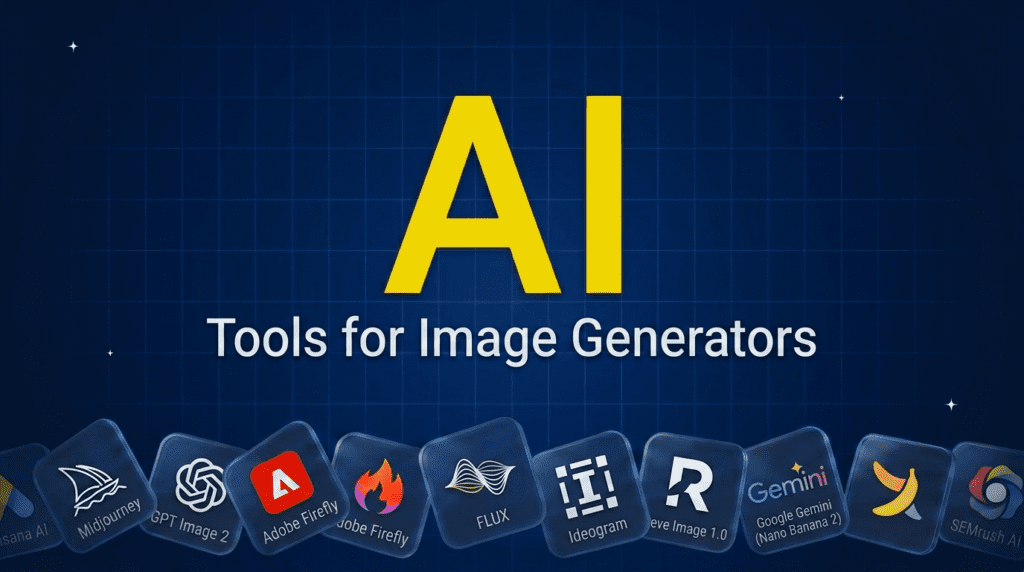
The 8 best AI image generators in 2026
- Midjourney: Best for artistic quality
- GPT Image 2 (via ChatGPT): Best for ease of use and prompt accuracy
- Adobe Firefly: Best for commercial-safe images
- FLUX: Best for photorealism and open-source flexibility
- Ideogram: Best for text inside images
- Reve Image 1.0: Best for tight prompt following
- Google Gemini (Nano Banana 2): Best free option
- Stable Diffusion: Best for advanced users who want total control
1. Midjourney
Best for: Artistic quality and cinematic visuals If you want images that look stunning the kind that stop you mid-scroll Midjourney is still the benchmark. It has a richness to its outputs that other tools struggle to replicate. Colors pop without looking oversaturated. Compositions feel intentional. Give it something atmospheric and creative, a foggy city at dusk, a portrait with dramatic lighting and it will almost always deliver something gallery-worthy. Midjourney v7 has been the default model since mid-2025, and it’s a noticeable step up from v6 in terms of character consistency and scene handling. That said, Midjourney has a few well-known weaknesses. Text inside images is still messy, it frequently misspells or distorts words, which rules it out for posters and graphics-heavy work. And the interface, while improving, still runs primarily through Discord or its own web app, with no official API for developers. Pricing: No free tier. Plans start at $10/month (Basic, ~200 fast images), $30/month (Standard, 15 fast GPU hours + unlimited relaxed), $60/month (Pro, adds Stealth Mode), and $120/month (Mega). Annual billing saves 20%. All plans include commercial usage rights. The honest take: If visual quality is your top priority and you’re not trying to embed text in images, Midjourney is worth the subscription. The $30/month Standard plan is the sweet spot for most creators.2. GPT Image 2 (via ChatGPT)
Best for: Ease of use and following complex prompts OpenAI‘s image generation has had quite a journey, DALL-E felt like the pioneer, then fell behind, and now GPT Image 2 has quietly climbed back to near the top of quality leaderboards. What makes it stand out isn’t just image quality; it’s how well it understands what you’re actually asking for. You can write a conversational prompt “a flat lay of coffee and a notebook on a wooden desk, morning light, warm tones, like a lifestyle blog photo” and it will get it right without you needing to learn any special syntax. That matters a lot if you’re not a prompt engineering enthusiast. It’s also the easiest entry point because it lives inside ChatGPT. You don’t need a separate account, a Discord server, or a new interface to learn. Just type, and you get an image. Text rendering is also strong, significantly better than Midjourney for things like quotes or headlines inside an image. The one real downside: it’s slower than some alternatives due to how it generates images. But the results usually justify the wait. Pricing: GPT Image 2 is available to ChatGPT Plus subscribers at $20/month. Free users get limited access to GPT Image 1.5. API access (gpt-image-2) is available via OpenAI’s platform with usage-based pricing. The honest take: If you’re already using ChatGPT, this is your first stop. It’s the most accessible high-quality image generator available, and it’s consistently underrated.3. Adobe Firefly
Best for: Commercial-safe image generation Here’s the thing about every other tool on this list: there are legitimate questions about what they were trained on. Adobe Firefly doesn’t have that problem. It was trained exclusively on licensed Adobe Stock images, openly licensed content, and public domain material which means enterprise customers get commercial indemnity. If something goes wrong with an IP claim, Adobe will defend and cover qualifying customers. No other major tool offers that. For agencies, marketing teams, and anyone creating content for clients, that’s not a small thing. The images it produces are clean and professional. They’re not always as artistically striking as Midjourney, but they follow commercial briefs reliably product mockups, marketing assets, background generation. The integration with Photoshop and Illustrator is genuinely useful too. Generative Fill in Photoshop runs on Firefly under the hood, and it’s become a real part of professional workflows. Pricing: Firefly Standard is $9.99/month (2,000 premium credits). Firefly Pro is $19.99/month (4,000 credits + Adobe Express and Photoshop web). If you’re already a Creative Cloud subscriber ($59.99/month), Firefly credits are included you likely don’t need a standalone plan. The honest take: If you’re doing any kind of professional or client-facing creative work, Firefly’s commercial safety is a genuine competitive advantage. The raw image quality might not top the charts, but the peace of mind does.4. FLUX (by Black Forest Labs)
Best for: Photorealism and developer flexibility FLUX has had a real moment over the last year. It’s become the go-to model for anyone who wants serious photorealism without the price tag of premium APIs. Black Forest Labs, the team behind it, has shipped regular updates FLUX 1.1 Pro, FLUX 2 Pro and each version has pushed quality forward meaningfully. What makes FLUX different from most tools here is that it’s open-weight. Technically sophisticated users can run it locally on a GPU with 12GB+ VRAM at zero per-image cost. Developers building image generation into products often reach for FLUX because it offers solid API pricing ($0.003–$0.05 per image depending on the provider and model tier) and real control over outputs. For photorealism specifically product photography, food shots, realistic portraits like FLUX competes with anyone. It also supports LoRA fine-tuning, which means you can train it on specific visual styles or characters and get consistent results across many generations. Pricing: Open-weights models are free to self-host; the hosted API is usage-based (pay per generation, no subscription). The honest take: If you’re a developer, content platform, or technically inclined creator who wants photorealistic images at scale, FLUX is the most cost-efficient serious option out there. For casual users, the interface is less polished, and you’ll get better mileage from Midjourney or GPT Image 2.5. Ideogram
Best for: Text inside images Almost every AI image generator struggles with text. They misspell words, smudge letters, or produce something that looks like text from a fever dream. Ideogram is the clear exception. It was built with typography in mind, and it shows. In testing, Ideogram 3 rendered legible, correctly-spelled text in images with near-perfect accuracy multi-word phrases, brand slogans, and product labels all came out clean. For anyone making social media graphics, YouTube thumbnails, event posters, or anything where words need to appear in the image, Ideogram should be your first call. The overall image quality has also improved significantly with version 3. Lighting, composition, and realism are all better. It’s not just a text tool anymore, it’s a genuinely capable all-around generator that happens to have an edge in typography. Pricing: Free tier gives 10 prompts/day (~40 images, since each prompt generates 4 variations). Paid plans start at around $7–$8/month (Basic), $15–$20/month (Plus, includes API access), and $42–$48/month (Pro, full commercial licensing). Annual billing saves ~40%. The honest take: If you make any visual content that includes text, Ideogram is not optional, it’s the only tool that does this reliably. Even as a complement to Midjourney or GPT Image 2, it earns a spot in the workflow.6. Reve Image 1.0
Best for: Sticking precisely to your prompt Reve came out of nowhere in early 2025, and its reputation spread fast specifically because it does one thing exceptionally well: it actually reads your entire prompt. Not just the first part. Not the vibe of it. The whole thing. Long, complex prompts that trip up other generators “a Victorian-era scientist at a mahogany desk, surrounded by brass instruments, warm candlelight, rain streaking the window behind her, photorealistic” tend to land well in Reve. It’s consistently impressive at handling multiple details simultaneously. The editing features are also strong. You can iterate on generated images in ways that feel genuinely useful, not just cosmetic. The tradeoff is that Reve is newer and less well-known, which means the community around it is smaller and the interface is still evolving. But the core output quality is legitimately competitive with tools that have been around far longer. Pricing: Reve offers a free tier to get started. Paid plans are available for higher volume and commercial use check their current pricing at reve.art as it continues to evolve. The honest take: Reve is the best-kept secret on this list. If prompt adherence matters to you and it usually does it’s worth testing alongside whatever your current tool of choice is.7. Google Gemini (Nano Banana 2)
Best for: Free use and everyday image generation Google’s image generation now powered by the Nano Banana 2 model inside Gemini has quietly become one of the strongest free options available. If you have a Google account, you already have access. No signup, no credit card, no waitlist. The quality is genuinely good. Prompt following is reliable, photorealism is strong, and it handles everyday use cases like social media images, concept visuals, quick illustrations without a fight. In testing, it captured scene details accurately and consistently, which is more than you can say for a lot of free tools. The main limitation is that you’re working within Google’s ecosystem. The generation happens inside the Gemini chatbot interface, which is easy to use but less specialized than a dedicated image tool. You won’t get the granular controls of Midjourney or the typography accuracy of Ideogram. Pricing: Free with a Google account via the Gemini app. Gemini Advanced (part of Google One AI Premium) unlocks higher limits and is included in the $19.99/month Google One AI Premium plan. The honest take: If you need image generation for free not trial-free, actually free Nano Banana 2 in Gemini is the best option right now. Start here before you start paying for anything else.8. Stable Diffusion
Best for: Total control and unlimited local generation Stable Diffusion is the Linux of AI image generators. It’s open source, runs on your own machine, and gives you more control than any other option on this list. Custom models, LoRAs, ControlNet, inpainting, custom workflows through ComfyUI or Automatic1111, the ecosystem is enormous and entirely community-driven. The catch is obvious: setup takes real technical knowledge. You need a capable GPU (8GB+ VRAM recommended), patience with configuration, and willingness to troubleshoot. Once it’s running, though, you have unlimited generation at effectively zero cost per image. For batch work, experimental projects, fine-tuned models for specific aesthetics, or anyone who wants to run everything locally without usage limits or data privacy concerns, Stable Diffusion remains unbeatable. Pricing: Open-source models are free to self-host (Community License); hosted Stability Brand Studio offers a free trial, then Core at $50/mo (5,000 credits). The honest take: This isn’t for everyone. But if you have the technical chops and generate images at volume, the economics are compelling. You’ll never pay per image again.Which AI image generator should you use?
Here’s the quick version:- You want the best-looking images: Midjourney
- You want the easiest experience: GPT Image 2 via ChatGPT
- You’re doing commercial or client work: Adobe Firefly
- You need text inside your images: Ideogram
- You need photorealism at scale: FLUX
- You care deeply about prompt accuracy: Reve Image 1.0
- You want free and good: Google Gemini (Nano Banana 2)
- You want full control with no usage limits: Stable Diffusion
A note on copyright and commercial use
This is still unsettled territory. Most AI image generators were trained on data scraped from the internet, and the legal landscape around that is actively being litigated. Midjourney vs. Disney and Universal is one case worth following. For casual personal use social posts, blog images, concept exploration, you’re unlikely to run into issues. But if you’re building a brand, running client campaigns, or creating assets for commercial distribution, Adobe Firefly is currently the only tool that offers genuine commercial indemnity. Keep that in mind when choosing your stack. To stay updated with latest AI tools and updates, stay in tune with InsideAIMedia. AI image generation is moving fast. Every time this space feels settled, a new model drops and rearranges the rankings. The tools above are the best available as of mid-2026 and some of them weren’t even around 18 months ago.
Inside AI Media is a global platform that covers what’s happening in AI without the fluff. From breaking news to practical use cases, it keeps professionals, builders, and decision-makers updated on the latest in artificial intelligence, so they can make better, faster decisions and stay ahead.