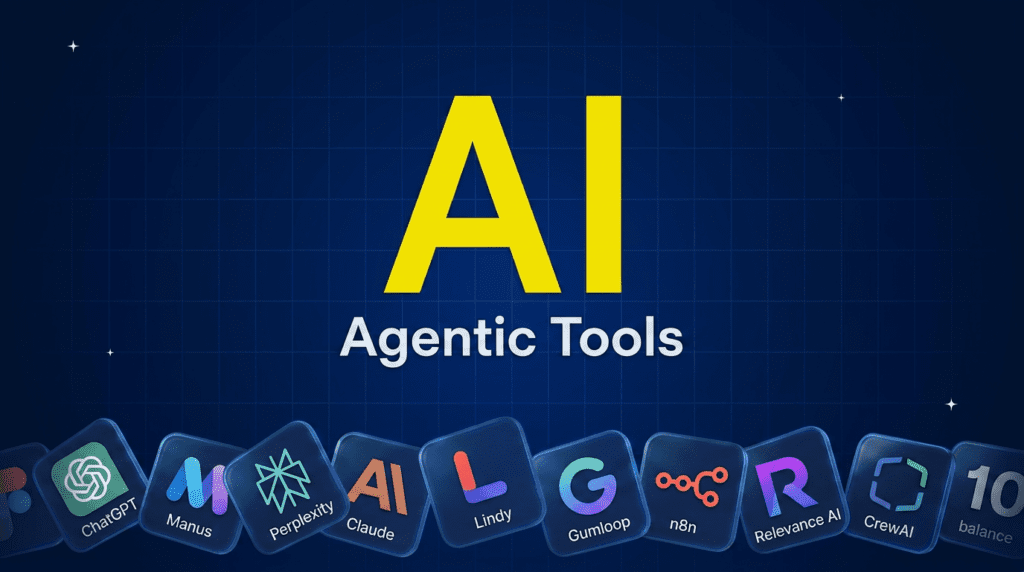
TL;DR: What You Need to Know
The best AI agent depends on whether you want to use one or build one. For ready-made agents that take actions for you, ChatGPT agent, Manus, and Perplexity lead, with Claude strong for agentic and coding work. To build your own without code, Lindy and Gumloop are the easiest, and n8n is best if you want control. Developers building custom multi-agent systems reach for CrewAI. Most have free tiers, so start by deciding whether your goal is to delegate a task or automate a workflow.Pricing verified June 2026. AI tool pricing changes often, so confirm the current price on each vendor’s site before you subscribe. Inside AI Media is not an AI tool vendor; these picks are ranked on merit, not promotion.
The best AI agents at a glance
Here is how the main options compare on what they are best for, the type, whether you need to code, and where paid plans start. This space moves fast and pricing shifts often, so confirm on the vendor’s site before committing.| Agent | Best for | Type | Coding needed | Starting price |
|---|---|---|---|---|
| ChatGPT agent | General task automation | Ready-to-use | No | $20/mo |
| Manus | Autonomous multi-step tasks | Ready-to-use | No | $39/mo |
| Perplexity | Research and answers | Ready-to-use | No | $20/mo |
| Claude | Agentic and coding work | Ready-to-use | $17/mo | $20/mo |
| Lindy | No-code business agents | Builder | $49.99/mo | $49/mo |
| Gumloop | No-code automation flows | Builder | $37/mo | $97/mo |
| n8n | Flexible workflow automation | Builder | $20/mo | Free / $20/mo |
| Relevance AI | Teams of AI “workers” | Builder | No | $19/mo |
| CrewAI | Developer multi-agent systems | Framework | Free | Free / paid |
What is an AI agent?
An AI agent is software that does not just answer a question but takes actions to complete a goal. Give it a task, and it can plan the steps, use tools like a browser, your apps, or an API, and work through them with limited supervision, checking its own progress along the way. That is the difference from a normal chatbot: a chatbot replies, an agent acts. In practice “AI agents” covers three things, ready-made agents you can use today, no-code platforms for building your own, and developer frameworks for custom multi-agent systems, and the right pick depends on which you need.How we picked
We are an independent publisher and do not sell an agent platform, so none of these picks is our own product. We weighed each on what it reliably does today rather than what it promises, how much setup and supervision it needs, whether it requires code, integrations with the tools you already use, and value. Because this field is young and changing quickly, treat any agent as something to pilot on a low-risk task first and supervise, not to hand the keys to.Best ready-to-use AI agents
These work out of the box, no building required, and take actions on your behalf.1. ChatGPT agent, best for general task automation
OpenAI’s agent mode lets ChatGPT go beyond chat to carry out tasks, browsing the web, filling forms, and working through multi-step jobs in its own virtual environment while you watch and approve. It is the most accessible way for most people to try a real agent, since it lives inside the app they already use.- Best for: A first, general-purpose agent inside a familiar tool.
- Pricing: Included with paid ChatGPT plans from around $20/mo.
- Skip if: you need a custom agent wired deeply into your own systems.
2. Manus, best for autonomous multi-step tasks
Manus is built to run longer, more autonomous jobs, planning and executing multi-step tasks like research, building a simple site, or compiling a report with less back-and-forth. It aims to work more independently than a standard assistant, which makes it a strong pick when you want to hand off a whole task rather than guide each step.- Best for: Delegating longer, multi-step tasks end to end.
- Pricing: Credit-based plans from around $39/mo.
- Skip if: you want tight control over every step.
3. Perplexity, best agent for research
Perplexity acts as a research agent, searching the web, reading sources, and returning a cited answer, and its deeper research modes will work through a question across many sources before reporting back. For turning a question into a sourced briefing, it is the most reliable agent here.- Best for: Research and sourced answers from across the web.
- Pricing: Free tier; Pro around $20/mo.
- Skip if: you need an agent that takes actions in your apps.
4. Claude, best for agentic and coding work
Claude is widely used for agentic tasks, especially those involving code, where it can work through a problem across files and tools with strong reasoning. Its computer-use and coding abilities make it a favorite for technical workflows, and it doubles as a capable everyday assistant. For developer use specifically, see our best AI coding assistants guide.- Best for: Agentic coding and reasoning-heavy tasks.
- Pricing: Free; Pro $20/mo ($17/mo billed annually); Max from $100/mo; Team $25/seat/mo ($20 annually).
- Skip if: you want a no-code platform to build business agents.
Best no-code AI agent builders
These let you build agents that run your own workflows without writing code.5. Lindy, best for no-code business agents
Lindy lets you build AI agents that handle real business jobs, like triaging email, scheduling, or following up with leads, by connecting to your tools and triggering on events. Its no-code builder and multi-agent workflows make it one of the easiest ways for a non-developer to put an agent to work on day-to-day operations.- Best for: Non-developers automating business tasks with agents.
- Pricing: No free tier (7-day trial); Plus $49.99/mo; Pro $99.99/mo; Max $199.99/mo; Enterprise custom.
- Skip if: you need open-source control or a developer framework.
6. Gumloop, best for no-code automation flows
Gumloop builds AI-powered automations on a visual canvas, chaining steps that scrape, summarize, analyze, and act across your apps. It suits teams that think in workflows and want agents handling repetitive multi-step processes, with more depth than a simple trigger-and-action tool.- Best for: Visual, multi-step AI automations for teams.
- Pricing: Free ($0, 5,000 credits, 1 seat); Pro $37/mo (20,000+ credits, unlimited seats); Enterprise custom.
- Skip if: you want a cheaper or simpler starting point.
7. n8n, best for flexible workflow automation
n8n is a powerful automation platform with AI agent capabilities, and because you can self-host it, it gives the most control over data and logic. It is more technical than Lindy or Gumloop but far more flexible, which makes it the pick for teams that want to own their automation and connect almost anything.- Best for: Flexible, self-hostable automation with AI agents.
- Pricing: Free and open source (self-hosted); Cloud Starter $20/mo; Pro $50/mo; Business $667/mo; Enterprise custom.
- Skip if: you want the simplest possible no-code builder.
8. Relevance AI, best for building a team of AI “workers”
Relevance AI lets you assemble agents into an “AI workforce,” where specialized agents handle roles like research, sales, or support and work together on a process. It is aimed at businesses that want several coordinated agents rather than one, without standing up a developer framework.- Best for: Coordinated teams of role-based business agents.
- Pricing: Free tier; paid from around $19/mo.
- Skip if: you only need a single simple agent.
Best AI agent framework for developers
When you are coding custom agents, you want a framework, not an app.9. CrewAI, best for developer multi-agent systems
CrewAI is an open-source Python framework for building systems where multiple agents take on roles and collaborate to complete a task. It gives developers fine control over how agents plan, delegate, and use tools, and it has become one of the most popular ways to build custom multi-agent applications.- Best for: Developers building custom, collaborating multi-agent systems.
- Pricing: Open-source framework free to self-host; free cloud Basic tier (50 executions/mo); Enterprise custom.
- Skip if: you do not write code or want a ready-made app.
How to choose the right AI agent
Start with your goal. If you want to delegate a task today, use a ready-made agent: ChatGPT agent for general work, Manus for longer autonomous jobs, Perplexity for research, or Claude for anything code-related. If you want to automate a repeating workflow in your business, build one on a no-code platform, Lindy or Relevance AI for ease, Gumloop or n8n for depth and control. If you are a developer building a custom product, start with a framework like CrewAI. Whatever you pick, pilot it on a low-stakes task with supervision first, because today’s agents still make mistakes and work best with a human reviewing the important steps. For the wider landscape, our top generative AI tools guide has more.Frequently asked questions
It depends on the job. For ready-to-use agents, ChatGPT agent is the most accessible, Manus the most autonomous, and Perplexity the best for research, while Claude leads for coding. For building your own, Lindy and Gumloop are the easiest no-code options and CrewAI is the top developer framework.
A chatbot responds to what you say. An AI agent takes actions to reach a goal: it plans steps, uses tools like a browser or your apps, and works through a task with limited supervision. Every agent can chat, but not every chatbot can act, which is the key distinction.
Yes. n8n is free to self-host, Lindy, Relevance AI, and Perplexity have free tiers, and CrewAI is open source. Free plans usually limit runs, integrations, or compute, so they are good for testing before you commit to a paid plan.
It can be. Standard ChatGPT is a chatbot, but its agent mode turns it into an agent that browses the web and completes multi-step tasks in a virtual environment. So ChatGPT is both, depending on whether you are simply chatting or using its agent capabilities.
They are improving but not infallible, so use them with care. Because an agent takes real actions, a mistake can have real consequences, which is why you should start on low-risk tasks, keep a human approving important steps, and avoid giving an agent unsupervised access to sensitive accounts or money until you trust it.

Inside AI Media is a global platform that covers what’s happening in AI without the fluff. From breaking news to practical use cases, it keeps professionals, builders, and decision-makers updated on the latest in artificial intelligence, so they can make better, faster decisions and stay ahead.