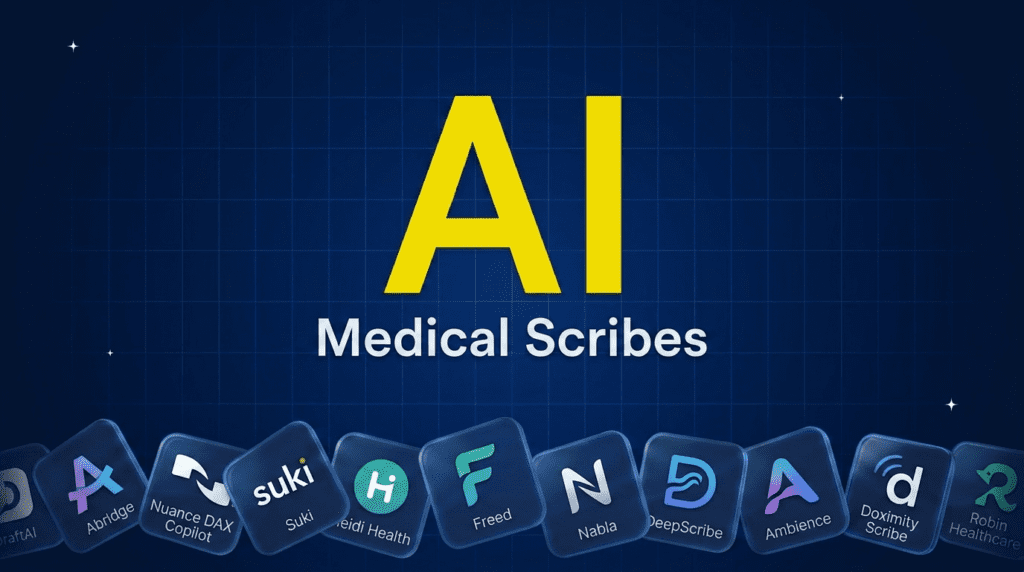
TL;DR: What You Need to Know
The best AI medical scribe depends on your setup. For large Epic-based health systems, Abridge and Nuance DAX Copilot (now Dragon Copilot) lead on deep EHR integration. For solo and small practices on a budget, Freed and Heidi Health are the easiest to start with, and Heidi has a real free tier. For specialty care, DeepScribe and Ambience handle complex visits well, and Doximity Scribe is free for verified US physicians. Whichever you pick, you stay responsible for reviewing and signing every note.Pricing verified June 2026. AI tool pricing changes often, so confirm the current price on each vendor’s site before you subscribe. Inside AI Media is not an AI tool vendor; these picks are ranked on merit, not promotion.
The best AI medical scribes at a glance
Here is how the main tools compare on the clinician they suit best, EHR integration, whether there is a free option, and where paid plans start. Pricing in this market is often quote-based and changes quickly, so confirm directly with the vendor and check the current Business Associate Agreement before you commit.| Scribe | Best for | EHR integration | Free option | Starting price |
|---|---|---|---|---|
| Abridge | Large Epic health systems | Deep (Epic) | No | Enterprise quote |
| Nuance DAX Copilot | Microsoft-centric hospitals | Deep (Epic, others) | No | Enterprise quote |
| Suki | Broad EHR coverage | Broad | Trial | $399/mo |
| Heidi Health | Solo to mid, international | Via integrations | Free | $99/mo |
| Freed | Solo and small practices | Copy-paste / select EHRs | $39/mo | $99/mo |
| Nabla | Fast real-time notes, Europe | Via integrations | Limited free | $119/mo |
| DeepScribe | Specialty and procedural care | Multiple EHRs | No | Custom |
| Ambience Healthcare | Enterprise + coding | Deep (Epic, others) | No | Enterprise quote |
| Doximity Scribe | Free for US physicians | Copy-paste | Yes | Free |
What is an AI medical scribe?
An AI medical scribe, often called an ambient scribe, listens to a patient visit with consent and drafts the clinical note for you: history, exam, assessment, and plan, formatted the way you chart. It uses speech recognition and a language model to turn the conversation into a structured draft in your EHR, so you spend less time typing and more time with the patient. It is a documentation aid, not a decision-maker. You review, correct, and sign every note, and you remain clinically and legally responsible for what goes in the record.How we picked
We are an independent publisher and do not sell a scribe, so none of these picks is our own product. We weighed each tool on note accuracy on real visits rather than easy ones, depth of EHR integration, security and HIPAA posture including whether the vendor signs a Business Associate Agreement, the fit for solo clinicians versus large systems, and total cost rather than the headline subscription. We deliberately avoided ranking by marketing claims, because in this market several common claims, from “Epic compatible” to “HIPAA compliant,” can mean very different things in practice. Treat every pick as a shortlist to pilot, not a final answer.9 best AI medical scribes in 2026
1. Abridge, best for large Epic-based health systems
Abridge is the scribe most often chosen by big hospital systems, with deep Epic integration and a track record across large enterprise deployments. It generates structured notes in real time, links back to the conversation so clinicians can verify what it captured, and is built to scale across many specialties and thousands of clinicians.- Best for: Enterprise health systems standardizing on Epic.
- Pricing: Enterprise quote; no public self-serve plan.
- Skip if: you are a solo clinician who wants to sign up and start today.
2. Nuance DAX Copilot, best for Microsoft-centric hospitals
DAX Copilot, now folded into Microsoft’s Dragon Copilot, is the enterprise scribe from the team behind Dragon Medical. It captures the visit, drafts the note, and fits naturally into organizations already invested in Microsoft and Nuance, with broad EHR support and mature security and compliance behind it.- Best for: Large organizations in the Microsoft and Nuance ecosystem.
- Pricing: Enterprise quote.
- Skip if: you want a lightweight tool without an enterprise rollout.
3. Suki, best for broad EHR integration
Suki is a voice-enabled assistant that drafts notes and also takes spoken commands, and it connects to a wide range of EHRs rather than just one or two. That breadth makes it a strong pick for practices that are not standardized on Epic, and the voice interface suits clinicians who would rather talk than tap.- Best for: Practices wanting wide EHR coverage and a voice assistant.
- Pricing: From around $399/mo per clinician.
- Skip if: you want the lowest possible monthly cost.
4. Heidi Health, best free-to-start scribe for solo and mid-size
Heidi Health has become one of the most popular scribes with individual clinicians, partly because it has a genuine free tier you can use before paying. It works across specialties and countries, produces clean templated notes, and is easy to trial without a procurement process, which makes it a sensible first scribe for many practices.- Best for: Clinicians who want to try a capable scribe free first.
- Pricing: Free (unlimited transcription, standard templates); paid Evidence Plus, Clinician, and Practice tiers are quote-based (14-day trial).
- Skip if: you need deep, pre-built integration into a single enterprise EHR.
5. Freed, best budget scribe for solo physicians
Freed is built for solo and small practices and is one of the easiest scribes to adopt: record the visit, get a structured note in seconds, edit, and paste it in. It learns your style over time and is priced for an individual clinician rather than a health system, which is why it shows up so often in solo-physician recommendations.- Best for: Solo and small-practice clinicians who want simple and affordable.
- Pricing: 7-day free trial; Starter $39/provider/mo (up to 40 notes/mo); Unlimited plan at a higher tier.
- Skip if: you need deep two-way EHR write-back at enterprise scale.
6. Nabla, best for fast, real-time notes
Nabla generates notes quickly and is widely used in Europe, with a strong focus on GDPR and data protection alongside HIPAA for US users. It supports in-person and telehealth visits, multiple languages, and a fast turnaround that suits high-volume clinics where every minute between patients counts.- Best for: High-volume clinics and European practices with GDPR needs.
- Pricing: Limited free use; paid from around $119/mo.
- Skip if: you need a deeply embedded single-EHR enterprise deployment.
7. DeepScribe, best for specialty and procedural care
DeepScribe focuses on specialty workflows and customizable notes, which matters because accuracy on a complex specialty visit is a different problem from accuracy on a simple one. It lets practices tailor note structure to their specialty and connects to multiple EHRs, making it a fit for oncology, cardiology, and other documentation-heavy fields.- Best for: Specialty and procedural practices needing customizable notes.
- Pricing: Custom quote.
- Skip if: you want a fixed, public per-seat price.
8. Ambience Healthcare, best for enterprise plus coding support
Ambience is an enterprise-grade scribe that goes beyond the note to help with coding and compliance, capturing the visit and supporting accurate documentation for billing. It is aimed at health systems that want documentation and revenue-cycle support from one ambient platform across many specialties.- Best for: Health systems wanting scribing plus coding and compliance support.
- Pricing: Enterprise quote.
- Skip if: you are an individual clinician who only needs notes.
9. Doximity Scribe, best free option for US physicians
Doximity Scribe is a free ambient scribe for verified US physicians, built into the Doximity app many already use. It drafts notes you copy into your EHR, with a HIPAA-conscious design, and is the easiest no-cost way to try ambient documentation if you qualify, though it is lighter on direct EHR integration than the paid enterprise tools.- Best for: Verified US physicians who want a free, no-commitment scribe.
- Pricing: Free for verified US physicians.
- Skip if: you need deep EHR write-back or are outside the US.
How to choose the right AI medical scribe
Pricing aside, four things decide whether a scribe actually works for you. First, EHR integration: “compatible with Epic” can mean a deep two-way link or just copy and paste, so ask exactly how notes reach your chart. Second, accuracy on your real visits, not a clean demo, which is why a pilot on your own complex cases matters more than any benchmark. Third, security and compliance: confirm the vendor will sign a Business Associate Agreement and ask where data is stored and whether it is used for training. Fourth, total cost, including onboarding, integration, and any per-note fees beyond the subscription. Run a short pilot with two or three tools before you commit a whole practice.Frequently asked questions
There is no single best one. For large Epic-based systems, Abridge and Nuance DAX Copilot lead. For solo and small practices, Freed and Heidi Health are the easiest and most affordable to start with, and Heidi has a free tier. For specialty care, DeepScribe and Ambience handle complex visits well. The right pick depends on your EHR, specialty, and budget.
Yes. Heidi Health has a free tier, Doximity Scribe is free for verified US physicians, and several others including Freed and Nabla offer free trials or limited free use. Free tiers usually cap the number of notes or hold back advanced features, so confirm the limits before relying on one.
The major tools are built to support HIPAA compliance and will sign a Business Associate Agreement, but the details vary by vendor, so do not take a “HIPAA compliant” label at face value. Ask each vendor for a BAA, confirm where your data is stored, and check whether your patient data is used to train models.
No. AI scribes automate the drafting of notes, but a clinician still reviews, corrects, and signs every note and remains responsible for the record. They are designed to reduce documentation time and burnout, not to make clinical decisions or replace the people accountable for care.
Accuracy is good on straightforward visits and more variable on complex or specialty cases with overlapping speakers, accents, or dense terminology. That is why every note needs clinician review before signing, and why a pilot on your own real visits tells you far more than a vendor benchmark.

Inside AI Media is a global platform that covers what’s happening in AI without the fluff. From breaking news to practical use cases, it keeps professionals, builders, and decision-makers updated on the latest in artificial intelligence, so they can make better, faster decisions and stay ahead.