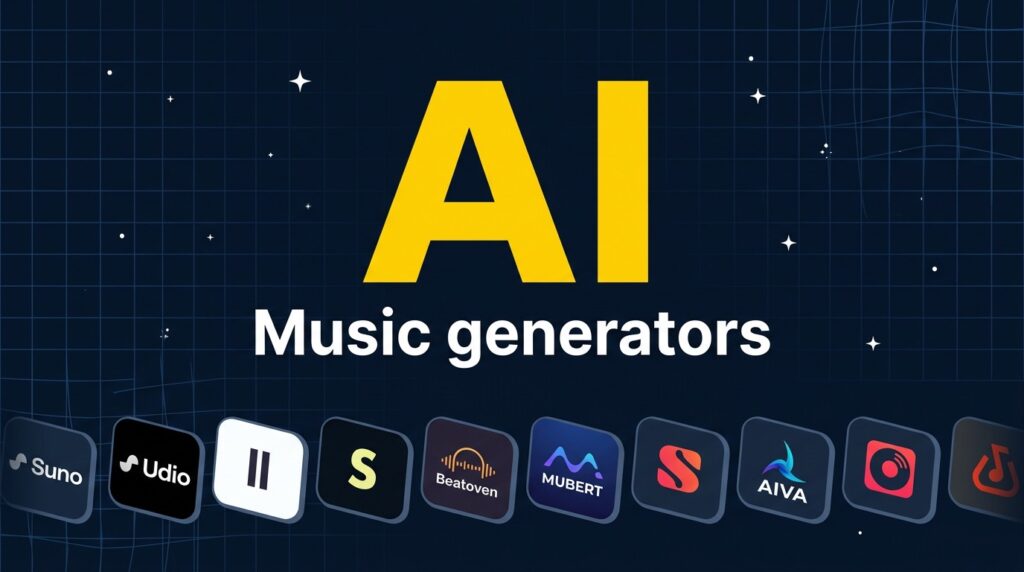
TL;DR: What You Need to Know
For full songs with vocals, Suno is the one to beat, and Udio is the better pick if you want to fine-tune a track section by section. If you make videos and podcasts and just need safe background music, Soundraw and Beatoven give you royalty-free tracks without the copyright headaches. Want the cleanest licensing story for monetized content? ElevenLabs Music trains on licensed catalogs, and AIVA‘s Pro plan is one of the few that hands you full copyright ownership. The trap that catches most people is licensing, not sound quality, so read the section on commercial use before you publish anything.
Pricing verified June 2026. AI tool pricing changes often, so confirm the current price on each vendor’s site before you subscribe. Inside AI Media is not an AI tool vendor; these picks are ranked on merit, not promotion.
At a glance: how the top AI music generators compare
Every tool below makes listenable music. What separates them is whether they produce full vocal songs or background instrumentals, and what you are actually allowed to do with the result. That second column is where creators get burned, so it leads the table.
| Tool | Best for | Vocals? | Commercial use / ownership | Starting paid price |
|---|---|---|---|---|
| Suno | Complete songs with lyrics | Yes | $8/mo | $10/mo |
| Udio | Refining and remixing tracks | Yes | Full commercial on Pro only | $10/mo |
| ElevenLabs Music | Licensed, broadcast-quality audio | Yes | $6/mo | $5/mo |
| Soundraw | Royalty-free background music | Limited | Royalty-free license on all paid plans | $16.99/mo |
| Beatoven | Mood-based video and podcast scoring | No | Royalty-free, trained on licensed audio | $3/mo |
| Mubert | Streaming, apps, long-form audio | No | Royalty-free, no attribution on paid | $14/mo |
| Soundful | Loops and beats with buy-out option | No | Royalty-free; full buy-out available | $15/mo |
| AIVA | Cinematic and orchestral scores | No | Full copyright ownership on Pro | $11/mo |
| Boomy | Instant tracks and Spotify payouts | Limited | Commercial and distribution on paid | $9.99/mo |
| BandLab SongStarter | Free song ideas and full DAW | Yes (your recording) | Free and royalty-free | Free |
How we picked these tools
We weighted four things: audio quality on a blind listen, how clearly each vendor explains commercial rights, the real cost once you need downloads or monetization, and how well each tool fits a specific job. Three of the most-cited roundups online are published by the tools themselves, which tends to put their own product at number one. Inside AI Media does not sell any of these, so the order below reflects merit and fit, not promotion.
The best AI music generators in 2026
1. Suno
Suno is the tool most people mean when they say “AI music.” You type a description or paste your own lyrics, and it returns a finished song with vocals, structure, and production in under a minute. The v5 model fixed most of the muddy, watery sound that older AI tracks had, and the output now holds up in a content feed.
- Best for: Creators and hobbyists who want a complete, radio-style song fast.
- Pricing: Free (50 credits/day); Pro $8/mo ($64/yr); Premier $24/mo ($192/yr).
- Free tier: Generous for testing, but anything you make on it cannot be monetized.
- Licensing catch: Commercial rights are not retroactive. Songs you made on the free plan stay non-commercial even after you upgrade, so subscribe before you create anything you plan to publish.
- Skip if: You need precise control over individual instruments or a guaranteed copyright transfer.
2. Udio
Udio went head to head with Suno from launch and tends to win on instrumental detail and arrangement clarity. Its real strength is iteration: you can extend a track, regenerate one section, or remix a part you do not like instead of rerolling the whole song. In late 2025 it signed a licensing deal with Universal Music Group, which points to a more rights-clean future for the platform.
- Best for: People who treat the first generation as a draft and want to shape it.
- Pricing: Free: 10 credits a day. Standard $10/mo, 2,400 credits, but no commercial use. Pro $30/mo, 6,000 credits, full commercial rights.
- Free tier: Fine for experiments; the daily cap is low.
- Licensing catch: The Standard plan does not include commercial rights, so monetizing means jumping to Pro. Confirm current download terms before relying on it for client work.
- Skip if: You want commercial use at the cheapest paid tier.
3. ElevenLabs Music
ElevenLabs built its name on the most natural AI voices available, and its Music product carries that quality into songs. The bigger draw for professionals is the legal footing: the model is trained on licensed catalogs through deals with rights holders, which removes most of the “was this trained on stolen music” anxiety that hangs over the category.
- Best for: Brands, agencies, and podcasters who need broadcast-quality audio with a clean licensing story.
- Pricing: Free (10,000 credits); Starter $6/mo (unlocks music commercial use); Creator $22/mo; Pro $99/mo.
- Free tier: Limited credits for testing; commercial use starts at Starter.
- Licensing: Trained on licensed data and cleared for commercial use, which is the cleanest position of any tool here.
- Skip if: You only need a few hobby tracks and do not care about licensed training data.
4. Soundraw
Soundraw is not trying to write the next pop hit. It generates royalty-free background music you customize by mood, genre, length, and energy, then drop straight into a video or podcast. You are picking and shaping tracks rather than prompting a song from scratch, which is faster when you just need something that fits a scene.
- Best for: YouTubers, editors, and podcasters who need safe background music on a deadline.
- Pricing: Creator plan around $16.99/mo (cheaper billed annually) with unlimited downloads. A separate Artist plan adds streaming distribution.
- Free tier: You can generate and preview, but downloads need a paid plan.
- Licensing: Every paid plan includes a royalty-free commercial license for videos, ads, and client work. You hold a license rather than the copyright, which is fine for most content use.
- Skip if: You want songs with vocals or full ownership of the master.
5. Beatoven.ai
Beatoven focuses on mood-based scoring for video and podcasts, and it is one of the few tools that markets itself on ethics: it trains on licensed and owned audio rather than scraped tracks. You describe the emotion and length you need, and it composes background music to match the pacing.
- Best for: Creators who want affordable, conscience-clean background scoring.
- Pricing: Free: preview only, no downloads. Creator Lite $3/mo, Creator $10/mo (30 minutes of downloads), Visionary $20/mo (60 minutes). Extra minutes cost about $3 each.
- Free tier: Lets you test prompt quality but blocks downloads entirely.
- Licensing: Royalty-free, with training data the company says is licensed or owned.
- Skip if: You generate a lot of long tracks; the per-minute download caps add up.
6. Mubert
Mubert leans toward infinite, streaming-style audio, which makes it a favorite for apps, games, livestreams, and long videos where you need music that never ends and never repeats awkwardly. It also offers an API, so developers can generate adaptive soundtracks inside their own products.
- Best for: Streamers, app developers, and anyone scoring long or live content.
- Pricing: Free Ambassador tier. Creator $14/mo, Pro $39/mo, Business $199/mo, with enterprise on request.
- Free tier: Usable with attribution; paid plans drop the credit requirement.
- Licensing: Royalty-free on paid plans, with no attribution required.
- Skip if: You want structured, song-format tracks rather than ambient or loop-based audio.
7. Soundful
Soundful generates clean, loop-friendly beats and backing tracks aimed at creators and producers. Its standout feature is the buy-out option: on top of the usual royalty-free license, you can purchase exclusive rights to a track so nobody else can use it, which matters if you want a signature sound.
- Best for: Creators who want cheap loops now and the option to own a track outright later.
- Pricing: Free plan with unlimited generations and 25+ styles. Content Creator $15/mo, Music Creator Plus $49/mo. Annual billing cuts the cost meaningfully.
- Free tier: One of the more usable free plans here, with real generation access.
- Licensing: Royalty-free on paid plans, plus a per-track exclusive buy-out.
- Skip if: You need full vocal songs.
8. AIVA
AIVA specializes in cinematic, orchestral, and instrumental composition, and it has been at it longer than most of the newer names. Filmmakers and game developers use it for scores. Its most distinctive feature is ownership: the Pro plan gives you the full copyright to what you generate, with no attribution, which almost no other tool on this list offers.
- Best for: Film, game, and trailer composers who need orchestral music they fully own.
- Pricing: Free: 3 downloads a month, personal use, AIVA keeps the copyright. Standard about $11/mo (billed annually, requires a “Music by AIVA” credit). Pro about $33/mo (billed annually) with full ownership.
- Free tier: Good for auditioning the sound; not for anything you publish.
- Licensing: The Pro plan transfers full copyright to you, a genuine rarity in AI music.
- Skip if: You want modern vocal pop or quick social-clip music.
9. Boomy
Boomy is built for speed and distribution. It spins up a track in seconds with almost no input, then lets you release it to Spotify, Apple Music, and other platforms through its system, where you can collect streaming revenue. It is less about craft and more about volume and getting music live.
- Best for: Beginners who want to publish to streaming platforms and earn from plays.
- Pricing: Free tier to create. Commercial use and distribution start around $9.99/mo.
- Free tier: Lets you make tracks; releasing and monetizing needs a paid plan.
- Licensing: Paid plans include commercial rights and streaming distribution.
- Skip if: You care about originality and detailed control over the final track.
10. BandLab SongStarter
If your budget is zero, start here. SongStarter generates royalty-free musical ideas like beats, melodies, and chord progressions, and it sits inside BandLab’s free cloud studio, so you can take the idea and build a real song around it. You do more of the work, but you keep full creative control and pay nothing.
- Best for: Musicians and beginners who want a free starting point and a real DAW.
- Pricing: Free, with no credits or per-generation cap. An optional sound pack runs about $14.95/mo.
- Free tier: The whole core product is free, which makes it the strongest no-cost option here.
- Licensing: The ideas are royalty-free, and you own the song you build from them.
- Skip if: You want a finished track from a single prompt with no editing.
AI music licensing and copyright, explained
This is the part most roundups skip, and it is the part that gets creators a copyright strike. “Royalty-free,” “commercial license,” and “copyright ownership” are three different things, and the difference decides whether you can safely put a track on a monetized video or sell it.
Commercial license means you are allowed to use the music in money-making projects, but the vendor or its model still owns the underlying work. Soundraw, Mubert, and Beatoven work this way. You can publish freely, but you do not own the master.
Copyright ownership means the track is legally yours, to license, sell, or register as you like. AIVA’s Pro plan is the clearest example here.
Training data matters too. Tools trained on licensed catalogs, like ElevenLabs Music, carry far less legal risk than tools whose training sources are unclear. Two practical rules will keep you safe: upgrade to a paid plan before you create anything you intend to monetize, because rights on tools like Suno are not granted retroactively, and always confirm the current license terms on the vendor’s own page before a commercial release, since these policies change often.
Which AI music generator should you choose?
The right tool depends entirely on what you are making.
- You are a content creator who needs background music for videos: Soundraw or Beatoven, with BandLab if your budget is zero. Pair the track with your AI video tool and you can produce a full clip end to end.
- You want full songs with vocals to share or release: Suno first, Udio if you like to refine.
- You need licensed, low-risk audio for a brand or client: ElevenLabs Music.
- You compose for film or games and need to own the result: AIVA Pro.
- You want to publish to Spotify and earn from streams: Boomy.
- You are a developer or streamer scoring long or live content: Mubert.
How to write better AI music prompts
The output is only as good as the brief. A vague prompt like “happy song” gives generic results, so stack details across four areas: genre and era (“90s boom-bap hip hop”), mood and energy (“calm, reflective, low tempo”), instrumentation (“warm Rhodes piano, soft drums, upright bass”), and use case (“background for a cooking tutorial”). For tools that take lyrics, structure them with tags like [Verse], [Chorus], and [Bridge] so the model knows where the hooks go. Generate three or four versions of every idea, then keep the best and regenerate the weak sections rather than starting over.
Frequently asked questions
For most people it is Suno, because it produces complete, good-sounding songs with vocals from a simple text prompt. If you mainly need background music for videos, Soundraw or Beatoven are better fits, and ElevenLabs Music is the strongest pick when licensing matters.
Yes. BandLab SongStarter is fully free, and Suno, Udio, Soundful, Mubert, and Boomy all have free tiers. The catch is that free output is almost always non-commercial, so you cannot monetize it until you upgrade to a paid plan.
Only on a paid plan, and only if you subscribed before creating the track on tools like Suno where rights are not retroactive. Check each vendor’s license terms before you publish, because a commercial license and full copyright ownership are not the same thing.
It depends on the tool. Most grant you a royalty-free commercial license while keeping the underlying copyright themselves. AIVA’s Pro plan is one of the few that transfers full copyright ownership to you with no attribution required.
It can if you use music made on a free, non-commercial tier or a tool with unclear training data. To stay safe, use a paid plan with a clear commercial license, prefer tools trained on licensed catalogs, and keep proof of your subscription and generation date.
Suno is faster and stronger at finished, radio-style songs from one prompt. Udio is better for iteration, with tools to extend, remix, and regenerate individual sections, and it tends to have an edge on instrumental detail.
Yes. Boomy distributes directly to Spotify and other platforms and lets you collect streaming revenue, and you can distribute tracks from other tools through a standard music distributor as long as your plan grants commercial and distribution rights.

Inside AI Media is a global platform that covers what’s happening in AI without the fluff. From breaking news to practical use cases, it keeps professionals, builders, and decision-makers updated on the latest in artificial intelligence, so they can make better, faster decisions and stay ahead.