TL;DR: What You Need to Know
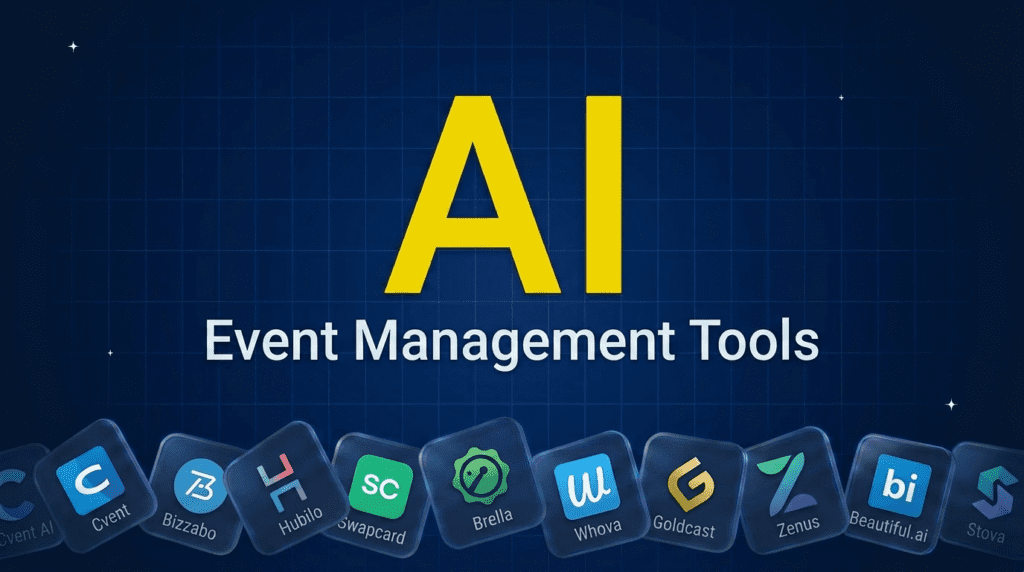
The best AI tools for event management automate planning, registration, networking, and follow-up so a small team can run a big event. For all-in-one platforms, Cvent, Bizzabo, and Hubilo lead. For attendee networking, Swapcard and Brella use AI matchmaking. Whova powers the event app and agenda, Goldcast handles virtual events and content, Zenus measures on-site engagement, and Beautiful.ai builds decks fast. Pick by your event type and biggest bottleneck, planning, engagement, or measurement, and pilot before your next event.Pricing verified June 2026. AI tool pricing changes often, so confirm the current price on each vendor’s site before you subscribe. Inside AI Media is not an AI tool vendor; these picks are ranked on merit, not promotion.
The best AI tools for event management at a glance
Here is how the main tools compare on the event job they do, the event type they suit, and pricing model. Event software is usually quote-based or tiered by event size, so confirm with the vendor.| Tool | Best for | Event type | Pricing |
|---|---|---|---|
| Cvent | Enterprise event management | In-person / hybrid | Quote |
| Bizzabo | Experience-led events | In-person / hybrid | $17,999/yr |
| Hubilo | Virtual and hybrid events | Virtual / hybrid | Quote |
| Swapcard | AI networking and matchmaking | Conferences / expos | Quote |
| Brella | Attendee matchmaking | Conferences | Quote |
| Whova | Event app and agenda | All events | Quote |
| Goldcast | Virtual events + content | Webinars / B2B | Quote |
| Zenus | On-site engagement analytics | In-person | Quote |
| Beautiful.ai | Event decks and content | All events | $12/user/mo |
How is AI used in event management?
AI helps at every stage of an event. It drafts agendas, marketing copy, and emails, recommends sessions and matches attendees for networking, powers chatbots that answer attendee questions, personalizes each attendee’s experience, captures and scores leads, measures engagement and sentiment on site, and turns session recordings into clips and follow-up content. The result is less manual coordination and a more personalized event, letting a lean team deliver an experience that once needed many more people. The biggest wins are usually in attendee matchmaking, registration and marketing, and post-event content and analytics.How we picked the best event platform
We are an independent publisher and do not sell event software, so none of these picks is our own product. We grouped tools by the event job they do, then weighed each on capability, fit for the type and size of event, integration with registration and CRM systems, and value. We focused on platforms and tools event teams actually use, and we note where a tool is a full platform versus a focused specialist.Best AI-powered event platforms
These run the whole event, with AI woven through planning, registration, and engagement.1. Cvent, best for enterprise event management
Cvent is the most established end-to-end event management platform, covering venue sourcing, registration, marketing, and on-site, now with AI for writing copy, recommending sessions, and sourcing venues and vendors. For organizations running many or large events, its depth and AI features make it the enterprise standard.- Best for: Large organizations running complex events at scale.
- Pricing: Enterprise quote.
- Skip if: you run small, simple events occasionally.
2. Bizzabo, best for experience-led events
Bizzabo is an event experience platform that uses AI to personalize attendee journeys, recommend sessions and connections, and streamline registration and analytics. It suits marketing and events teams focused on the attendee experience for conferences and flagship events, with strong data and engagement features.- Best for: Experience-focused conferences and flagship events.
- Pricing: Event Experience OS from $17,999/year ($499/user/mo, billed annually, 3-user minimum); add-ons quote-based.
- Skip if: you need the cheapest basic registration tool.
3. Hubilo, best for virtual and hybrid events
Hubilo is a virtual and hybrid event platform with AI that helps with engagement, content, and lead capture, and repurposes event content afterward. For teams whose events are primarily online or hybrid, it focuses on keeping remote attendees engaged and proving ROI.- Best for: Virtual and hybrid event engagement.
- Pricing: Quote-based.
- Skip if: your events are purely in-person.
Best AI tools for networking and matchmaking
Helping the right people meet is one of AI’s clearest wins at events.4. Swapcard, best for AI networking and matchmaking
Swapcard uses AI to match attendees, exhibitors, and sessions based on interests and goals, recommending who to meet and what to attend so networking actually happens. For conferences and expos where connections are the point, its matchmaking meaningfully improves the attendee experience.- Best for: AI-driven attendee and exhibitor matchmaking.
- Pricing: Quote-based.
- Skip if: networking is not central to your event.
5. Brella, best for attendee matchmaking
Brella focuses on networking, using AI to recommend relevant connections and schedule meetings between attendees, with a clean experience built around helping people find each other. It is a strong, focused pick for conferences where one-to-one meetings drive the value.- Best for: Scheduled one-to-one attendee meetings.
- Pricing: Quote-based.
- Skip if: you want a full all-in-one platform.
Best AI tools for engagement and content
These run the event app, measure the room, and create the content around it.6. Whova, best for the event app and agenda
Whova is a widely used event app that uses AI to build agendas, recommend sessions and connections, and drive attendee engagement before, during, and after the event. For organizers who want a polished attendee app without heavy setup, it is a popular, practical choice across event types.- Best for: A smart event app and agenda for attendees.
- Pricing: Quote-based.
- Skip if: your event does not need an app.
7. Goldcast, best for virtual events and content
Goldcast is a B2B platform for webinars and virtual events that uses AI to run engaging sessions and, crucially, repurpose recordings into clips, blogs, and social content afterward. For marketing teams that treat events as a content engine, its content AI extends the value well beyond the live day.- Best for: B2B webinars and turning events into content.
- Pricing: Quote-based.
- Skip if: you only run in-person events.
8. Zenus, best for on-site engagement analytics
Zenus uses ethical AI to measure on-site engagement, attendance, foot traffic, and sentiment, giving organizers real data on what worked in the physical event. For in-person events where proving impact is hard, it turns the room into measurable insight.- Best for: Measuring engagement at in-person events.
- Pricing: Quote-based.
- Skip if: your events are virtual only.
Best AI tool for event content and decks
9. Beautiful.ai, best for event decks and presentations
Beautiful.ai uses AI to build polished presentations and decks quickly, useful for pitching an event, briefing stakeholders, or creating speaker and sponsor materials. It is an affordable, accessible tool that removes the design grind from the constant decks an event team produces.- Best for: Fast, professional event presentations and decks.
- Pricing: Presentation tool. Pro $12/user/mo (billed annually); Team $40/user/mo; Enterprise custom.
- Skip if: you rarely build presentations.
How to choose AI tools for event management
Start with your event type and biggest bottleneck. For large or complex events, an all-in-one platform like Cvent or Bizzabo is the backbone; for virtual and hybrid, Hubilo or Goldcast. If networking is the point, add Swapcard or Brella for matchmaking, and Whova for a smart attendee app. To prove impact, Zenus measures the room, and Beautiful.ai keeps your decks sharp. Check how each tool integrates with your registration and CRM, pilot it on one event, and remember AI handles the coordination and personalization while your team owns the experience and the relationships.Frequently asked questions
It depends on the event. Cvent and Bizzabo lead for full event management, Hubilo and Goldcast for virtual and hybrid, Swapcard and Brella for networking, Whova for the attendee app, Zenus for on-site analytics, and Beautiful.ai for decks. Most teams pair a platform with a specialist tool for their key need.
AI drafts agendas, marketing, and emails, recommends sessions and matches attendees, powers chatbots that answer questions, personalizes the experience, captures and scores leads, measures engagement, and repurposes recordings into content. It cuts manual coordination and makes events more personalized and measurable.
AI can do a lot of the planning work, building schedules, drafting communications, suggesting vendors, and personalizing attendee journeys, but it works best as an assistant to a planner who sets the vision, makes decisions, and manages relationships. It speeds up the process rather than replacing the planner.
Some tools like Beautiful.ai have low-cost plans, and general assistants can help with drafting and ideas, but the dedicated event platforms are mostly quote-based and priced by event size. Many vendors offer demos, so you can test the AI features before committing to a contract.
AI personalizes the event for each attendee, recommending relevant sessions, matching them with the right people to meet, answering questions instantly via chatbots, and tailoring the agenda. Better matchmaking and personalization are consistently among the most valued benefits of AI at events.

Inside AI Media is a global platform that covers what’s happening in AI without the fluff. From breaking news to practical use cases, it keeps professionals, builders, and decision-makers updated on the latest in artificial intelligence, so they can make better, faster decisions and stay ahead.