TL;DR: What You Need to Know
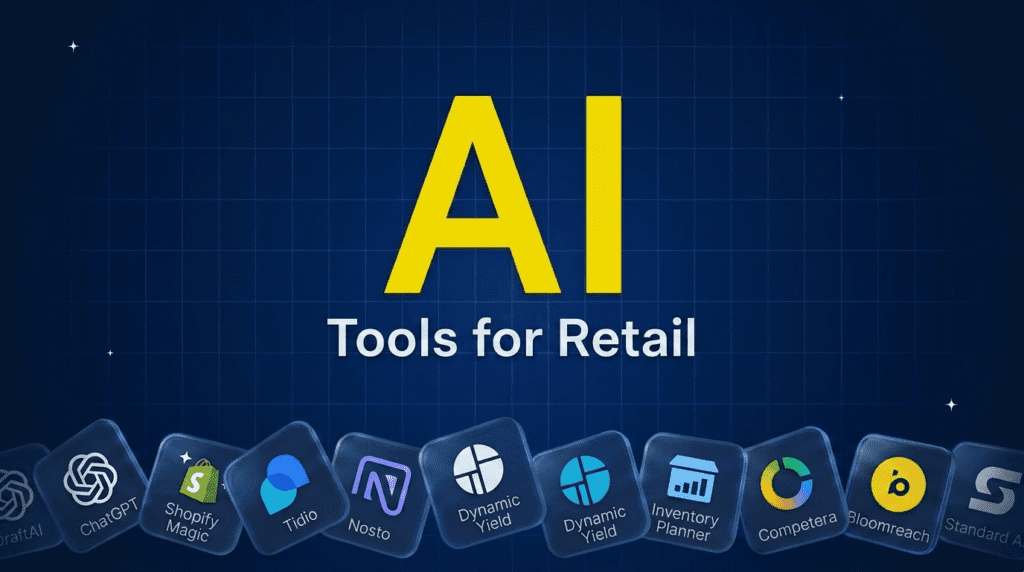
The best AI tools for retail depend on the goal. For content and product copy, ChatGPT and Shopify Magic are the fastest wins. For customer service, Tidio answers shoppers around the clock. For personalization and recommendations, Nosto and Dynamic Yield lift sales. For stock, Inventory Planner forecasts demand, and Competera optimizes pricing. For discovery, Bloomreach powers smart search, and Standard AI brings computer vision in-store. Most retailers start with one or two that match where they lose sales or time most.Pricing verified June 2026. AI tool pricing changes often, so confirm the current price on each vendor’s site before you subscribe. Inside AI Media is not an AI tool vendor; these picks are ranked on merit, not promotion.
The best AI tools for retail at a glance
Here is how the main tools compare on the retail job they do, who they suit, the free option, and where paid plans start. Retail software pricing is often quote-based or tied to sales volume, so confirm with the vendor before committing.| Tool | Best for | Function | Free option | Starting price |
|---|---|---|---|---|
| ChatGPT | Product copy and content | Content | Yes | $20/mo |
| Shopify Magic | AI inside Shopify | Ecommerce | Free in Shopify | From $39/mo |
| Tidio | Customer service chat | Service | $24.17/mo | $29/mo |
| Nosto | Personalization + recs | Personalization | Contact sales | Quote |
| Dynamic Yield | Experience personalization | Personalization | Contact sales | Quote |
| Inventory Planner | Demand forecasting | Inventory | Contact sales | Quote |
| Competera | AI pricing optimization | Pricing | Contact sales | Quote |
| Bloomreach | AI search and merchandising | Discovery | No | Quote |
| Standard AI | In-store computer vision | In-store | Contact sales | Quote |
How is AI used in retail?
AI touches nearly every part of retail. It writes product descriptions and marketing, personalizes what each shopper sees and recommends products they are likely to buy, powers chat and service that answers customers instantly, forecasts demand so shelves are neither empty nor overstocked, optimizes pricing in real time, and, in physical stores, uses computer vision for checkout-free shopping and shelf analytics. The aim is the same online and in-store: sell more, waste less, and serve customers better, with the biggest, fastest wins usually in personalization, customer service, and inventory.How we picked AI for retail
We are an independent publisher and do not sell retail software, so none of these picks is our own product. We grouped tools by the retail job they do, then weighed each on results, how well it integrates with common ecommerce and point-of-sale systems, suitability for small and mid-sized retailers as well as enterprises, and value. We favored tools a retailer can actually adopt over enterprise-only platforms that need a year-long rollout.Best AI tools for content and ecommerce
Writing product copy and running an online store is where most retailers get the quickest win.1. ChatGPT, best for product copy and content
ChatGPT is the cheapest, most flexible AI a retailer can use. It writes product descriptions at scale, drafts marketing emails and social posts, answers customer questions, and helps analyze sales data, all from a simple prompt. It is the first tool most small retailers should learn, though product claims still need a human check for accuracy.- Best for: Product descriptions, marketing copy, and content.
- Pricing: Free tier; Plus around $20/mo. [VERIFY]
- Skip if: you want AI built into your store platform.
2. Shopify Magic, best for AI inside your store
Shopify Magic is the AI built into Shopify, generating product descriptions, email subject lines, and store content, with the Sidekick assistant helping run the store by answering questions and making changes. For the millions of retailers on Shopify, it is AI that works where they already sell, with nothing extra to install.- Best for: Shopify retailers wanting built-in AI.
- Pricing: Included free with every Shopify plan (no separate charge); capabilities and usage limits scale with the plan tier.
- Skip if: you are not on Shopify.
Best AI tools for customer service and discovery
Helping shoppers find and buy is where AI most directly affects sales.3. Tidio, best for customer service chat
Tidio is an AI customer service platform popular with small and mid-sized retailers, with a chatbot, Lyro, that answers common questions, tracks orders, and recommends products around the clock, handing off to a human when needed. It is an affordable way to give shoppers instant answers and recover sales that would otherwise be lost to slow replies.- Best for: Always-on customer service for smaller retailers.
- Pricing: Free ($0, 50 conversations); Starter from $24.17/mo; Growth from $49.17/mo; Plus from $749/mo; Premium contact sales.
- Skip if: you need enterprise-grade contact-center features.
4. Bloomreach, best for AI search and merchandising
Bloomreach uses AI to power site search, product discovery, and merchandising, showing each shopper the most relevant products and helping them find what they want faster. Because so many sales are lost to poor on-site search, its smart, personalized discovery can have an outsized effect on conversion for larger catalogs.- Best for: AI-powered site search and merchandising at scale.
- Pricing: Quote-based. [VERIFY]
- Skip if: you have a small catalog and simple search needs.
Best AI tools for personalization
Showing the right product to the right shopper is one of AI’s biggest revenue levers.5. Nosto, best for personalization and recommendations
Nosto is a commerce experience platform that personalizes product recommendations, content, and offers for each shopper in real time, and it is built to be accessible to mid-sized retailers, not just enterprises. For stores that want to lift average order value with relevant recommendations, it is a strong, retail-focused choice.- Best for: Real-time personalization and product recommendations.
- Pricing: No fixed tiers; modular pricing based on store GMV and traffic (contact sales).
- Skip if: you want a free or very low-cost tool.
6. Dynamic Yield, best for experience personalization
Dynamic Yield, now part of Mastercard, personalizes the entire shopping experience across web, app, and email, using AI to test and tailor what each customer sees. It is an enterprise-grade platform for retailers that want deep, data-driven personalization across every channel rather than recommendations alone.- Best for: Enterprise omnichannel experience personalization.
- Pricing: Custom enterprise pricing (contact sales).
- Skip if: you are a small retailer wanting something simpler.
Best AI tools for inventory and pricing
Getting stock and prices right protects both sales and margin.7. Inventory Planner, best for demand forecasting
Inventory Planner uses AI to forecast demand and recommend what to reorder and when, so retailers avoid both stockouts and dead inventory. It connects to major ecommerce and ERP systems and is widely used by growing retailers for whom tied-up or missing stock is a constant drain on cash and sales.- Best for: Forecasting demand and optimizing reorders.
- Pricing: Pricing based on the volume of inventory managed; unlimited users included (contact sales).
- Skip if: you carry very little inventory.
8. Competera, best for AI pricing optimization
Competera uses AI to set optimal prices, analyzing demand, competitor pricing, and elasticity to recommend prices that protect margin and stay competitive. For retailers managing many SKUs where manual pricing is guesswork, it turns price-setting into a data-driven decision.- Best for: Data-driven pricing across large assortments.
- Pricing: Custom quote for its data and AI pricing products (contact sales).
- Skip if: you have a small, stable product range.
Best AI tool for physical stores
9. Standard AI, best for in-store computer vision
Standard AI brings computer vision to physical retail, enabling checkout-free shopping and shelf analytics by understanding what shoppers pick up and buy without scanning. For brick-and-mortar retailers exploring autonomous stores or better in-store insight, it is a leading specialist in retail vision.- Best for: Checkout-free stores and in-store analytics.
- Pricing: Custom pricing (book a demo).
- Skip if: you are online-only.
How to choose the right AI tools for retail
Start with where you lose the most sales or time. If product copy and marketing are the bottleneck, ChatGPT or Shopify Magic are immediate wins. If shoppers go unanswered, add a service tool like Tidio. If you want bigger baskets, personalization from Nosto or Dynamic Yield is the lever. If stock or margin is the problem, Inventory Planner and Competera pay for themselves fast. Check whether your ecommerce or POS platform already includes AI you are paying for, pilot one tool against a clear metric like conversion or stockouts, and scale what works rather than buying a whole suite at once.Frequently asked questions
It depends on the goal. ChatGPT and Shopify Magic are best for content, Tidio for customer service, Nosto and Dynamic Yield for personalization, Inventory Planner for stock, and Competera for pricing. Most retailers combine a couple that target where they lose the most sales or time.
Retailers use AI to write product and marketing copy, personalize recommendations, answer customer questions, forecast demand and manage inventory, optimize pricing, power site search, and, in stores, enable checkout-free shopping and shelf analytics. It helps sell more, cut waste, and serve customers better across online and physical retail.
Yes, partly. ChatGPT’s free tier handles a lot of content and analysis, and Tidio has a free plan. Many retail-specific platforms for personalization, inventory, and pricing are paid and quote-based, since their value is in data, integrations, and scale.
Small retailers benefit most from accessible tools: ChatGPT for copy, Shopify Magic if they sell on Shopify, and Tidio for service. These are affordable and quick to adopt, letting a small team punch above its weight on content, support, and merchandising without enterprise budgets.
No, though it changes the work. AI automates repetitive tasks like answering routine questions, writing copy, and forecasting stock, but retail still relies on people for service, merchandising judgment, and experience. The shift is toward staff spending less time on admin and more on customers and higher-value work.

Inside AI Media is a global platform that covers what’s happening in AI without the fluff. From breaking news to practical use cases, it keeps professionals, builders, and decision-makers updated on the latest in artificial intelligence, so they can make better, faster decisions and stay ahead.