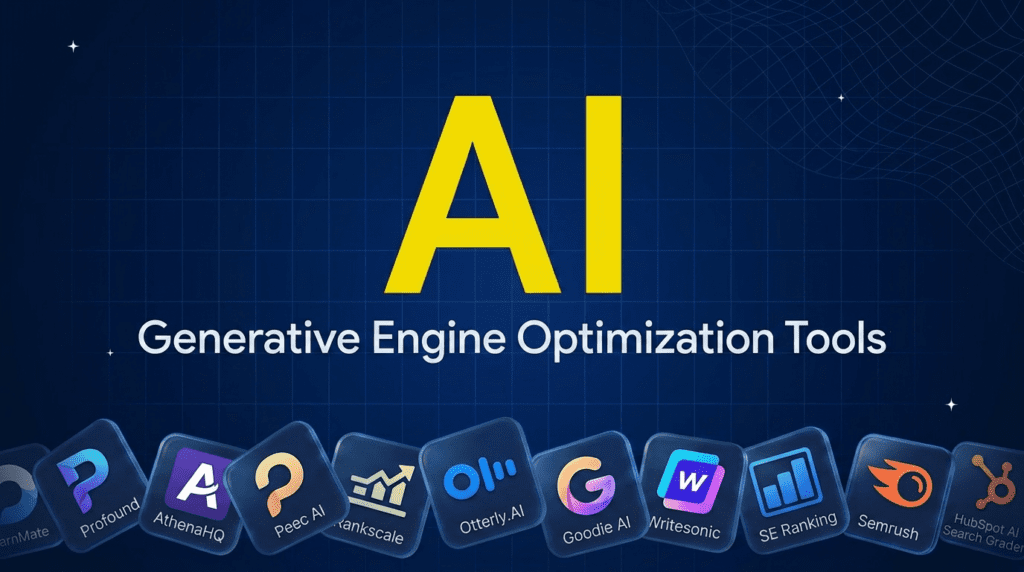
TL;DR: What You Need to Know
Generative engine optimization tools help you see and improve how your brand shows up in AI answers from ChatGPT, Perplexity, Gemini, and Google AI Overviews. For enterprise monitoring, Profound and AthenaHQ lead. For affordable tracking, Peec AI and Rankscale are the value picks. For optimizing content to get cited, Goodie AI and Writesonic stand out, and if you already run an SEO suite, SE Ranking and Semrush add GEO on top. To start free, use HubSpot’s AI Search Grader or Otterly.AI.Pricing verified June 2026. AI tool pricing changes often, so confirm the current price on each vendor’s site before you subscribe. Inside AI Media is not an AI tool vendor; these picks are ranked on merit, not promotion.
The best GEO tools at a glance
Here is how the main tools compare on what they do, which AI engines they track, the free tier, and where paid plans start. Pricing in this category is new and changes constantly, and vendors quote very different numbers, so treat the figures as a starting point and confirm on each site.| Tool | Best for | Type | Free tier | Starting price |
|---|---|---|---|---|
| Profound | Enterprise monitoring | Monitoring | No | From ~$99/mo |
| AthenaHQ | Enterprise teams + attribution | Monitoring + optimization | $95/mo | See site |
| Peec AI | In-house marketing teams | Monitoring | 7-day trial | From ~€89/mo |
| Rankscale | Affordable tracking + audits | Monitoring | $20/mo | From ~$20/mo |
| Otterly.AI | Beginners, small teams | Monitoring | $29/mo | From ~$29/mo |
| Goodie AI | Content optimization | Optimization | $399/mo | See site |
| Writesonic | Content + tracking combined | Optimization + monitoring | $79/mo | From ~$49/mo |
| SE Ranking | SEO teams adding GEO | SEO suite | $129/mo | AI add-on |
| Semrush | All-in-one SEO + GEO | SEO suite | Trial | GEO add-on |
| HubSpot AI Search Grader | A free starting audit | Free grader | Free | Free |
What is GEO, and what do GEO tools do?
Generative engine optimization, or GEO, is the practice of getting your brand mentioned and cited in the answers that AI engines like ChatGPT, Perplexity, Gemini, and Google’s AI Overviews generate. Where traditional SEO chases rankings and clicks, GEO is about whether the AI names you when someone asks a relevant question. GEO tools fall into two camps. Monitoring tools show you how often and where your brand appears across AI engines, who the AI cites instead, and how that changes over time. Optimization tools help you fix it, by improving content, structure, and citations so the models are more likely to reference you. Many newer tools do both.GEO vs SEO: how they differ
GEO does not replace SEO, it extends it. Traditional SEO optimizes for a ranked list of blue links and measures rankings, traffic, and clicks. GEO optimizes for a synthesized answer and measures mentions, citations, and share of voice inside that answer. The work overlaps, since clear, authoritative, well-structured content helps in both, but the metrics and tools differ. If your audience increasingly asks ChatGPT or Perplexity instead of typing into Google, GEO is where you find out whether they hear about you. For the wider marketing stack, see our AI marketing tools guide.Best AI-visibility monitoring tools
These show you where you stand: how your brand appears across AI engines and who gets cited instead.1. Profound
Profound is the most-cited name for enterprise GEO. It tracks your brand across more than ten engines, including ChatGPT, Perplexity, Gemini, Google AI Overviews, Copilot, and more, with deep analytics on the prompts and citations behind your visibility.
- Best for: Enterprises and agencies needing broad, deep tracking.
- Pricing: From around $99/mo, with higher enterprise tiers.
- Skip if: you are a small team on a tight budget.
2. AthenaHQ
AthenaHQ, built by former Google Search and DeepMind people, pairs monitoring with an action center that recommends fixes, plus revenue attribution and competitor benchmarking. It leans enterprise and data-driven.
- Best for: Enterprise marketing teams wanting monitoring plus action.
- Pricing: Self-Serve $295/mo ($95/mo billed annually, 3,600 credits); Enterprise custom.
- Skip if: you want a cheap, simple tracker.
3. Peec AI
Peec AI is the value pick for in-house teams, tracking your brand against competitors across the big three engines with clean prompt organization and daily updates.
- Best for: In-house marketing teams and SMBs.
- Pricing: From around €89/mo; 7-day trial.
- Skip if: you need SSO, an API, or LLM traffic volume data.
4. Rankscale
Rankscale combines mention tracking with AI-readiness audits of your site, at one of the lowest entry prices in the category, which makes it a good first paid tool.
- Best for: Affordable tracking plus site audits.
- Pricing: Essentials from $20/mo; Pro $99/mo; Growth $385/mo; Enterprise $780/mo (yearly saves 15%).
- Skip if: you need enterprise-scale features.
5. Otterly.AI
Otterly.AI is the easiest starting point, with automatic brand-mention and link tracking, sentiment, and weekly reports, plus a genuine free tier.
- Best for: Beginners and small teams.
- Pricing: Lite $29/mo ($25 annually, 15 prompts); Standard $189/mo; Premium $489/mo; Enterprise custom.
- Skip if: you need deep enterprise analytics.
Best GEO content optimization tools
These help you act on what monitoring reveals, by improving content so the AI engines cite you.6. Goodie AI
Goodie AI combines monitoring with an optimization hub, an answer-engine content writer, schema help, and crawler analytics, so you can find gaps and fix them in one place.
- Best for: Growth and PR teams optimizing for AI citation.
- Pricing: Explorer $399/mo (100 prompts, 3 seats); Pro and Enterprise by quote.
- Skip if: you only need monitoring.
7. Writesonic
Writesonic blends content production with AI-visibility tracking, including an action center that flags citation gaps and helps you fill them, which suits teams that want to write and measure in one tool. Our AI writing tools guide covers its writing side in depth.
- Best for: Teams combining content creation with GEO.
- Pricing: AI Search Visibility: Starter $79/mo; Basic $199/mo; Growth $399/mo; Enterprise custom (annual billing).
- Skip if: you want a pure tracker without the content suite.
Best all-in-one SEO suites with GEO features
If you already run an SEO platform, these add AI visibility without a new tool.8. SE Ranking
SE Ranking bolts an AI-visibility module onto a full SEO suite, tracking real AI responses across AI Overviews, AI Mode, Gemini, ChatGPT, and Perplexity, and correlating them with your rankings and backlinks.
- Best for: SEO teams and agencies wanting GEO in their existing stack.
- Pricing: Core $129/mo ($103.20 annually); Growth $279/mo; Enterprise custom (14-day trial).
- Skip if: you want a GEO-only specialist.
9. Semrush
Semrush ‘s AI visibility toolkit adds share-of-answer and cross-LLM benchmarking to its large SEO suite, with a unified view of Google and AI rankings.
- Best for: All-in-one SEO and SEM teams.
- Pricing: Semrush subscription plus a GEO add-on.
- Skip if: you do not already use Semrush.
10. Ahrefs Brand Radar
Ahrefs Brand Radar extends the Ahrefs backlink suite into AI, tracking unlinked brand mentions across the web and AI-referred traffic, which suits entity-first marketers.
- Best for: Marketers focused on entities and mentions.
- Pricing: Part of Ahrefs.
- Skip if: you do not use Ahrefs.
Best free GEO tools
You can start measuring without paying. HubSpot’s AI Search Grader is the easiest free audit: enter your brand and it scores how you appear in AI search with recommendations to improve. Otterly.AI offers a free tracking tier, KAI Footprint has a free analytics tier, and GetCito provides a free self-hosted plan for the technically inclined. None of these match a paid platform’s depth, but they are enough to learn where you stand before you commit to a subscription.How to choose a GEO tool
Start with where you are. If you do not yet know how visible you are in AI answers, begin with a monitoring tool or a free grader, since you cannot improve what you cannot see. If you already know you are missing from the answers but not why, an optimization tool that recommends fixes earns its keep. Then weigh five things: whether it covers the AI engines your audience actually uses, whether it reports real AI outputs rather than guesses, how actionable its recommendations are, whether it fits your existing stack, and the price against your scale. A sensible first step is a 60 to 90 day pilot on one content cluster before rolling GEO out widely.Frequently asked questions
They are tools that track and improve how your brand appears in AI-generated answers from engines like ChatGPT, Perplexity, Gemini, and Google AI Overviews, either by monitoring your visibility, optimizing your content, or both.
Profound and AthenaHQ lead for enterprise monitoring, Peec AI and Rankscale are the affordable picks, and Goodie AI and Writesonic are strong for optimizing content to get cited.
Yes. HubSpot’s AI Search Grader is a free audit, and Otterly.AI, KAI Footprint, and GetCito all offer free tiers to start tracking your AI visibility.
SEO optimizes for ranked links and measures rankings and clicks. GEO optimizes for AI-generated answers and measures mentions, citations, and share of voice. GEO extends SEO rather than replacing it.
Use a GEO monitoring tool. It runs relevant prompts across the AI engines and reports how often you are mentioned, who is cited instead, and how that changes over time.
Yes. The major tools track ChatGPT, Perplexity, Gemini, and Google AI Overviews, and some add Copilot, Claude, and others.
It varies widely, from free graders and roughly $20 to $30 a month for entry tools to several hundred or more for enterprise platforms. Pricing is new and shifts often, so check each vendor’s site.
If your audience is starting to ask AI tools instead of searching Google, yes. At minimum, a free grader or a low-cost monitor tells you whether you are visible, which is worth knowing.
The bottom line
GEO tools are how you find out whether AI engines mention your brand, and how you fix it when they do not. Start by measuring with a free grader or an affordable monitor like Otterly, Peec, or Rankscale, step up to Profound or AthenaHQ when you need enterprise depth, and reach for Goodie AI or Writesonic when you are ready to optimize content for citation. Treat pricing as a moving target, run a small pilot first, and remember that GEO works best alongside the SEO you already do.
Inside AI Media is a global platform that covers what’s happening in AI without the fluff. From breaking news to practical use cases, it keeps professionals, builders, and decision-makers updated on the latest in artificial intelligence, so they can make better, faster decisions and stay ahead.