

White House Executive Order Could Override State AI Laws
Leaked Executive Order Targets State AI Laws
What the leaked draft proposes
A draft executive order from the Trump administration, recently leaked, reveals plans to challenge state-level artificial intelligence (AI) laws by labeling them unconstitutional and tying federal funding to state compliance. The move would authorize the Department of Justice (DOJ) to actively litigate against states that do not align with federal AI policies.
Why it matters
Industry leaders share concerns about the complexity caused by differing state regulations. Many favor a nationwide framework to control AI, arguing that inconsistent laws increase costs, hinder competitiveness, and put the U.S. behind global rivals in the AI race. Yet, some lawmakers, especially within the Republican Party, question the wisdom of overriding state authority, pointing to federalism as a core principle. Senator Josh Hawley, for instance, expressed reservations about sidelining state powers on AI regulation.
Recent policy backdrop
Earlier this summer, attempts to pause state AI legislation failed to make it into key federal bills. Meanwhile, the administration’s AI Action Plan has outlined an accelerationist approach, favoring rapid development with minimal restrictions—popular in Silicon Valley but more controversial among civil society groups calling for stronger regulation and public safeguards.
Key provisions in the draft order
- Block new and existing state AI laws and establish a streamlined federal standard, reviving elements of prior moratorium proposals.
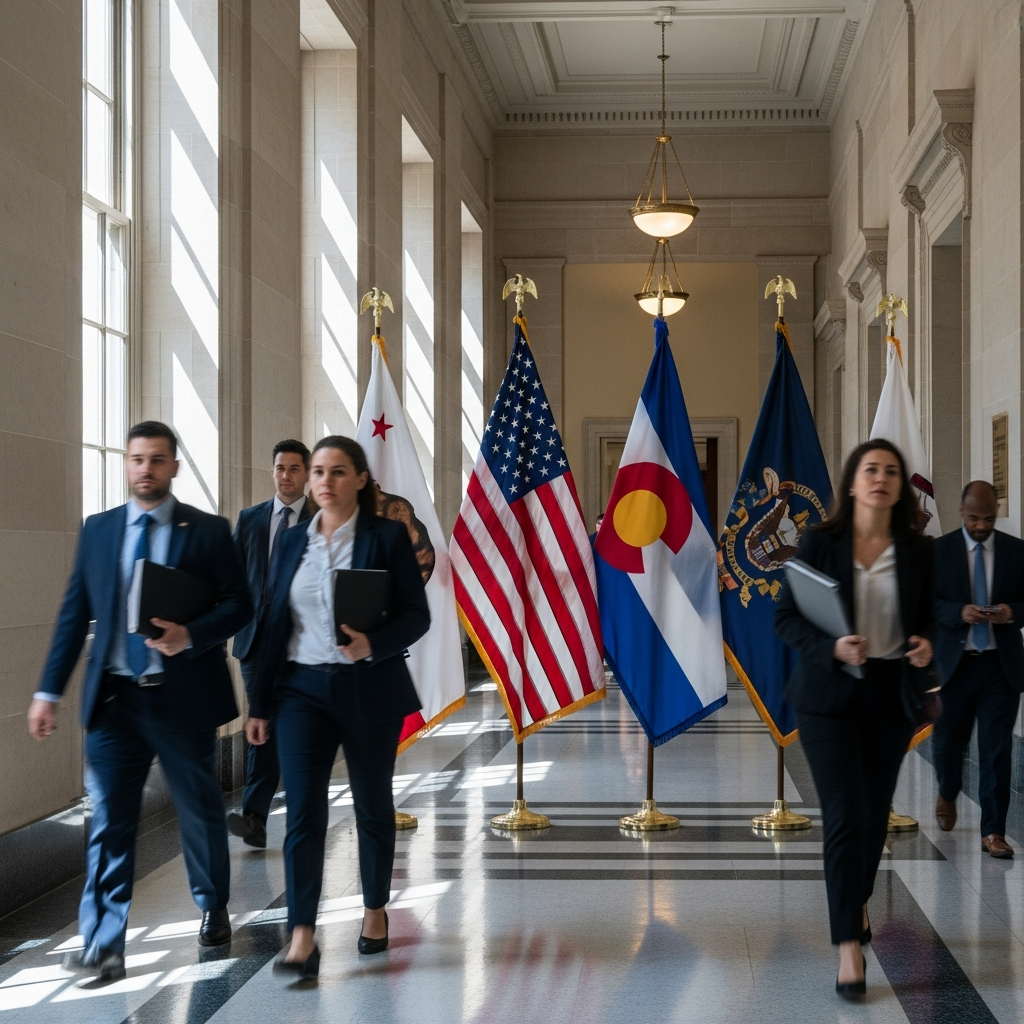
- Create a DOJ litigation task force to oppose state laws seen as regulating interstate commerce—potentially affecting rules in states like California, Colorado, and Illinois covering employment decisions, consumer protections, and algorithm accountability.
- Direct the Commerce Department to review state laws that conflict with federal AI policies and refer problematic statutes to the DOJ.
- Restrict federal funding for states that enforce AI laws at odds with the administration’s approach, conditioning discretionary grants on compliance each funding year.
Federal agency actions
- Federal Communications Commission (FCC): Develop a uniform national disclosure standard.
- Federal Trade Commission (FTC): Clarify when state regulations that require changes in AI outputs are not permitted under federal law.
- Department of Commerce: Coordinate review of conflicting state laws and escalate to DOJ where necessary.
Enforcement and funding mechanisms
Agencies would be required to audit discretionary grants, limiting support to states that align with federal AI policy during each funding cycle. The DOJ’s litigation task force would pursue cases challenging state rules deemed to burden interstate commerce or conflict with the federal standard.
Legislative strategy and advisors
Advisors such as David Sacks and James Braid are tasked with drafting new legislation to establish a comprehensive federal regulatory framework for AI. Critics suggest this approach caters too strongly to tech industry interests, prioritizing rapid innovation over balanced oversight.
Reactions across the tech sector
Within the tech sector, opinions differ. Large firms like Microsoft and IBM back federal regulation but stress the need for accountability and robust standards, while companies like Anthropic support unified national AI rules but also recognize value in cautious, state-level safety measures as federal action lags.
The administration’s initiative could reduce regulatory fragmentation and strengthen U.S. innovation, but experts warn lasting progress depends on building public trust and incorporating flexible, independent oversight models. Dynamic governance and third-party verification could help rules keep pace with fast-changing technology.
Outlook
If enacted, the executive order would mark a significant increase in federal intervention on technology regulation, potentially sparking legal battles over constitutional limits. The lack of relevant Congressional action leaves considerable uncertainty about the future landscape of U.S. AI law.