TL;DR: What You Need to Know
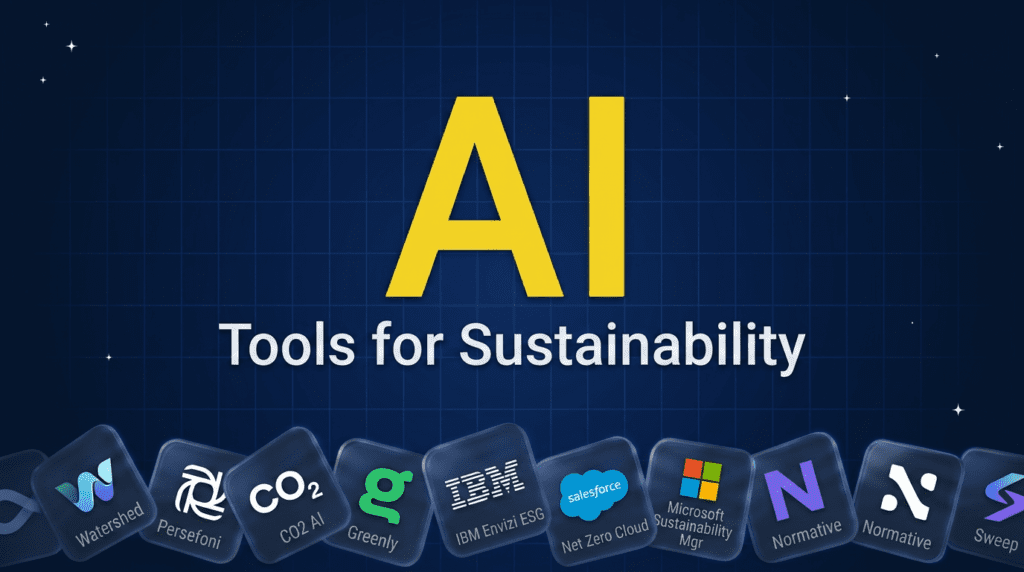
The best AI tools for sustainability help companies measure, report, and cut their environmental impact, mostly carbon emissions. For enterprise carbon accounting, Watershed, Persefoni, and CO2 AI lead, with Greenly strong for smaller businesses. For ESG data and reporting inside your existing stack, IBM Envizi, Salesforce Net Zero Cloud, and Microsoft Sustainability Manager fit. For supply-chain emissions, Normative and Sweep go deep. Pick by your size and where your data lives, and remember accurate data matters more than the dashboard.Pricing verified June 2026. AI tool pricing changes often, so confirm the current price on each vendor’s site before you subscribe. Inside AI Media is not an AI tool vendor; these picks are ranked on merit, not promotion.
The best AI tools for sustainability at a glance
Here is how the main tools compare on what they do, who they suit, and pricing model. Sustainability software is almost entirely quote-based and tied to company size, so confirm with the vendor.| Tool | Best for | Focus | Pricing |
|---|---|---|---|
| Watershed | Enterprise carbon management | Carbon accounting | Quote |
| Persefoni | Carbon accounting + disclosure | Carbon / ESG | Quote |
| CO2 AI | AI sustainability action | Carbon accounting | Quote |
| Greenly | SMBs and mid-market | Carbon accounting | Quote |
| IBM Envizi | ESG data and reporting | ESG platform | Quote |
| Salesforce Net Zero Cloud | Salesforce users | ESG / carbon | Quote |
| Microsoft Sustainability Mgr | Microsoft Cloud users | Emissions data | Quote |
| Normative | Supply-chain emissions | Carbon / Scope 3 | Quote |
| Sweep | Carbon and ESG data | Carbon / ESG | Quote |
How is AI used in sustainability?
AI helps companies turn messy data into action on sustainability. It gathers and cleans emissions data from across operations and suppliers, estimates carbon footprints including hard-to-measure Scope 3 supply-chain emissions, automates ESG reporting against frameworks and regulations, models reduction scenarios, and flags where to cut impact and cost. It is also used to optimize energy use and operations. The result is faster, more accurate measurement and reporting, which is increasingly a regulatory requirement, not just good practice. A separate, growing topic is “sustainable AI,” reducing the energy and carbon footprint of running AI itself. The biggest wins here are usually in carbon accounting and automated ESG reporting.How we picked these AI sustainability tools
We are an independent publisher and do not sell sustainability software, so none of these picks is our own product. We grouped tools by the job they do, then weighed each on the rigor and auditability of their data and methodology, fit for enterprises versus smaller businesses, integration with existing systems, and value. Because sustainability reporting is increasingly regulated, we treated data accuracy and compliance support as essential.Best AI tools for carbon accounting
Measuring your carbon footprint accurately is the foundation of any sustainability program.1. Watershed, best for enterprise carbon management
Watershed is a leading enterprise carbon management platform that measures emissions across operations and supply chains, uses AI to handle and estimate large volumes of data, and supports reduction planning and regulatory disclosure. For large companies that need rigorous, audit-ready carbon accounting, it is a top choice.- Best for: Enterprise-grade, audit-ready carbon management.
- Pricing: Enterprise quote.
- Skip if: you are a small business wanting something lighter.
2. Persefoni, best for carbon accounting and disclosure
Persefoni is a carbon accounting and climate management platform built around financial-grade rigor and regulatory disclosure, with AI to streamline data and calculations. It suits organizations that need to report emissions to standards and regulators with confidence, treating carbon data with the seriousness of financial data.- Best for: Disclosure-grade carbon accounting and compliance.
- Pricing: Quote-based.
- Skip if: you need only a rough footprint estimate.
3. CO2 AI, best for AI-driven sustainability action
CO2 AI, developed with BCG, uses AI to measure emissions at scale, including supply-chain data, and to simulate and prioritize reduction actions. It is aimed at large enterprises that want not just measurement but AI-guided decisions on where to cut emissions and cost most effectively.- Best for: AI-guided emissions reduction at enterprise scale.
- Pricing: Enterprise quote.
- Skip if: you want a simple SMB tool.
4. Greenly, best for SMBs and mid-market
Greenly makes carbon accounting accessible to smaller and mid-sized companies, using AI to estimate emissions from financial and activity data and guide reduction, without the cost or complexity of enterprise platforms. For businesses starting their sustainability journey, it is an approachable, affordable entry point.- Best for: Small and mid-sized businesses starting out.
- Pricing: Quote-based, mid-market friendly.
- Skip if: you are a large enterprise with complex needs.
Best ESG data and reporting platforms
For broader ESG reporting inside systems you already run, these are the picks.5. IBM Envizi, best for ESG data and reporting
IBM Envizi consolidates ESG data from across an organization into a single system, with AI to manage data and automate reporting against major frameworks. For enterprises that need one source of truth for environmental, social, and governance metrics, it is a robust, established platform.- Best for: Centralized enterprise ESG data and reporting.
- Pricing: Enterprise quote.
- Skip if: you only need carbon, not full ESG.
6. Salesforce Net Zero Cloud, best for Salesforce users
Net Zero Cloud brings carbon accounting and sustainability reporting into the Salesforce platform, with AI and analytics to track emissions and progress toward targets. For organizations already on Salesforce, it puts sustainability data alongside the rest of their business data.- Best for: Sustainability tracking within Salesforce.
- Pricing: Quote-based.
- Skip if: you do not use Salesforce.
7. Microsoft Sustainability Manager, best for Microsoft Cloud users
Microsoft Sustainability Manager records, reports, and reduces emissions using data unified in the Microsoft Cloud, with AI and Copilot to surface insights. For organizations in the Microsoft ecosystem, it is the integrated way to manage environmental data alongside their other operations.- Best for: Emissions data within the Microsoft Cloud.
- Pricing: Essentials $4,000/tenant/mo; Premium $12,000/tenant/mo (adds full Scope 3 and Copilot).
- Skip if: you are not on Microsoft.
Best AI tools for supply-chain emissions
Scope 3 supply-chain emissions are the hardest to measure, and these specialize in them.8. Normative, best for supply-chain emissions
Normative focuses on comprehensive carbon accounting including complex Scope 3 supply-chain emissions, using AI and a large emissions database to estimate the footprint companies struggle to measure directly. For organizations where most impact sits in the supply chain, its depth there is the draw.- Best for: Measuring hard-to-track Scope 3 emissions.
- Pricing: Quote-based.
- Skip if: your emissions are mostly direct and simple.
9. Sweep, best for carbon and ESG data management
Sweep is a carbon and ESG data platform that helps companies track emissions across their operations and value chain and manage broader sustainability data, with AI to handle the complexity. It suits organizations that want carbon and wider ESG data managed together in a modern platform.- Best for: Managing carbon and ESG data together.
- Pricing: Quote-based.
- Skip if: you only need a basic footprint calculator.
How to choose the right AI sustainability tool
Start with your size and where your data lives. Large enterprises that need audit-ready carbon accounting should look at Watershed, Persefoni, or CO2 AI; smaller businesses at Greenly. If you want ESG reporting inside an existing system, IBM Envizi, Salesforce Net Zero Cloud, or Microsoft Sustainability Manager fit naturally. If your footprint is dominated by suppliers, Normative or Sweep specialize in Scope 3. Whatever you choose, the value depends on data quality and methodology rigor, not the dashboard, so prioritize accuracy, auditability, and alignment with the standards you must report against.Frequently asked questions
For carbon accounting, Watershed, Persefoni, CO2 AI, and Greenly lead; for ESG data and reporting, IBM Envizi, Salesforce Net Zero Cloud, and Microsoft Sustainability Manager; and for supply-chain emissions, Normative and Sweep. The best one depends on your company size, your data systems, and whether you need carbon only or full ESG.
AI gathers and cleans emissions data, estimates carbon footprints including supply-chain Scope 3, automates ESG reporting against frameworks, models reduction scenarios, and optimizes energy and operations. It makes measurement and reporting faster and more accurate, which matters as sustainability disclosure becomes regulated.
Carbon accounting software measures an organization’s greenhouse gas emissions across its operations and value chain, then reports and helps reduce them. AI-powered tools like Watershed and Persefoni automate data collection and estimation, including emissions that are otherwise very hard to calculate, and support regulatory disclosure.
Running AI uses significant energy and water, so it has a real environmental footprint, which is the focus of “sustainable AI.” At the same time, AI is a powerful tool for measuring and cutting emissions elsewhere. The net impact depends on how efficiently AI is run and how effectively it is used to drive reductions.
Most enterprise platforms are quote-based and priced for larger organizations, but tools like Greenly target smaller and mid-sized businesses more affordably. Many vendors offer demos, and starting with a focused carbon footprint assessment is usually cheaper than a full ESG platform.

Inside AI Media is a global platform that covers what’s happening in AI without the fluff. From breaking news to practical use cases, it keeps professionals, builders, and decision-makers updated on the latest in artificial intelligence, so they can make better, faster decisions and stay ahead.