TL;DR: What You Need to Know
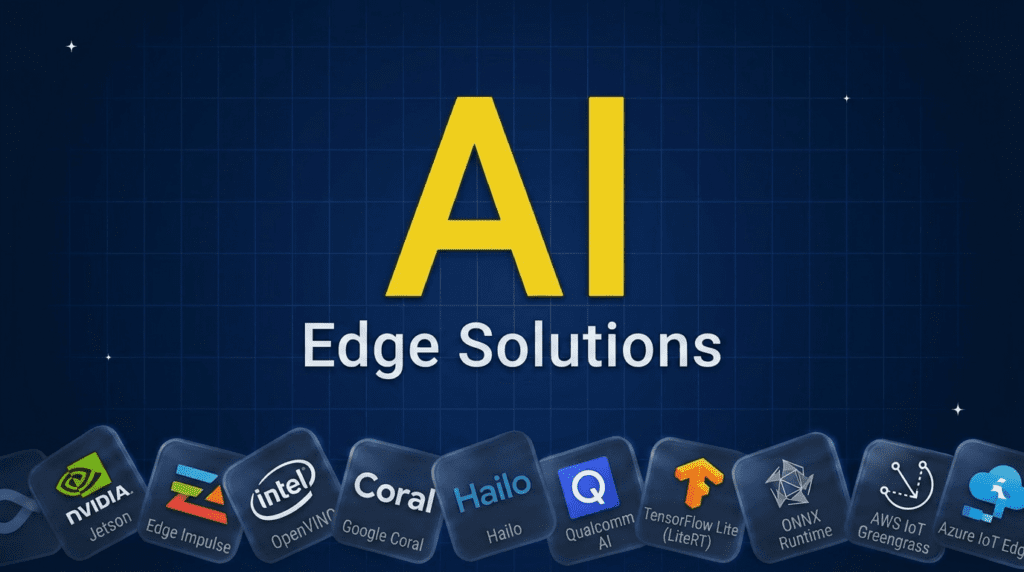
Edge AI runs models on devices, on cameras, sensors, machines, and phones, instead of the cloud, for instant, private, offline inference. For development platforms, NVIDIA Jetson and Edge Impulse lead, with Intel OpenVINO optimizing models. For hardware, Google Coral, Hailo, and Qualcomm AI. To run models on-device, TensorFlow Lite (LiteRT) and ONNX Runtime are the standards, and to deploy from the cloud to the edge, AWS IoT Greengrass and Azure IoT Edge. Pick by whether you need hardware, a dev platform, or a deployment path.Pricing verified June 2026. AI tool pricing changes often, so confirm the current price on each vendor’s site before you subscribe. Inside AI Media is not an AI tool vendor; these picks are ranked on merit, not promotion.
The best edge AI solutions at a glance
Here is how the main solutions compare on what they are, the layer they sit at, and pricing model. Hardware is priced per unit; software and runtimes are often free or usage-based, so confirm with the vendor.| Solution | Best for | Layer | Pricing |
|---|---|---|---|
| NVIDIA Jetson | Edge AI dev + deployment | Hardware + platform | $249 |
| Edge Impulse | End-to-end edge ML | Dev platform | Free |
| Intel OpenVINO | Optimizing inference | Toolkit | Free |
| Google Coral | Edge TPU acceleration | Hardware | Per device |
| Hailo | High-performance edge chips | Hardware | Per device |
| Qualcomm AI | Mobile and on-device AI | Hardware / platform | OEM / SDK |
| TensorFlow Lite (LiteRT) | On-device ML runtime | Framework | Free |
| ONNX Runtime | Cross-platform inference | Runtime | Free |
| AWS IoT Greengrass | Cloud-to-edge on AWS | Deployment | Free |
| Azure IoT Edge | Cloud-to-edge on Azure | Deployment | Free |
What is edge AI and why does it matter?
Edge AI means running AI models directly on a device at the “edge” of the network, a camera, sensor, machine, robot, or phone, rather than sending data to the cloud. The benefits are speed (no round trip, so real-time inference), privacy (data stays on the device), reliability (it works offline), and lower bandwidth and cloud cost. It powers things like smart cameras, autonomous machines, industrial quality inspection, and on-device assistants. Building edge AI involves a few layers: the hardware that runs the model, a development platform to build and optimize it, an on-device runtime, and a way to deploy and manage models across many devices. The tools below cover each.How we picked
We are an independent publisher and do not sell edge hardware or software, so none of these picks is our own product. We grouped solutions by the layer they sit at, then weighed each on capability, ecosystem and tooling, adoption, and fit for both prototyping and production. We focused on the platforms, chips, and runtimes teams actually build edge AI on.Best edge AI development platforms
These help you build, optimize, and deploy models for the edge.1. NVIDIA Jetson, best for edge AI development and deployment
NVIDIA Jetson is the leading platform for edge AI, combining powerful small form-factor hardware with a mature software stack (JetPack, TAO, Metropolis) for building and running demanding models like computer vision on devices. From hobbyist kits to production modules, it is the default choice for serious edge AI, especially anything vision-heavy.- Best for: Powerful, vision-capable edge AI on real hardware.
- Pricing: Hardware. Jetson Orin Nano Super Developer Kit from $249; higher modules priced via distributors.
- Skip if: you need an ultra-low-cost, low-power microcontroller.
2. Edge Impulse, best end-to-end edge ML platform
Edge Impulse is a development platform for building machine learning models that run on edge devices and microcontrollers, handling data collection, training, optimization, and deployment with a largely no-code workflow. It is especially strong for sensor and TinyML applications, making edge AI accessible without deep embedded expertise.- Best for: Building edge ML, including TinyML on microcontrollers.
- Pricing: Developer plan free; Enterprise custom.
- Skip if: you only run large vision models on powerful hardware.
3. Intel OpenVINO, best for optimizing inference
OpenVINO is Intel’s free toolkit for optimizing and deploying AI inference across Intel hardware (CPUs, integrated GPUs, and accelerators), squeezing more performance from models at the edge. For teams running edge AI on Intel-based devices, it is the standard way to make models fast and efficient.- Best for: Optimizing inference on Intel edge hardware.
- Pricing: Free and open source (Apache 2.0).
- Skip if: your edge hardware is not Intel-based.
Best edge AI hardware and chips
The silicon that makes on-device inference fast and power-efficient.4. Google Coral, best for Edge TPU acceleration
Google Coral provides Edge TPU hardware, dev boards, and USB accelerators that run TensorFlow Lite models extremely efficiently at the edge. For low-power, cost-effective on-device inference, especially vision, it is a popular, accessible accelerator.- Best for: Low-power, efficient edge inference.
- Pricing: Hardware priced per device.
- Skip if: you need to run very large models.
5. Hailo, best for high-performance edge chips
Hailo makes specialized AI processors that deliver high performance per watt for edge devices, enabling demanding real-time AI like advanced vision on compact, low-power hardware. It is increasingly used in automotive, smart cities, and industrial edge applications that need serious throughput at the edge.- Best for: High-throughput edge AI on low power.
- Pricing: Hardware / module pricing.
- Skip if: a general dev board meets your needs.
6. Qualcomm AI, best for mobile and on-device AI
Qualcomm’s AI capabilities, in its Snapdragon platforms and AI Hub, power on-device AI across phones, laptops, and embedded devices, running models efficiently on its NPUs. For mobile and consumer-device AI at scale, it is a dominant platform, with tooling to optimize and deploy models.- Best for: On-device AI in phones and consumer hardware.
- Pricing: OEM / SDK based.
- Skip if: you build custom industrial edge boxes.
Best on-device frameworks and runtimes
These run optimized models on the device itself, across many platforms.7. TensorFlow Lite (LiteRT), best on-device ML runtime
TensorFlow Lite, now LiteRT, is Google’s lightweight runtime for running ML models on mobile, embedded, and IoT devices, with tooling to shrink and optimize models for limited hardware. It is one of the most widely used ways to deploy models on-device, with broad framework support.- Best for: Running optimized models on mobile and embedded devices.
- Pricing: Free and open source (LiteRT, Apache 2.0).
- Skip if: you need a different framework’s native runtime.
8. ONNX Runtime, best for cross-platform inference
ONNX Runtime is an open-source engine for running models in the ONNX format across many hardware targets and operating systems, including edge devices, with hardware-specific accelerations. For teams that want one runtime that works everywhere regardless of the training framework, it is the portable standard.- Best for: Portable inference across hardware and platforms.
- Pricing: Free and open source (MIT, maintained by Microsoft).
- Skip if: you are locked to a single vendor’s stack.
Best cloud-to-edge deployment solutions
These manage and deploy models from the cloud to fleets of edge devices.9. AWS IoT Greengrass, best for cloud-to-edge on AWS
AWS IoT Greengrass extends AWS to edge devices, letting you deploy, run, and manage ML inference and applications locally while staying connected to the cloud for updates and orchestration. For organizations on AWS running edge AI across many devices, it is the managed path to deployment at scale.- Best for: Deploying and managing edge AI fleets on AWS.
- Pricing: Edge runtime free; cloud management $0.16 per core device/mo (first 3 free for a year).
- Skip if: you are not on AWS.
10. Azure IoT Edge, best for cloud-to-edge on Azure
Azure IoT Edge runs AI and analytics workloads on edge devices as managed containers, deployed and monitored from Azure, so models run locally with cloud oversight. For Microsoft-aligned organizations operating edge AI at scale, it is the natural deployment and management layer.- Best for: Managed edge AI deployment on Azure.
- Pricing: Runtime free and open source; billed via Azure IoT Hub.
- Skip if: you are not in the Microsoft ecosystem.
How to choose an edge AI solution
Work through the layers. Pick hardware that matches your power, performance, and cost needs: NVIDIA Jetson for demanding vision, Google Coral or Hailo for efficient acceleration, Qualcomm for mobile. Use a development platform, Edge Impulse for accessible end-to-end edge ML, or Jetson’s stack, and optimize with OpenVINO on Intel. Run models with TensorFlow Lite or ONNX Runtime, and if you manage many devices, deploy through AWS IoT Greengrass or Azure IoT Edge. Start by prototyping on a dev kit, validate the model runs fast enough on the target hardware, then plan deployment and updates across your fleet. For getting models production-ready first, see our AI deployment tools guide.Frequently asked questions
They are the hardware, platforms, runtimes, and deployment tools used to run AI models directly on devices at the edge, rather than in the cloud. Examples include NVIDIA Jetson and Google Coral hardware, Edge Impulse for development, TensorFlow Lite and ONNX Runtime for on-device inference, and AWS IoT Greengrass or Azure IoT Edge for deployment.
Edge AI offers real-time inference with no network round trip, keeps data private on the device, works offline, and cuts bandwidth and cloud costs. It is essential where latency, privacy, or connectivity matter, like autonomous machines, smart cameras, and industrial systems. Cloud AI still wins for the largest models and heavy training.
Common edge AI hardware includes NVIDIA Jetson modules, Google Coral Edge TPUs, Hailo AI processors, and Qualcomm Snapdragon platforms for mobile, plus industrial edge systems from vendors like Advantech and Supermicro. The right choice depends on your performance, power, and cost requirements.
It is more involved than calling a cloud API, because you must fit and optimize models for constrained hardware and manage deployment across devices. But platforms like Edge Impulse and optimization tools like OpenVINO have made it far more accessible, and you can prototype on an affordable dev kit before scaling.
It varies widely. Hardware ranges from inexpensive accelerators and dev boards to higher-end modules, while many runtimes and toolkits (TensorFlow Lite, ONNX Runtime, OpenVINO) are free. Cloud-to-edge deployment services are usage-based. Total cost depends mostly on the hardware and the number of devices you deploy.

Inside AI Media is a global platform that covers what’s happening in AI without the fluff. From breaking news to practical use cases, it keeps professionals, builders, and decision-makers updated on the latest in artificial intelligence, so they can make better, faster decisions and stay ahead.