TL;DR: What You Need to Know
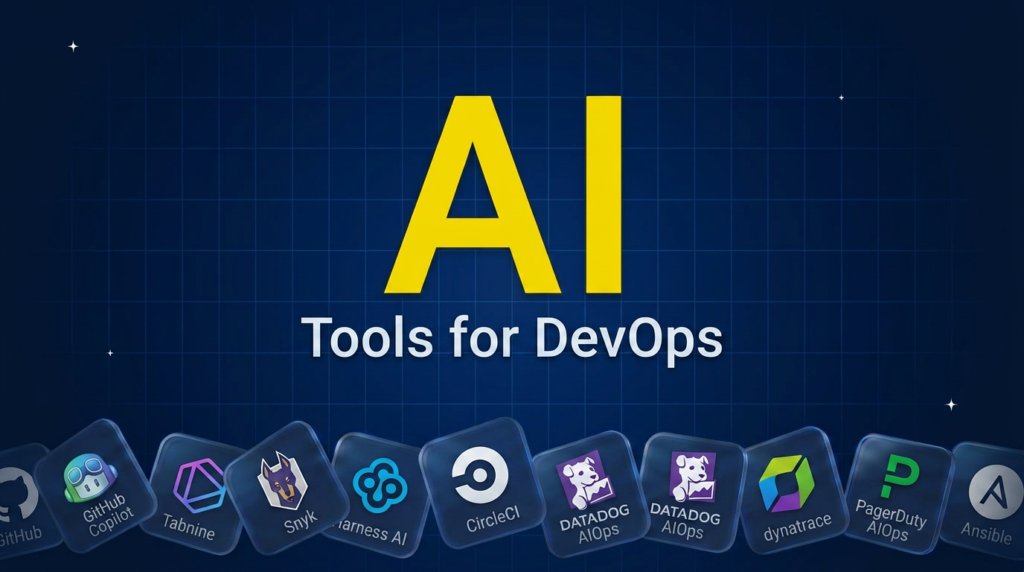
The best AI tools for DevOps depend on the stage of the pipeline. For writing and reviewing code, GitHub Copilot and Tabnine lead, with Snyk catching security issues as you go. For CI/CD, Harness AI optimizes pipelines and CircleCI speeds them up. For monitoring and incidents, the AIOps platforms Datadog, Dynatrace, and PagerDuty cut the noise and find root cause fast. And Ansible Lightspeed turns plain English into automation. Most teams already own several of these, so the win is switching on the AI features you are paying for.Pricing verified June 2026. AI tool pricing changes often, so confirm the current price on each vendor’s site before you subscribe. Inside AI Media is not an AI tool vendor; these picks are ranked on merit, not promotion.
The best AI tools for DevOps at a glance
Here is how the main tools compare on where they fit in the DevOps lifecycle, what they do, the free option, and where paid plans start. Much of this market is enterprise and quote-based, so confirm pricing with the vendor before committing.| Tool | Best for | Stage | Free option | Starting price |
|---|---|---|---|---|
| GitHub Copilot | AI pair programming | Code | $10/mo | $10/mo |
| Tabnine | Private, on-prem coding AI | Code | $39/mo | $9/mo |
| Snyk | AI security scanning | Code/Sec | $25/mo | Free / paid |
| Harness AI | AI-enhanced CI/CD | CI/CD | Trial | Quote |
| CircleCI | Pipeline optimization | CI/CD | $15/mo | Free / paid |
| Datadog AIOps | Predictive monitoring | Observability | Trial | Per host |
| Dynatrace | Automated root cause | Observability | $7/mo | Per host |
| PagerDuty AIOps | Alert correlation, incidents | Incidents | $699/mo | Per user |
| Ansible Lightspeed | AI automation and IaC | Automation | Trial | Quote |
How is AI used in DevOps?
AI shows up across the whole DevOps lifecycle, not in one place. It writes and reviews code and flags vulnerabilities before they merge, it optimizes CI/CD pipelines and predicts which builds will fail, and on the operations side, the discipline known as AIOps reduces alert noise, spots anomalies, and points at the root cause of an incident faster than a human scanning dashboards. It also turns plain-English requests into automation scripts and infrastructure code. The goal is the same throughout: less toil and faster, more reliable delivery, with engineers reviewing what the AI proposes rather than handing over control.How we picked
We are an independent publisher and do not sell DevOps software, so none of these picks is our own product. We grouped tools by where they fit in the pipeline, then weighed each on what it does well in real use, how it integrates with existing stacks, security and data handling, and value. Because much of this space is enterprise, we favored tools teams can actually trial, and we flag where a capability is a feature inside a larger platform you may already run.Best AI tools for code and security
The most mature use of AI in DevOps is helping engineers write, review, and secure code.1. GitHub Copilot, best for AI pair programming
GitHub Copilot is the most widely used AI coding assistant, suggesting lines and whole functions in your editor, explaining code, and now reviewing pull requests and helping fix failing checks. For DevOps engineers writing scripts, pipelines, and infrastructure code, it is the default starting point and integrates tightly with the GitHub workflow.- Best for: In-editor code suggestions and PR help.
- Pricing: Free ($0, 2,000 completions/mo); Pro $10/user/mo; Pro+ $39/user/mo; Max $100/user/mo.
- Skip if: your policy forbids sending code to a cloud service.
2. Tabnine, best for private, on-prem coding AI
Tabnine is the pick for teams with strict security or compliance needs, offering code completion that can run fully on-premises or in a private environment, trained without exposing your code. It trades some raw capability for control and privacy, which matters in regulated industries where Copilot’s cloud model is a non-starter.- Best for: Coding AI that keeps code in your own environment.
- Pricing: No free tier; Code Assistant Platform $39/user/mo; Agentic Platform $59/user/mo (billed annually).
- Skip if: you want the most capable model and can use the cloud.
3. Snyk, best for AI security scanning
Snyk brings AI to security, scanning code, dependencies, containers, and infrastructure as code for vulnerabilities and suggesting fixes inside the developer workflow. Shifting security left like this catches issues before they reach production, which makes Snyk a near-default in modern DevSecOps pipelines.- Best for: Catching and fixing vulnerabilities as you build.
- Pricing: Free plan; Team $25/mo per contributing developer (min 5); Ignite about $105/mo per developer; Enterprise contact sales.
- Skip if: security is handled entirely by a separate team and tool.
Best AI tools for CI/CD pipelines
These make the build, test, and deploy pipeline faster and more reliable.4. Harness AI, best for AI-enhanced CI/CD
Harness is a delivery platform that uses AI across CI/CD, from generating pipelines to verifying deployments and automatically rolling back a release when it detects a problem from your metrics. For teams that want intelligence built into the deployment process rather than bolted on, it is the most complete option.- Best for: AI woven through the full delivery pipeline.
- Pricing: Trial; enterprise quote.
- Skip if: you only need a lightweight CI tool.
5. CircleCI, best for pipeline optimization
CircleCI is a popular CI/CD platform adding AI to speed up and troubleshoot pipelines, surfacing why builds fail and helping optimize test runs and resource use. It is a practical pick for teams that want faster, more reliable pipelines without re-platforming their whole delivery setup.- Best for: Faster, self-troubleshooting CI/CD pipelines.
- Pricing: Free (up to 6,000 build minutes, 5 users); Performance from $15/mo (30,000 credits); Scale custom.
- Skip if: you need a single platform spanning delivery and ops.
Best AIOps tools for monitoring and incidents
On the operations side, AIOps platforms turn a flood of signals into a clear answer.6. Datadog AIOps, best for predictive monitoring
Datadog is a leading observability platform whose AI features detect anomalies, forecast issues before they hit users, and reduce alert noise across metrics, logs, and traces. If you already run Datadog, its AIOps capabilities are some of the easiest, highest-value AI to switch on in your stack.- Best for: Predictive monitoring across a unified observability stack.
- Pricing: Trial; priced per host and feature.
- Skip if: you are committed to a different observability vendor.
7. Dynatrace, best for automated root cause analysis
Dynatrace is built around its Davis AI, which automatically maps dependencies and pinpoints the root cause of a problem rather than just alerting that something is wrong. For complex, large-scale environments where tracing an incident by hand is painful, that automated causation is its standout strength.- Best for: Automatic root-cause analysis in complex systems.
- Pricing: No free tier; Foundation and Discovery $7/mo per host; Infrastructure Monitoring $29/mo per host; Full-Stack $58/mo per 8 GiB host (usage-based).
- Skip if: you run a small, simple environment.
8. PagerDuty AIOps, best for alert correlation and incidents
PagerDuty AIOps groups related alerts into a single incident, cuts noise, and automates parts of the response, so on-call engineers are not buried under hundreds of notifications during an outage. It is the pick for tightening incident response and protecting your team from alert fatigue.- Best for: Correlating alerts and streamlining incident response.
- Pricing: No free tier; AIOps from $699/mo (billed annually), consumption-based per accepted event; requires a paid Incident Response plan.
- Skip if: your alert volume is low enough to handle manually.
Best AI tool for automation and infrastructure
9. Ansible Lightspeed, best for AI automation and IaC
Ansible Lightspeed uses AI to turn plain-English requests into Ansible automation content, helping engineers write playbooks and infrastructure code faster and more consistently. For teams standardized on Ansible, it lowers the barrier to automating more of their infrastructure without memorizing every module.- Best for: Generating Ansible playbooks and automation from plain English.
- Pricing: Trial; enterprise quote.
- Skip if: you do not use Ansible for automation.
How to choose AI tools for DevOps
Start with where your team loses the most time, and check what you already pay for. If engineers are bogged down writing code and scripts, turn on Copilot or Tabnine and add Snyk for security. If pipelines are slow or flaky, look at Harness or your CI provider’s AI features. If on-call is drowning in alerts, an AIOps layer like Datadog, Dynatrace, or PagerDuty pays off fast. Many of these are features inside platforms you already run, so audit your current stack before buying anything new, pilot on one team, and keep engineers reviewing what the AI proposes, especially anything touching production.Frequently asked questions
It depends on the stage. GitHub Copilot and Tabnine are best for code, Snyk for security, Harness and CircleCI for CI/CD, and Datadog, Dynatrace, and PagerDuty for monitoring and incidents. Most teams combine a coding assistant with an AIOps platform rather than relying on one tool.
AI helps write and review code, scan for vulnerabilities, optimize and troubleshoot CI/CD pipelines, predict failures, reduce alert noise, find the root cause of incidents, and generate automation and infrastructure code. The aim is to cut repetitive toil and speed up reliable delivery.
AIOps means applying AI to IT operations: using machine learning on metrics, logs, and traces to detect anomalies, correlate alerts, and identify root causes automatically. Datadog, Dynatrace, and PagerDuty are common AIOps platforms, and it is the operations counterpart to AI coding tools on the development side.
No. AI automates toil like boilerplate code, alert triage, and routine analysis, but designing systems, judging tradeoffs, and owning production reliability still need experienced engineers. The likely shift is DevOps engineers spending less time firefighting and more time on architecture and improvement.
Yes. Several open-source projects bring AI to Kubernetes troubleshooting, log analysis, and automation, and many commercial tools have free tiers. Open-source options give the most control over your data, which matters for teams with strict security requirements, though they usually need more setup than a managed platform.

Inside AI Media is a global platform that covers what’s happening in AI without the fluff. From breaking news to practical use cases, it keeps professionals, builders, and decision-makers updated on the latest in artificial intelligence, so they can make better, faster decisions and stay ahead.