TL;DR: What You Need to Know
Langfuse is the best open-source LLM observability tool for most teams, giving you full request tracing, cost dashboards, and easy self-hosting. Arize Phoenix is the strongest for debugging agent and RAG traces, Helicone is the fastest to set up because it works as a proxy with no SDK, and Datadog is the pick for enterprises that want LLM monitoring inside their existing infrastructure observability. Observability is about knowing what your LLM app actually did in production: tracing every step, tracking token cost and latency, and getting alerted when things break. That is different from evaluation, which scores whether the output was good. This guide ranks 10 observability tools with a monitoring focus, explains OpenTelemetry, and covers how to instrument an app and debug a production failure.Pricing verified June 2026. AI tool pricing changes often, so confirm the current price on each vendor’s site before you subscribe. Inside AI Media is not an AI tool vendor; these picks are ranked on merit, not promotion.
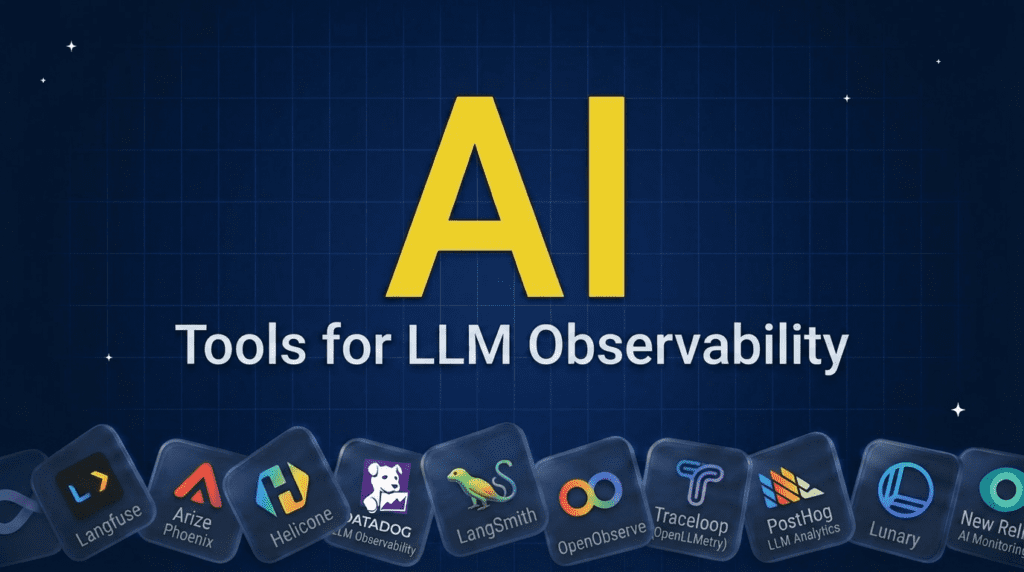
Best LLM observability tools at a glance
Here is the quick comparison, leaning toward production monitoring rather than quality scoring. For measuring output quality, pair these with our best LLM evaluation tools guide, which is the companion to this one.| Tool | Type | Focus | Self-host | Best for |
|---|---|---|---|---|
| Langfuse | Open-source (MIT) | Tracing + cost dashboards | Yes | Default open-source platform |
| Arize Phoenix | Open-source | Span tracing, RAG/agent debug | Yes | Deep trace debugging |
| Helicone | Open-source | Proxy/gateway, cost tracking | Yes | Fastest setup, no SDK |
| Datadog LLM Observability | Commercial | LLM spans + infra APM | SaaS | Enterprise unified monitoring |
| LangSmith | Commercial | Execution-tree traces | Enterprise | Agent debugging, LangChain stacks |
| OpenObserve | Open-source (AGPL) | Unified infra + LLM telemetry | Yes | High volume, low storage cost |
| Traceloop (OpenLLMetry) | Open-source | OpenTelemetry instrumentation | Yes | Vendor-neutral, any backend |
| PostHog LLM Analytics | Open-source (MIT) | LLM + product analytics | Yes | Correlating LLM and user behavior |
| Lunary | Open-source | Lightweight tracing + cost | Yes | Quick setup, per-user cost |
| New Relic AI Monitoring | Commercial | AI telemetry in APM | SaaS | Teams already on New Relic |
What is LLM observability?
LLM observability is the practice of monitoring a language-model application in production so you can see what it is doing and fix it when it breaks. It rests on the same three pillars as traditional observability, logs, traces, and metrics, adapted for AI: traces capture every step of a request, including each model call, tool use, and retrieval; metrics track latency, token usage, cost, and error rates; and logs record the prompts and responses. Unlike a simple dashboard, good observability lets you follow a single user request through a multi-step agent and find exactly where it went wrong.Observability vs evaluation, and how they work together
These two get conflated, but they answer different questions. Observability tells you what happened: which steps ran, how long they took, what they cost, and where an error occurred. Evaluation tells you whether the output was good: was the answer faithful, relevant, and safe. You need both, and they connect, you use observability to capture real production traces, then run evaluation on a sample of them to score quality. This guide focuses on the monitoring side; for scoring output quality, see our best LLM evaluation tools guide, and note that several tools here do both.What to look for in an LLM observability tool
The features that matter for production monitoring are trace granularity, so you can see every span in a multi-step agent; cost and token tracking, ideally attributed per user or session; latency metrics including time to first token and p95; error and failure tracking with alerting to Slack or PagerDuty; OpenTelemetry support so you are not locked to one vendor; and a deployment model that fits your needs, whether self-hosted for data control or SaaS for convenience. Weigh these against how much instrumentation work each tool requires.The 10 best LLM observability tools in 2026
1. Langfuse
Langfuse is the most widely adopted open-source LLM observability platform and the sensible default. It captures detailed traces of every request, tracks token cost and latency, manages prompts, and is OpenTelemetry-native, and it self-hosts easily with Docker so your data stays in your environment. It covers the full lifecycle without locking you into a vendor.- Best for: the default open-source observability platform.
- Type: open-source (MIT); self-host or cloud.
- Pros: full tracing, cost and latency dashboards, prompt management, OTel-native, easy self-host.
- Cons: native quality alerting is limited; you run the infrastructure if self-hosting.
- Best for: most teams. Skip if: you want a fully managed APM with built-in alerting.
2. Arize Phoenix
Phoenix, from Arize, is built for debugging, with span-level tracing that shows exactly what an agent or RAG pipeline did at each step, plus real-time dashboards for latency, error rates, and token use. It is based on the open OpenInference standard, runs in a notebook or as a service, and adds hallucination and embedding-drift detection.- Best for: deep agent and RAG trace debugging.
- Type: open-source; self-host.
- Pros: granular span tracing, real-time dashboards, OpenInference/OTel, drift detection.
- Cons: notebook-first workflow; less of an all-in-one platform.
- Best for: debugging pipelines. Skip if: you want a turnkey hosted dashboard.
3. Helicone
Helicone is the fastest way to add observability because it works as a proxy: you change your API base URL and it logs every request, with no SDK to integrate. It tracks cost per user and per session across hundreds of models, and adds caching and failover as an AI gateway, which makes it a practical first step for cost visibility.- Best for: the fastest setup and per-user cost tracking.
- Type: open-source; self-host or cloud.
- Pros: one-line proxy setup, per-user and per-session cost, caching and failover, many models.
- Cons: proxy approach captures less deep agent context than SDK tracing.
- Best for: quick cost visibility. Skip if: you need detailed multi-step agent traces.
4. Datadog LLM Observability
Datadog extends its mature APM platform to LLMs, correlating model spans with the rest of your infrastructure so you see the whole system in one place. It auto-instruments applications, offers an agentless mode, and brings the strongest alerting here, with anomaly and threshold alerts wired to PagerDuty and Slack, plus security scanning for prompt injection.- Best for: enterprises wanting unified infrastructure and LLM monitoring.
- Type: commercial (SaaS).
- Pros: LLM spans tied to infra APM, mature alerting, auto-instrumentation, security scanning.
- Cons: commercial pricing per request; no built-in quality evaluation.
- Best for: existing Datadog users. Skip if: you want an open-source tool.
5. LangSmith
LangSmith, from the LangChain team, gives full execution-tree traces of an agent run, with step-level cost and latency, and it works whether or not you use LangChain, though the integration is deepest there. It supports online monitoring and annotation queues, which makes it a strong choice for debugging complex agent behavior.- Best for: agent debugging, especially in LangChain and LangGraph stacks.
- Type: commercial (self-host on enterprise).
- Pros: detailed execution traces, step-level cost and latency, annotation queues, framework-agnostic.
- Cons: managed pricing; most valuable inside the LangChain ecosystem.
- Best for: LangChain users. Skip if: you want a fully open-source platform.
6. OpenObserve
OpenObserve unifies infrastructure and LLM telemetry in one OpenTelemetry-native platform, so you monitor your models and your servers together. It runs as a single binary, lets you query data with SQL, alerts on token, latency, and error thresholds, and is designed for low storage cost, which matters when you log high volumes of traces.- Best for: unified infra and LLM telemetry at high volume.
- Type: open-source (AGPL); self-host.
- Pros: infra plus LLM in one place, OTel-native, SQL queries, low storage cost, real-time alerting.
- Cons: more of a general observability platform than an LLM-specialist; AGPL license.
- Best for: high-volume teams. Skip if: you want LLM-specific features out of the box.
7. Traceloop (OpenLLMetry)
Traceloop’s OpenLLMetry is an open-source instrumentation library built purely on OpenTelemetry, so it captures LLM traces with a single line of setup and ships them to whatever backend you already use. It has the widest provider and framework coverage, which makes it the vendor-neutral way to instrument without committing to one platform.- Best for: vendor-neutral OpenTelemetry instrumentation.
- Type: open-source (Apache 2.0).
- Pros: single-line setup, widest provider coverage, ships to any OTel backend, no lock-in.
- Cons: instrumentation only, so you need a separate backend to store and view data.
- Best for: OTel-standard teams. Skip if: you want an all-in-one dashboard.
8. PostHog LLM Analytics
PostHog brings LLM observability into a product-analytics platform, so you can correlate model behavior with user behavior. Alongside traces and cost tracking, you get session replay for AI features, funnels, and A/B testing of prompts, which suits product teams that want to see how LLM quality affects retention and conversion, not just system metrics.- Best for: correlating LLM behavior with product and user analytics.
- Type: open-source (MIT); self-host or cloud.
- Pros: LLM plus product analytics, session replay, funnels, prompt A/B testing.
- Cons: less specialized on deep agent tracing than dedicated tools.
- Best for: product-led teams. Skip if: you only need engineering-grade traces.
9. Lunary
Lunary is a lightweight open-source observability tool that gets you tracing and cost tracking in minutes, with good support for JavaScript runtimes and per-user cost attribution. It suits chatbots and RAG apps where you want visibility quickly without standing up a heavy platform.- Best for: quick, lightweight tracing with per-user cost.
- Type: open-source; self-host or cloud.
- Pros: very fast setup, per-user cost, JavaScript-friendly, auto-categorization of usage.
- Cons: fewer advanced features than the larger platforms.
- Best for: chatbots and small teams. Skip if: you need enterprise alerting and infra correlation.
10. New Relic AI Monitoring
New Relic extends its established APM with AI monitoring, surfacing latency, throughput, token use, and cost inside the same platform teams already use for application performance. For organizations standardized on New Relic, it adds LLM visibility without introducing a new tool or vendor.- Best for: teams already standardized on New Relic.
- Type: commercial (SaaS).
- Pros: AI telemetry inside existing APM, enterprise alerting, no new vendor.
- Cons: consumption-based pricing; no built-in quality evaluation.
- Best for: New Relic shops. Skip if: you want an LLM-native or open-source tool.
Tracing multi-step agents and RAG pipelines
The reason observability matters more for LLMs than for ordinary software is that a single request fans out into many steps. An agent might call a model, decide to use a tool, retrieve documents, call the model again, and only then answer, and a failure at any step compounds into a bad result. A trace captures this as a tree of spans, one per step, so you can see which retrieval returned the wrong document or which tool call failed. Tools like Phoenix, Langfuse, and LangSmith are built around this span-level view, which is what makes debugging an agent tractable rather than guesswork.Monitoring token cost and latency
Two production metrics decide whether an LLM feature is viable: cost and speed. Token cost can balloon silently as usage grows or prompts get longer, so attributing dollars per request, per user, and per session is essential, which Helicone, Lunary, and Langfuse do well. Latency shapes the user experience, so track time to first token and the p95 latency, not just the average, since the slow tail is what users notice. Set budgets and watch these trends, because a small prompt change can move both cost and latency more than you expect.Error tracking, drift, and alerting
Catching problems quickly depends on monitoring failures and being alerted. Track error and timeout rates, failed tool calls, and quality drift, the slow degradation that happens when a provider silently updates a model or your data changes. The strongest alerting here comes from Datadog and New Relic, which fire on anomaly and threshold rules into PagerDuty or Slack, while OpenObserve offers real-time alerts on token, latency, and error thresholds. Decide which conditions should page someone before a small issue becomes an outage.OpenTelemetry for LLMs
OpenTelemetry (OTel) is the vendor-neutral standard for collecting traces and metrics, and it increasingly underpins LLM observability through extensions like OpenInference and OpenLLMetry. Instrumenting with OTel means you can send the same telemetry to any compatible backend and switch tools later without re-instrumenting, which avoids lock-in. Langfuse, Phoenix, OpenObserve, and Traceloop are OTel-native, so if long-term flexibility matters, favor a tool that speaks the standard.How to instrument your LLM app
There are three common ways to add observability, in rising order of depth. The simplest is a proxy or gateway like Helicone, where you change your API base URL and capture every request with no code changes. The next is an SDK or callback integration, where you add a tracing library to your app for richer, step-level context. The deepest and most portable is OpenTelemetry auto-instrumentation, using a library like OpenLLMetry to emit standard traces to any backend. Start with a proxy for quick cost visibility, then move to SDK or OTel instrumentation as you need detailed traces.Production debugging workflow
Observability pays off in a repeatable debugging loop. An alert fires on a spike in errors or latency, you open the affected traces and find the failing span, whether it was a slow tool call, a bad retrieval, or a malformed model response, you reproduce it from the captured prompt and context, then you fix it and add an evaluation case so the same regression is caught automatically next time. This loop, from alert to trace to root cause to regression test, is what turns observability from passive dashboards into faster, more reliable releases.How to choose the right tool
Match the tool to your stack and biggest pain point. If you want one open-source platform, Langfuse is the default; for the deepest agent and RAG debugging, choose Phoenix; for the fastest cost visibility, Helicone; and if you are already on Datadog or New Relic, extend what you have. Teams that value vendor neutrality should instrument with OpenTelemetry through Traceloop, and product-focused teams get extra value from PostHog. Decide between self-host and SaaS based on data residency and how much infrastructure you want to run.The bottom line on LLM observability tools
The best LLM observability tool depends on your stack and what you most need to see. Langfuse is the strongest open-source default, Phoenix is best for debugging agent and RAG traces, Helicone is the quickest to set up, and Datadog or New Relic fit enterprises wanting LLM monitoring inside existing APM. Track cost and latency from day one, favor OpenTelemetry to avoid lock-in, and pair observability with evaluation so you catch both system failures and quality drops.Related Blogs
Frequently asked questions
LLM observability is monitoring a language-model application in production so you can see what it did and fix problems. It uses traces of each step, metrics like latency, token cost, and error rates, and logs of prompts and responses, which together let you follow a single request through a multi-step agent.
Observability tells you what happened, which steps ran, how long they took, and what they cost, while evaluation tells you whether the output was good, such as faithful and relevant. You need both: observability captures real production traces, and evaluation scores a sample of them for quality.
Langfuse is the most popular open-source choice, with Arize Phoenix best for trace debugging, Helicone for fast cost tracking, and OpenObserve for unified infra and LLM telemetry. All are free to self-host.
Yes. Most track token usage and latency, and tools like Helicone, Lunary, and Langfuse attribute cost per request, per user, and per session. Track time to first token and p95 latency, not just the average, since the slow tail is what users feel.
Instrument the app with a proxy, an SDK, or OpenTelemetry to capture traces, then watch cost, latency, and error rates on a dashboard and set alerts on the thresholds that matter. When an alert fires, open the trace, find the failing step, and fix it.
OpenTelemetry is the vendor-neutral standard for collecting traces and metrics, extended for LLMs through OpenInference and OpenLLMetry. Instrumenting with it lets you send telemetry to any compatible backend and change tools later without re-instrumenting, which avoids lock-in.
Yes. Langfuse, Arize Phoenix, OpenObserve, Lunary, Helicone, and PostHog can all be self-hosted, which keeps your data in your environment for privacy and compliance. Commercial tools like Datadog and New Relic are SaaS, though LangSmith offers self-hosting on enterprise plans.
Use a tool that captures span-level traces, such as Phoenix, Langfuse, or LangSmith, which record each model call, tool use, and retrieval as a tree of spans. That lets you see exactly which step failed, like a wrong retrieval or a bad tool call, instead of guessing.

Inside AI Media is a global platform that covers what’s happening in AI without the fluff. From breaking news to practical use cases, it keeps professionals, builders, and decision-makers updated on the latest in artificial intelligence, so they can make better, faster decisions and stay ahead.