TL;DR: What You Need to Know
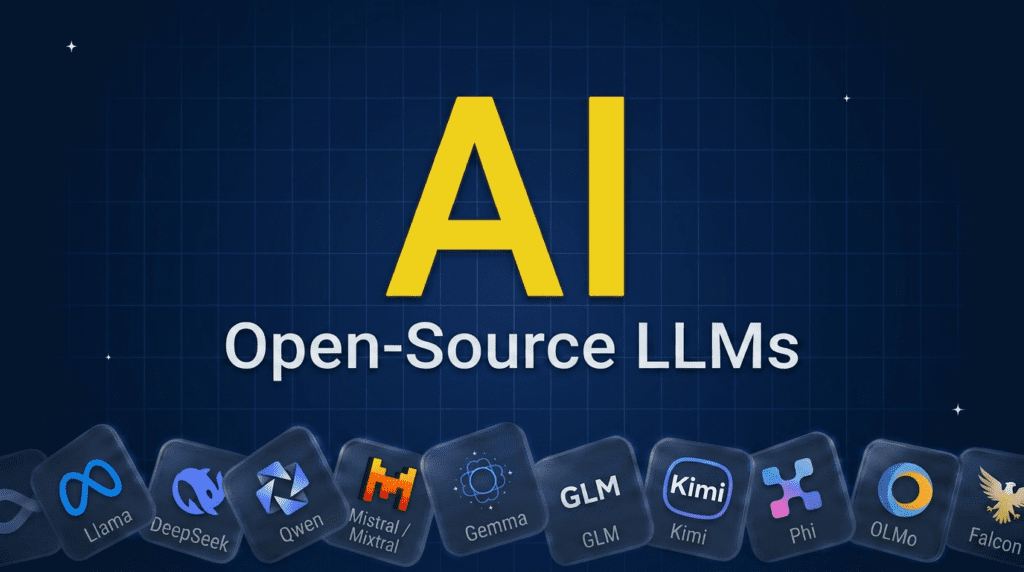
Meta’s Llama family is still the most popular open model and the safest default for general use and fine-tuning, but it is not the only strong option anymore. DeepSeek leads on reasoning and math at a low cost, Qwen from Alibaba is the most versatile for coding and multilingual work, and Mistral is the efficient European choice. If you need to run a model on a single GPU or a laptop, Google’s Gemma and Microsoft’s Phi are the small models to look at. One thing to get straight before you choose: most “open-source” LLMs are actually open-weight, meaning you can download and run the weights but the training data and full license freedoms vary. Truly open models like AI2’s OLMo release the data and code too. This guide ranks 10 open models, explains the licensing you need to check before commercial use, and covers how to actually run them.Pricing verified June 2026. AI tool pricing changes often, so confirm the current price on each vendor’s site before you subscribe. Inside AI Media is not an AI tool vendor; these picks are ranked on merit, not promotion.
Best open-source LLMs at a glance
Here is the quick comparison, including the license type that decides whether you can use a model commercially. To store and search the embeddings these models produce, pair them with one of our best vector databases.| Model | Developer | License type | Sizes | Best for |
|---|---|---|---|---|
| Llama | Meta | Open-weight (community license) | ~1B to 405B+ | General use, fine-tuning, ecosystem |
| DeepSeek | DeepSeek | Open-source (MIT) | Large MoE + distilled small | Reasoning and math, low cost |
| Qwen | Alibaba Cloud | Open-source (Apache 2.0) | ~0.5B to 235B | Coding, multilingual, vision |
| Mistral / Mixtral | Mistral AI | Open-source (Apache 2.0, open models) | 7B to 100B+ | Efficient MoE, European data needs |
| Gemma | Google DeepMind | Open-weight (Gemma terms) | Sub-1B to 27B | Small, on-device, single GPU |
| GLM | Zhipu AI (Z.ai) | Open-source (MIT weights) | Large MoE | Coding and agentic tasks |
| Kimi | Moonshot AI | Open-weight (modified MIT) | Very large MoE | Agentic workflows, long context |
| Phi | Microsoft | Open-source (MIT) | A few billion params | Best small model for its size |
| OLMo | Allen Institute (AI2) | Fully open (Apache 2.0 + data) | 1B to 32B | True open source, research |
| Falcon | TII | Open (Apache 2.0) | Small to very large | Permissive licensing, scale |
Open-source vs open-weight: what “open” really means
The labels get used loosely, and the difference matters for your legal and practical freedom. A truly open-source model releases the weights, the training code, and the training data under a permissive license, which lets anyone study, reproduce, and build on it freely. An open-weight model releases only the downloadable weights, often under a custom license with restrictions on commercial scale or use. Most well-known “open” models, including Llama and Gemma, are open-weight rather than fully open. Genuinely open models like OLMo are rarer. When licensing or reproducibility matters, check which category a model falls into before you commit.How we picked these models
We judged each model on real-world usefulness rather than a single leaderboard score: general capability, strength in coding and reasoning, multilingual support, the range of sizes available so you can match a model to your hardware, and how permissive the license is for commercial use. Because this space moves quickly, we focused on model families with active development and a strong track record rather than one-off releases, and we describe each at the family level since specific versions change often.The 10 best open-source LLMs in 2026
1. Llama (Meta)
Llama is the model that made open weights mainstream, and it remains the default starting point for most teams. It ships in a wide range of sizes, has the largest ecosystem of tools, tutorials, and fine-tuned variants, and the latest generation added multimodal capability and longer context. The trade-off is its license, which is open-weight rather than fully open and carries some conditions.- Best for: a general-purpose default with the biggest ecosystem and fine-tuning support.
- Developer: Meta.
- License: open-weight under the Llama community license, with some restrictions.
- Pros: huge ecosystem, wide size range, strong fine-tuning support, well documented.
- Cons: not fully open source; license terms need checking for large-scale commercial use.
- Best for: most teams. Skip if: you need a fully permissive open-source license.
2. DeepSeek
DeepSeek changed the conversation by matching frontier reasoning at a fraction of the cost. Its mixture-of-experts design activates only part of the model per query, which keeps inference efficient, and its reasoning-focused releases handle math and step-by-step problems well. The weights are released under the permissive MIT license, which makes it attractive for commercial use.- Best for: reasoning, math, and cost-efficient frontier performance.
- Developer: DeepSeek.
- License: open-source (MIT) for its main recent releases.
- Pros: strong reasoning, efficient MoE, permissive license, distilled smaller versions available.
- Cons: the largest models need serious hardware; some older releases used a custom license.
- Best for: reasoning workloads. Skip if: you want a tiny model for a laptop.
3. Qwen (Alibaba)
Qwen is the most versatile open family, with the widest range of sizes and strong results in coding, math, and especially multilingual tasks. It includes dedicated coding and vision variants, supports very long context in its larger releases, and most versions ship under Apache 2.0, which is about as permissive as licensing gets.- Best for: coding, multilingual work, and vision, across many model sizes.
- Developer: Alibaba Cloud.
- License: open-source (Apache 2.0) for most variants.
- Pros: very wide size range, strong coding and multilingual, vision variants, permissive license.
- Cons: so many variants it takes effort to pick the right one.
- Best for: coding and global apps. Skip if: you want a single simple choice.
4. Mistral / Mixtral
Mistral, from France, built its name on efficiency, releasing small dense models and Mixtral mixture-of-experts models that punch above their size. It is a strong choice for teams that want capable open models with European data governance, and its open releases use Apache 2.0, though some of its larger commercial models are not open.- Best for: efficient open models and European data sovereignty.
- Developer: Mistral AI.
- License: open-source (Apache 2.0) for its open models; some larger models are not open.
- Pros: efficient, strong multilingual, permissive open releases, EU-based.
- Cons: the most capable Mistral models are commercial and not open-licensed.
- Best for: efficient deployments. Skip if: you need the absolute top reasoning scores.
5. Gemma (Google)
Gemma is Google’s family of small open models built to run on modest hardware, from sub-billion-parameter versions for on-device use up to a 27B model that fits on a single consumer GPU. Larger variants add vision and broad multilingual support. It is open-weight under Google’s Gemma terms rather than a standard open-source license, so check the conditions for your use.- Best for: small, on-device, and single-GPU deployments.
- Developer: Google DeepMind.
- License: open-weight under the Gemma Terms of Use.
- Pros: efficient small models, runs on consumer hardware, vision in larger sizes, broad language support.
- Cons: open-weight rather than fully open; license has its own terms.
- Best for: edge and laptops. Skip if: you need the largest frontier model.
6. GLM (Zhipu AI)
GLM, from Zhipu AI, has become one of the stronger open families for coding and agentic tasks, with large mixture-of-experts releases that handle long, multi-step work and produce long outputs. Its weights are released under the permissive MIT license, which makes it a serious option for developers building agents on open infrastructure.- Best for: coding and long-horizon agentic tasks.
- Developer: Zhipu AI (Z.ai).
- License: open-source (MIT) for the weights.
- Pros: strong coding, agentic capability, long context and output, permissive license.
- Cons: the large models are demanding to self-host.
- Best for: agent builders. Skip if: you want a small, light model.
7. Kimi (Moonshot AI)
Kimi, from Moonshot AI, is built for agentic workflows, with very large mixture-of-experts models, long context windows, and the ability to chain many tool calls in a single run. It suits complex automation and visual-to-code tasks, and it is released as open-weight under a modified MIT license that adds conditions for very large-scale commercial use.- Best for: agentic workflows, long tool-call chains, and long context.
- Developer: Moonshot AI.
- License: open-weight (modified MIT, with scale-based conditions).
- Pros: strong agentic capability, very long context, multimodal options.
- Cons: huge models need heavy hardware; license adds conditions at large scale.
- Best for: automation and agents. Skip if: you want a simple chatbot on a budget.
8. Phi (Microsoft)
Microsoft’s Phi family proves that small models trained on high-quality data can outperform much larger ones for their size. At a few billion parameters, Phi models run cheaply on modest hardware while handling reasoning and coding surprisingly well, and they ship under the permissive MIT license. They are the small-model pick when you want capability without a big GPU.- Best for: the best capability-to-size ratio in a small model.
- Developer: Microsoft.
- License: open-source (MIT).
- Pros: strong for its size, cheap to run, permissive license, good on edge devices.
- Cons: smaller models trail the large ones on hard tasks; mainly English-focused.
- Best for: edge and budget inference. Skip if: you need frontier-level reasoning.
9. OLMo (Allen Institute for AI)
OLMo is the model to choose when “open” has to mean genuinely open. The Allen Institute releases not just the weights but the training data, code, and full documentation under a permissive license, which makes it uniquely reproducible and the cleanest choice for research and for organizations that need to audit what a model was trained on. It is smaller and less flashy than the frontier MoEs, but it is the real open-source option.- Best for: truly open source, reproducibility, and research.
- Developer: Allen Institute for AI (AI2).
- License: fully open (Apache 2.0) including training data and code.
- Pros: weights, data, and code all open; fully reproducible; clean licensing.
- Cons: not as capable as the largest frontier open models.
- Best for: research and auditing. Skip if: you only care about top benchmark scores.
10. Falcon (TII)
Falcon, from the Technology Innovation Institute in Abu Dhabi, was one of the early permissively-licensed open families and remains a solid, scalable option. It offers a range of sizes under open licensing, which makes it a dependable pick for teams that want a capable model without restrictive terms, especially outside the US-and-China model ecosystem.- Best for: permissively-licensed open models across a range of sizes.
- Developer: Technology Innovation Institute (TII).
- License: open (Apache 2.0 for its main releases).
- Pros: permissive licensing, range of sizes, established and stable.
- Cons: smaller community and ecosystem than Llama or Qwen.
- Best for: permissive deployments. Skip if: you want the biggest ecosystem.
Best open-source LLM by use case
| Use case | Best picks |
|---|---|
| General-purpose default | Llama, Qwen |
| Reasoning and math | DeepSeek, GLM |
| Coding | Qwen, GLM, DeepSeek |
| Multilingual | Qwen, Mistral, Gemma |
| Small / on-device | Gemma, Phi |
| Agentic workflows | Kimi, GLM |
| Truly open / research | OLMo, Falcon |
| Fine-tuning | Llama, Qwen, Mistral |
Can open-source LLMs beat GPT and Claude?
On specific tasks, yes. The best open models now match or beat the leading closed models on individual benchmarks for coding, math, and reasoning, and the gap on general capability has narrowed to a small margin rather than the chasm it once was. Where closed models like GPT and Claude still tend to lead is in the most demanding reasoning and the polish of the overall product. For most real applications, a strong open model is good enough, and it brings advantages closed models cannot: you can self-host it, keep your data private, fine-tune it, and avoid per-token API costs.How to run open-source LLMs
You have three practical paths. To run a model on your own machine, tools like Ollama and LM Studio let you download and run smaller models locally with a few clicks, which is ideal for privacy and experimentation. To use a large model without owning GPUs, an inference provider hosts it and bills per token, which is the fastest route to production. To run at scale on your own hardware, you self-host with serving frameworks like vLLM on data-center GPUs, which gives the most control and the lowest cost at high volume. Match the path to your priorities around privacy, scale, and budget, and see our best AI tools for deployment guide for serving options.Hardware and VRAM requirements
Model size drives the hardware you need, and quantization changes the math. As a rough guide, a small model of a few billion parameters runs on a laptop or a consumer GPU, a mid-size model around 7B to 13B fits on a single modern GPU, and a 70B model needs a high-end data-center GPU or two. The largest mixture-of-experts models with hundreds of billions of parameters require multiple data-center GPUs. Quantization to lower precision, such as INT4, cuts memory needs substantially and lets bigger models fit on smaller hardware with a modest quality trade-off. If you are GPU-constrained, start with a smaller model or a quantized version before scaling up. For fine-tuning these models on your own data, our best tools for LLM fine-tuning guide covers the workflow.Licensing and commercial use
Before you build a business on an open model, read its license. Apache 2.0 and MIT, used by Qwen, Mistral’s open models, DeepSeek, GLM, Phi, OLMo, and Falcon, are the most permissive and allow commercial use with few conditions. Llama’s community license and Google’s Gemma terms allow commercial use but add their own conditions, including some restrictions at very large scale. A few releases, such as certain larger Mistral models, are not open-licensed at all. The safe approach is to confirm the exact license of the specific version you plan to deploy, since terms can differ between a model family’s variants.The bottom line on open-source LLMs
The best open-source LLM depends on your job and your hardware. Llama is the safe general default with the biggest ecosystem, DeepSeek leads on reasoning at low cost, Qwen is the most versatile for coding and multilingual work, and Gemma or Phi are the picks for small and on-device use. If genuine openness matters, OLMo is the one that releases data and code, not just weights. Check the license of the exact version you deploy, choose a way to run it that fits your privacy and budget needs, and start with a smaller model before scaling to the large mixture-of-experts releases.Related Blogs
Frequently asked questions
Yes, but they are rarer than the label suggests. Most “open” models, including Llama and Gemma, are open-weight, meaning the weights are downloadable but the data and license freedoms vary. Truly open models like AI2’s OLMo release the weights, training data, and code under a permissive license.
Yes. The best open models now match or beat leading closed models on many coding, math, and reasoning benchmarks, and the overall gap is small. For most applications they are good enough, with the added benefits of self-hosting, data privacy, and no per-token API fees.
On specific tasks, several open models rival or beat GPT and Claude, especially in coding and math. Closed models still tend to lead on the hardest reasoning and overall polish, but a strong open model like DeepSeek, Qwen, or Llama is competitive for most real-world use.
Open-weight models are free to download and run yourself, so Llama, Qwen, DeepSeek, Mistral, Gemma, and Phi are all effectively free if you have the hardware or use a free inference tier. Tools like Ollama and LM Studio let you run smaller ones free on your own computer.
Open-source means the weights, training code, and data are all released under a permissive license, allowing full reproduction. Open-weight means only the weights are released, often under a custom license with restrictions. Most well-known open models are open-weight, while OLMo is an example of a fully open one.
Qwen, GLM, and DeepSeek are the strongest open models for coding, with dedicated coding variants and high scores on software-engineering benchmarks. For a smaller, cheaper coding model, a Qwen Coder variant is a good place to start.
Yes. Small models of a few billion parameters run on a laptop or consumer GPU using Ollama or LM Studio, mid-size models need a single modern GPU, and large models need data-center GPUs. Quantization to INT4 lowers the memory needed so bigger models fit on smaller hardware.
Usually yes, but check the license. Apache 2.0 and MIT models like Qwen, DeepSeek, Mistral’s open releases, Phi, and OLMo allow commercial use with few conditions, while Llama and Gemma allow it under their own terms with some restrictions at large scale. Always confirm the license of the exact version you deploy.

Inside AI Media is a global platform that covers what’s happening in AI without the fluff. From breaking news to practical use cases, it keeps professionals, builders, and decision-makers updated on the latest in artificial intelligence, so they can make better, faster decisions and stay ahead.