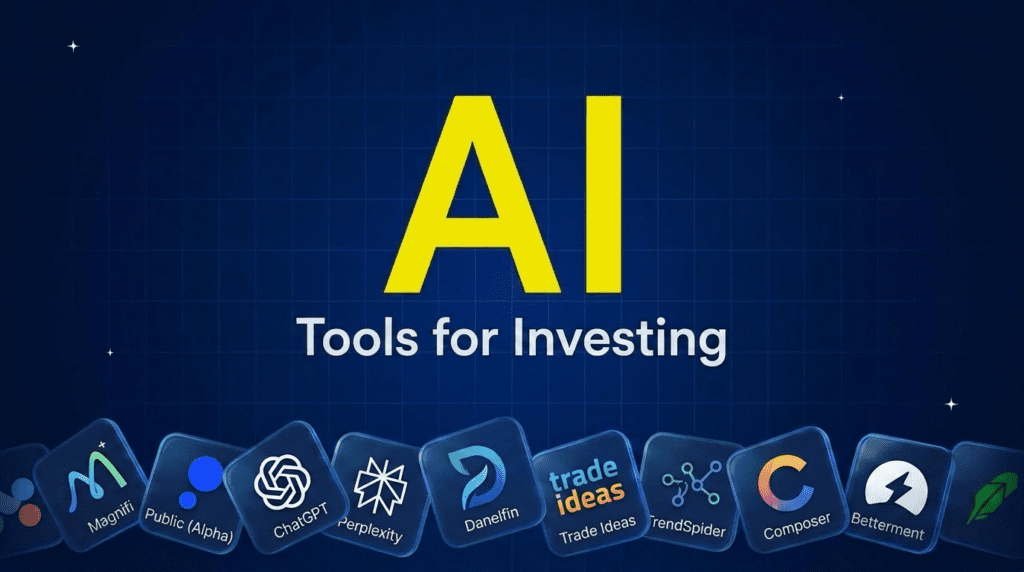
TL;DR: What You Need to Know
AI will not pick winning stocks for you, but it is genuinely useful for research, screening, and automating a strategy you already understand. For an AI investing assistant that explains markets in plain English, Magnifi and Public’s Alpha lead. For AI stock ratings and analysis, Danelfin and Trade Ideas are the go-tos. To automate a rules-based strategy without code, Composer is the standout, and robo-advisors like Betterment handle hands-off investing. Treat all of them as research aids, not advice, and never invest on an AI’s say-so alone.Important: This article is for general information only and is not financial advice. AI tools assist with research; they do not guarantee returns, and investing carries risk, including the possible loss of your money. Past performance does not predict future results. Always do your own research and consider speaking to a licensed financial advisor before investing.
Pricing verified June 2026. AI tool pricing changes often, so confirm the current price on each vendor’s site before you subscribe. Inside AI Media is not an AI tool vendor; these picks are ranked on merit, not promotion.
The best AI tools for investing at a glance
Here is how the main tools compare on the job they do, the type of investor they suit, the free option, and where paid plans start. Pricing and features change often, so confirm on the provider’s site before subscribing.| Tool | Best for | Type | Free option | Starting price |
|---|---|---|---|---|
| Magnifi | AI investing assistant | Research | Trial | $11/mo |
| Public (Alpha) | Research inside a brokerage | Research | Yes | Free / paid |
| ChatGPT / Perplexity | Explaining and summarizing | Research | Yes | $20/mo |
| Danelfin | Explainable AI stock ratings | Analysis | Limited | $21/mo |
| Trade Ideas | AI stock scanning for traders | Analysis | $89/mo | $84/mo |
| TrendSpider | Automated technical analysis | Analysis | Trial | $23/mo |
| Composer | No-code automated strategies | Automation | Trial | $30/mo |
| Betterment | Hands-off robo-investing | Robo-advisor | 0.25%/yr | 0.25%/yr |
What does “AI for investing” actually mean?
Two very different things get called AI investing. The first, and what this guide covers, is using AI tools to help you invest: researching companies, screening stocks, summarizing earnings and sentiment, and automating a strategy you set. The second is investing in AI itself, meaning buying AI-related stocks or funds, which is a different topic. On the tools side, it helps to be clear about what AI can and cannot do. It is good at processing huge amounts of data fast, spotting patterns, and explaining things in plain language. It cannot predict the market, and any tool promising guaranteed returns should be treated as a red flag. Used well, AI makes you a faster, better-informed investor. It does not make the decisions for you.How we picked
We are an independent publisher, we do not sell an investing product, and nothing here is a recommendation to buy any security or tool. We weighed each tool on what it genuinely does for an individual investor, transparency about how its AI works, ease of use, the free option, and value, and we favored tools that support your own decisions over ones that promise to make them for you. Anything claiming guaranteed profits was left off on principle.Best AI investing assistants and research tools
These help you research and understand investments in plain language.1. Magnifi, best AI investing assistant
Magnifi is an AI investing assistant you can talk to like a knowledgeable friend, asking it to compare funds, explain a stock, or find investments matching a theme, and getting clear answers with the data behind them. It is built to help everyday investors research and understand options rather than chase hot tips, which makes it a sensible first AI tool.- Best for: Conversational research and comparing investments.
- Pricing: Trial; paid from around $11/mo.
- Skip if: you want automated trading rather than research.
2. Public with Alpha, best research inside a brokerage
Public is an investing app with a built-in AI assistant, Alpha, that answers questions about your holdings and the market in context, explaining why a stock moved or what an earnings report means while you invest in the same place. Having research and a real brokerage together is convenient, though as always you make the final call.- Best for: Investors who want AI research where they actually trade.
- Pricing: Core app free; Premium (includes the Alpha AI assistant) $10/mo; free for accounts with $50,000+.
- Skip if: you prefer to keep research and brokerage separate.
3. ChatGPT and Perplexity, best for explaining and summarizing
General assistants are surprisingly useful for investing research: explaining concepts, summarizing a long earnings call, or comparing two companies in seconds. Perplexity cites its sources, which matters for finance, and ChatGPT is great for plain-English explanations. Verify anything important against primary sources, since both can be wrong or out of date.- Best for: Explaining concepts and summarizing research.
- Pricing: Free tiers; paid around $20/mo.
- Skip if: you need real-time market data and screening.
Best AI tools for stock analysis and screening
These rate, scan, and analyze stocks to narrow down where to look.4. Danelfin, best for explainable AI stock ratings
Danelfin scores stocks with an AI Score from 1 to 10 based on thousands of indicators, and importantly it shows the factors behind each rating rather than acting as a black box. That transparency makes it a useful screening tool for finding ideas to research further, as long as you treat the score as a starting point, not a buy signal.- Best for: Transparent AI ratings to surface ideas to research.
- Pricing: Limited free use; paid from around $21/mo.
- Skip if: you want a full trading or automation platform.
5. Trade Ideas, best AI scanning for active traders
Trade Ideas is aimed at active traders, with an AI engine, Holly, that scans the market for setups matching historical patterns and surfaces real-time opportunities. It is powerful and priced for serious traders, not casual investors, and like any trading tool it carries real risk, so paper-trade its ideas before risking money.- Best for: Active day and swing traders wanting AI scans.
- Pricing: Free (limited); TI Basic $89/mo ($1,068/yr); TI Premium $178/mo ($2,136/yr, adds AI signals and backtesting).
- Skip if: you are a long-term or hands-off investor.
6. TrendSpider, best for automated technical analysis
TrendSpider automates technical analysis, detecting trendlines and patterns, backtesting strategies, and setting alerts so chart work that took hours happens in seconds. It suits more technical investors who trade on charts and want to test ideas with data before acting on them.- Best for: Technical traders automating charts and backtesting.
- Pricing: Trial; paid from around $23/mo.
- Skip if: you do not use technical analysis.
Best AI tools for automated and hands-off investing
These act on a strategy for you, within rules you set or a portfolio they manage.7. Composer, best for no-code automated strategies
Composer lets you build, backtest, and run automated investing strategies without code, turning a set of rules, like rotating between assets on certain signals, into a portfolio that rebalances automatically. It makes algorithmic investing approachable, but you should fully understand a strategy and its risks before putting real money behind it.- Best for: Building and automating rules-based strategies, no code.
- Pricing: Trial; paid from around $30/mo.
- Skip if: you want a human-managed or fully passive portfolio.
8. Betterment, best robo-advisor for hands-off investing
Betterment is a leading robo-advisor that builds and manages a diversified portfolio for you based on your goals and risk tolerance, automatically rebalancing and optimizing for tax. It is the most hands-off option here, ideal for people who want sensible, automated investing without picking anything themselves. Wealthfront is a close, comparable alternative.- Best for: Hands-off, automated, diversified investing.
- Pricing: Self-directed investing free; automated investing 0.25%/yr (AUM) with a flat monthly fee option for small balances; Premium 0.65%/yr ($100,000 minimum).
- Skip if: you want to choose your own investments.
How to use AI for investing safely
Use AI to inform your decisions, not make them. Treat every AI rating, scan, or suggestion as one input to research further, and verify important facts against primary sources like company filings, because AI tools can be confidently wrong. Be deeply skeptical of any product promising guaranteed returns, “secret” algorithms, or risk-free profits, as these are classic hallmarks of investment scams, and AI has made such pitches more convincing. Never invest money you cannot afford to lose, understand any strategy before automating it, and remember that a licensed human advisor is still the right call for major financial decisions.Frequently asked questions
Yes, several. Magnifi and Public’s Alpha act as AI investing assistants, Danelfin and Trade Ideas analyze and rate stocks, and Composer automates strategies. They help you research, screen, and automate, but they assist your decisions rather than make them, and none can reliably predict the market.
It can be, as a research and efficiency tool. AI is excellent at processing data, screening, and explaining concepts, which makes a diligent investor faster and better informed. It becomes a bad idea when people treat its output as a guaranteed prediction or hand over decisions entirely, so use it to support your own judgment.
Not reliably. AI can surface ideas and analyze data well, but markets are unpredictable and no tool can consistently beat them. Be very wary of any product claiming it can. Use AI ratings and scans as a starting point for your own research, not as a crystal ball.
Yes, with limits. ChatGPT and Perplexity have free tiers useful for research, Public is free to use, and tools like Danelfin offer limited free access. The more specialized analysis and automation platforms are mostly paid, since they rely on real-time data and advanced models.
The established ones are legitimate tools, but the space also attracts scams. Stick to well-known, regulated providers, never trust promises of guaranteed or risk-free returns, and protect your personal and financial details. When in doubt, check whether the provider is properly registered with your financial regulator before depositing money.

Inside AI Media is a global platform that covers what’s happening in AI without the fluff. From breaking news to practical use cases, it keeps professionals, builders, and decision-makers updated on the latest in artificial intelligence, so they can make better, faster decisions and stay ahead.