TL;DR: What You Need to Know
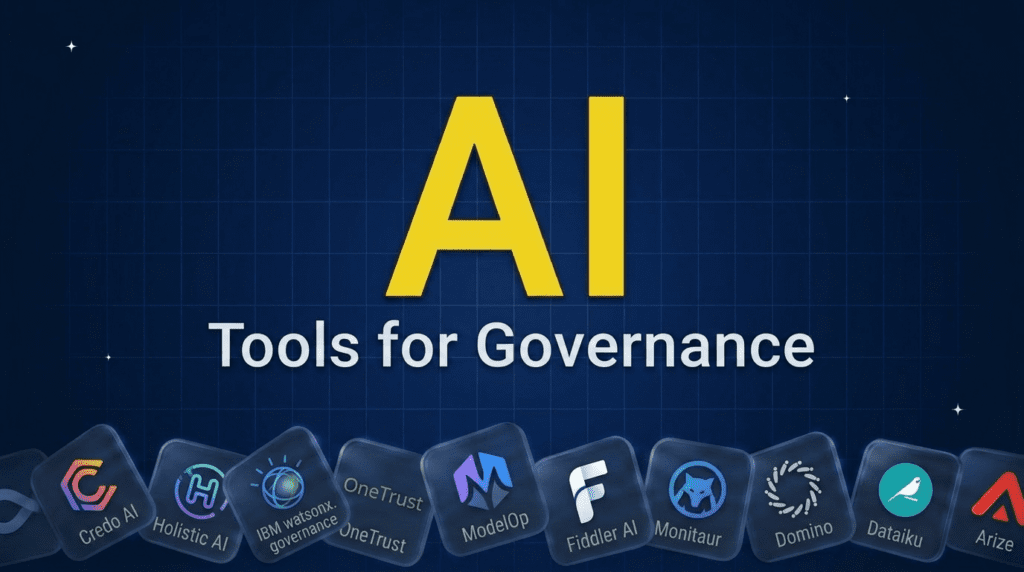
AI governance platforms help organizations track, assess, and control their AI systems for risk, bias, and compliance with rules like the EU AI Act and the NIST AI RMF. The dedicated leaders are Credo AI, Holistic AI, and IBM watsonx.governance. OneTrust and ModelOp bring governance into broader compliance and ModelOps, Fiddler AI and Monitaur focus on monitoring and assurance, and Domino and Dataiku govern within data-science platforms. Pick by whether you need standalone governance, monitoring, or governance inside your existing AI stack.Pricing verified June 2026. AI tool pricing changes often, so confirm the current price on each vendor’s site before you subscribe. Inside AI Media is not an AI tool vendor; these picks are ranked on merit, not promotion.
The best AI governance platforms at a glance
Here is how the main platforms compare on what they are best for, their focus, and pricing model. AI governance software is almost entirely enterprise and quote-based, so confirm with the vendor.| Platform | Best for | Focus | Pricing |
|---|---|---|---|
| Credo AI | Dedicated AI governance | Governance / compliance | Quote |
| Holistic AI | Governance + risk auditing | Governance / risk | Quote |
| IBM watsonx.governance | Enterprise AI governance | Governance / lifecycle | Quote |
| OneTrust | Governance within GRC | Governance / privacy | Quote |
| ModelOp | Governance + ModelOps | Model lifecycle | Quote |
| Fiddler AI | Model monitoring | Observability | Free + usage |
| Monitaur | AI assurance | Assurance / audit | Quote |
| Domino | Governing data science | MLOps governance | Quote |
| Dataiku | Governance in the platform | Platform governance | Quote |
What is an AI governance platform?
An AI governance platform helps an organization manage the risks and obligations of using AI: keeping an inventory of AI systems and models, assessing them for bias, security, and other risks, documenting them, enforcing policies, and proving compliance with frameworks and regulations like the EU AI Act and the NIST AI Risk Management Framework. As AI use and regulation grow, this has become a board-level concern, and dedicated platforms give risk, compliance, and data-science teams shared oversight of where and how AI is used. It overlaps with broader risk management, so see our AI tools for risk management guide for the wider context.How we picked these governance tools
We are an independent publisher and do not sell governance software, so none of these picks is our own product. We weighed each platform on the depth of its governance and compliance features, support for frameworks like the EU AI Act and NIST AI RMF, monitoring and documentation, integration with existing AI and GRC stacks, and credibility. Because this is a compliance-critical area, we favored established, serious platforms over lightweight tools.Best dedicated AI governance platforms
These are purpose-built to govern AI across its lifecycle.1. Credo AI, best dedicated AI governance platform
Credo AI is widely regarded as a leader in AI governance, helping organizations register, assess, and govern their AI systems against internal policies and external regulations, with strong support for the EU AI Act and NIST AI RMF. It gives compliance and risk teams oversight of the whole AI portfolio, which makes it a top standalone choice.- Best for: End-to-end governance of an AI portfolio.
- Pricing: Enterprise quote.
- Skip if: you only need model monitoring, not policy governance.
2. Holistic AI, best for governance plus risk auditing
Holistic AI is a leading platform for governing and auditing AI systems, assessing models for bias, robustness, privacy, and efficacy, and tracking them against emerging regulation. It pairs governance with technical risk auditing, which suits organizations that want to test models, not just document them.- Best for: Auditing AI models alongside governance.
- Pricing: Enterprise quote.
- Skip if: you want a US-headquartered vendor specifically.
3. IBM watsonx.governance, best for enterprise AI governance
IBM watsonx.governance manages AI across its lifecycle, model inventory, risk, monitoring, documentation, and compliance, with enterprise scale and integration into IBM’s wider AI and data stack. For large organizations that want governance from an established enterprise vendor, it is a comprehensive, well-supported option.- Best for: Enterprise-scale, full-lifecycle AI governance.
- Pricing: Enterprise quote.
- Skip if: you want a lightweight, focused tool.
Best governance within GRC and ModelOps
These fold AI governance into broader compliance or model operations.4. OneTrust, best for governance within GRC
OneTrust extends its established privacy and GRC platform to AI governance, letting organizations inventory AI, assess risk, and manage compliance alongside their existing data-governance and privacy programs. For companies already using OneTrust, it brings AI under the same governance umbrella.- Best for: AI governance inside an existing GRC program.
- Pricing: Enterprise quote.
- Skip if: you want a specialist AI-only platform.
5. ModelOp, best for governance plus ModelOps
ModelOp focuses on enterprise model operations and governance together, managing the full lifecycle of AI and analytical models with controls, monitoring, and compliance. For organizations operating many models in production, it ties governance directly to how models are run and maintained.- Best for: Governing models in production at scale.
- Pricing: Enterprise quote.
- Skip if: you have only a handful of models.
Best AI monitoring and assurance platforms
These watch deployed models for problems and provide evidence they behave correctly.6. Fiddler AI, best for model monitoring
Fiddler AI is an AI observability platform that monitors models in production for drift, bias, and performance, with explainability to understand why a model made a decision. For governance grounded in what models actually do live, not just paperwork, its monitoring and explainability are the strength.- Best for: Monitoring and explaining models in production.
- Pricing: Free tier; Developer plan $0.002 per trace; Enterprise custom.
- Skip if: you need policy and compliance management, not monitoring.
7. Monitaur, best for AI assurance
Monitaur focuses on AI assurance and governance, helping regulated organizations document, monitor, and demonstrate that their models are fair, compliant, and well-controlled, with an audit trail. It is aimed at industries like insurance and finance where proving responsible AI to regulators matters most.- Best for: Auditable AI assurance in regulated industries.
- Pricing: Quote-based.
- Skip if: you are not in a heavily regulated sector.
Best governance inside data-science platforms
If your team builds models on a platform, governance can live there too.8. Domino, best for governing data science
Domino Data Lab is an enterprise data-science platform with governance built in, controlling how models are developed, validated, and deployed with reproducibility and oversight. For organizations whose data scientists work in Domino, it embeds governance into the model-building workflow itself.- Best for: Governance within the data-science lifecycle.
- Pricing: Enterprise quote.
- Skip if: you do not build models in-house.
9. Dataiku, best for governance in the AI platform
Dataiku is a widely used AI and data-science platform whose Govern capabilities manage model registries, sign-offs, and risk across projects, so governance sits alongside building and deploying models. For teams standardized on Dataiku, it keeps oversight in the same place as the work.- Best for: Governance built into a data-science platform.
- Pricing: Enterprise quote.
- Skip if: you want a standalone governance tool across tools.
How to choose an AI governance platform
Start with your main need. For dedicated, policy-driven governance across your AI portfolio, Credo AI, Holistic AI, or IBM watsonx.governance lead. If you already run a GRC program, OneTrust folds AI in; if you operate many production models, ModelOp ties governance to operations. For watching live models, Fiddler AI and Monitaur focus on monitoring and assurance, and if your team builds in Domino or Dataiku, use their built-in governance. Map your obligations, the EU AI Act, NIST AI RMF, or sector rules, to the platform’s coverage, and remember governance is as much about process and accountability as software.Frequently asked questions
Credo AI, Holistic AI, and IBM watsonx.governance are the leading dedicated platforms, OneTrust and ModelOp bring governance into GRC and ModelOps, Fiddler AI and Monitaur focus on monitoring and assurance, and Domino and Dataiku govern within data-science platforms. The best depends on whether you need standalone governance, monitoring, or governance inside your AI stack.
It inventories an organization’s AI systems and models, assesses them for risk and bias, documents them, enforces policies, monitors them in production, and demonstrates compliance with frameworks and regulations like the EU AI Act and NIST AI RMF. It gives risk, compliance, and data teams shared oversight of AI use.
As organizations deploy more AI, they face real risks, bias, security, errors, and legal exposure, and growing regulation like the EU AI Act. Governance platforms help manage those risks, prove responsible and compliant AI use, and avoid penalties and reputational harm, which is why it has become a board-level priority.
They overlap heavily. AI governance is the broader practice of overseeing and controlling AI use, policies, inventory, accountability, and compliance, while AI risk management focuses on identifying and mitigating specific risks. Many platforms do both, and governance is often the umbrella that risk management sits under.
They are almost all enterprise and quote-based, priced by the size of the organization, number of models or AI systems, and features needed. There are rarely public self-serve prices, so expect to request a demo and quote. Costs reflect that these are compliance-critical, enterprise-grade platforms.

Inside AI Media is a global platform that covers what’s happening in AI without the fluff. From breaking news to practical use cases, it keeps professionals, builders, and decision-makers updated on the latest in artificial intelligence, so they can make better, faster decisions and stay ahead.