TL;DR: What You Need to Know
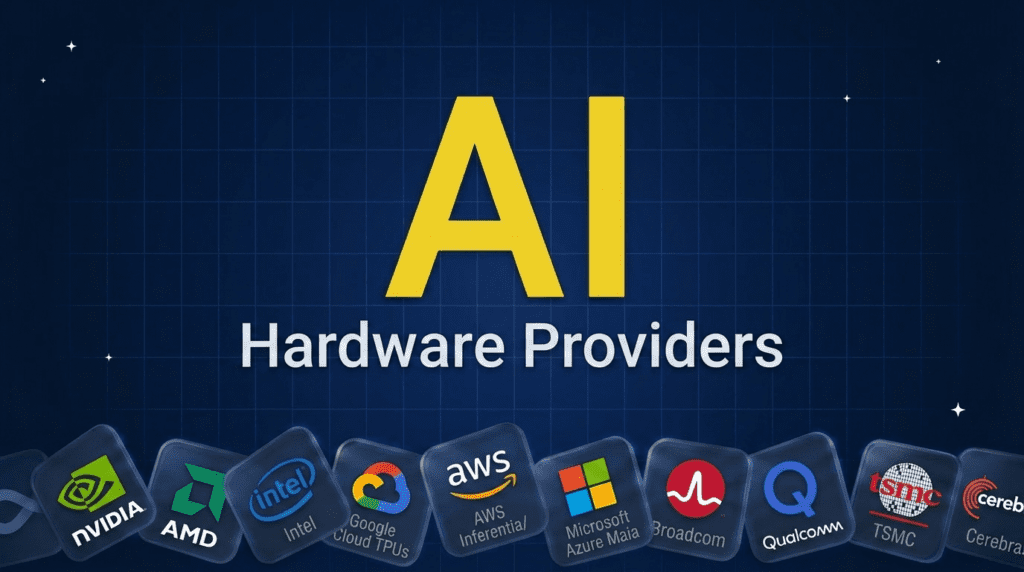
AI hardware providers make the chips and systems that train and run AI, the physical engine behind every model. NVIDIA dominates with its GPUs, followed by AMD and Intel. The cloud giants, Google (TPU), Amazon (Trainium/Inferentia), and Microsoft (Maia), build their own AI chips, while Broadcom, Qualcomm, and TSMC supply critical infrastructure. Challengers like Cerebras, Groq, and SambaNova push new architectures. Here are twelve of the most important AI hardware providers and what each is known for.Pricing verified June 2026. AI tool pricing changes often, so confirm the current price on each vendor’s site before you subscribe. Inside AI Media is not an AI tool vendor; these picks are ranked on merit, not promotion.
The top AI hardware providers at a glance
Here is how the leading AI hardware providers compare on what they are known for and their role. This is a fast-moving, high-stakes market, so treat it as a snapshot of the key players.| Provider | Known for | Role |
|---|---|---|
| NVIDIA | AI GPUs and CUDA | Chip leader |
| AMD | Instinct AI accelerators | Chip leader |
| Intel | Gaudi accelerators, CPUs | Chip leader |
| TPU custom chips | Hyperscaler | |
| Amazon (AWS) | Trainium and Inferentia | Hyperscaler |
| Microsoft | Maia AI accelerator | Hyperscaler |
| Broadcom | Custom chips + networking | Infrastructure |
| Qualcomm | Edge and on-device AI | Edge / mobile |
| TSMC | Manufacturing the chips | Foundry |
| Cerebras | Wafer-scale chips | Challenger |
| Groq | Fast inference (LPU) | Challenger |
| SambaNova | Reconfigurable AI chips | Challenger |
What are AI hardware providers?
AI hardware providers design, build, or manufacture the specialized chips and systems that AI runs on, mainly the processors that handle the massive parallel computation training and running models require. The category includes the chip designers (like NVIDIA and AMD), the cloud giants building custom silicon for their data centers, the companies supplying networking and manufacturing, and startups pursuing new architectures. Because AI’s progress is increasingly limited by compute, who makes the best, most available, most efficient hardware has become one of the most consequential questions in technology, and a defining factor in the AI race. Below are twelve of the most important, grouped by role.How we picked these hardware providers
We are an independent publisher with no affiliation to these companies. We chose based on importance to AI compute, market position, technical significance, and influence on the field, aiming for a representative mix of chip leaders, hyperscalers, infrastructure suppliers, and challengers. AI hardware is moving fast, so this reflects the current landscape rather than a fixed ranking.The chip leaders
These design the processors that most AI is trained and run on.1. NVIDIA, known for AI GPUs and CUDA
NVIDIA is the dominant force in AI hardware, its GPUs train and run the vast majority of modern AI, and its CUDA software ecosystem creates a powerful lock-in. As the company at the center of the AI compute boom, it is the single most important hardware provider in the field.- Known for: Market-leading AI GPUs and the CUDA ecosystem.
- Best for: Training and running AI at virtually any scale.
2. AMD, known for Instinct accelerators
AMD is NVIDIA’s main challenger in AI accelerators, with its Instinct (MI series) GPUs gaining traction in data centers as customers seek alternatives. For organizations wanting a credible second source of high-performance AI compute, AMD is the leading option.- Known for: Instinct data-center AI accelerators.
- Best for: A high-performance alternative to NVIDIA.
3. Intel, known for Gaudi and CPUs
Intel competes in AI hardware with its Gaudi accelerators and remains central through CPUs widely used alongside AI workloads, plus edge and PC AI efforts. While behind in data-center GPUs, it is a major player working to expand its AI footprint.- Known for: Gaudi accelerators and AI-capable CPUs.
- Best for: Mixed workloads and Intel-based environments.
The cloud hyperscalers’ custom chips
The biggest cloud providers now design their own AI silicon to cut cost and dependence.4. Google, known for TPU custom chips
Google designs its own Tensor Processing Units (TPUs), custom chips that power much of its AI and are available to customers through Google Cloud. As a pioneer of custom AI silicon, Google offers a major alternative to GPUs for training and inference.- Known for: TPUs for training and inference.
- Best for: AI workloads on Google Cloud.
5. Amazon (AWS), known for Trainium and Inferentia
Amazon builds custom AI chips, Trainium for training and Inferentia for inference, to give AWS customers cost-effective alternatives to GPUs. For organizations on AWS looking to reduce AI compute costs, its in-house silicon is a growing option.- Known for: Trainium and Inferentia AI chips on AWS.
- Best for: Cost-efficient AI compute on AWS.
6. Microsoft, known for the Maia accelerator
Microsoft has entered custom AI silicon with its Maia accelerator, designed to power AI workloads in Azure and reduce reliance on third-party chips. For the Azure ecosystem, it signals Microsoft’s push to control more of its AI infrastructure stack.- Known for: The Maia AI accelerator for Azure.
- Best for: AI workloads in the Microsoft cloud.
Critical infrastructure suppliers
These enable AI hardware through networking, edge chips, and manufacturing.7. Broadcom, known for custom chips and networking
Broadcom is a major force behind the scenes, helping hyperscalers design custom AI chips and supplying the high-speed networking that connects thousands of chips into AI clusters. As AI scales to huge clusters, its networking and custom-silicon role is increasingly vital.- Known for: Custom AI silicon and data-center networking.
- Best for: Connecting and scaling large AI clusters.
8. Qualcomm, known for edge and on-device AI
Qualcomm leads in AI hardware for the edge, its Snapdragon and Cloud AI chips run AI efficiently on phones, laptops, and devices. For on-device and edge AI rather than data-center training, it is a dominant provider.- Known for: Efficient on-device and edge AI chips.
- Best for: AI in phones, PCs, and edge devices.
9. TSMC, known for manufacturing the chips
TSMC does not design AI chips but manufactures most of them, the world’s leading contract chipmaker, fabricating the advanced silicon for NVIDIA, AMD, Apple, and others. As the foundry the whole industry depends on, it is one of the most critical companies in all of AI.- Known for: Manufacturing the world’s advanced AI chips.
- Best for: The foundation every chip designer relies on.
The AI chip challengers
These startups pursue novel architectures to challenge the incumbents.10. Cerebras, known for wafer-scale chips
Cerebras builds radically different hardware, a single, enormous wafer-scale chip designed to train and run large models faster than clusters of smaller chips. For organizations pushing the limits of AI compute, its unconventional approach offers a distinctive alternative.- Known for: Wafer-scale engine chips.
- Best for: High-end training with a novel architecture.
11. Groq, known for fast inference
Groq focuses on inference speed with its LPU (Language Processing Unit) architecture, designed to run AI models, especially LLMs, with very low latency. For applications where fast, real-time inference matters most, it is a notable specialist challenger.- Known for: Ultra-fast LLM inference with LPUs.
- Best for: Low-latency, real-time AI inference.
12. SambaNova, known for reconfigurable chips
SambaNova builds reconfigurable dataflow chips and full AI systems aimed at enterprises that want high-performance AI compute, including as an integrated platform. For organizations seeking an alternative full-stack AI hardware provider, it is a serious challenger.- Known for: Reconfigurable AI chips and systems.
- Best for: Enterprises wanting full-stack AI hardware.
How to think about AI hardware
For most organizations, the question is not which chip to buy but which compute to use, and that usually means accessing NVIDIA, AMD, or a hyperscaler’s chips through the cloud. If you train or run large models, NVIDIA remains the default, with AMD a growing alternative and Google’s TPUs, AWS’s Trainium, and Azure’s Maia offering cost options within their clouds. For edge and on-device AI, Qualcomm leads. The challengers, Cerebras, Groq, SambaNova, are worth watching for specific needs like fast inference or novel scale. And remember TSMC underpins nearly all of it. Match your choice to where you run AI, your cloud, and whether your priority is training, inference, or edge.Frequently asked questions
NVIDIA leads, followed by AMD and Intel among chip designers; Google, Amazon, and Microsoft build custom cloud AI chips; Broadcom, Qualcomm, and TSMC supply critical infrastructure; and Cerebras, Groq, and SambaNova are notable challengers. NVIDIA is the dominant single provider.
NVIDIA is the clear leader, with its GPUs powering the large majority of AI training and inference, reinforced by its CUDA software ecosystem. AMD is its main challenger, and the cloud giants’ custom chips are growing alternatives, but NVIDIA remains dominant by a wide margin.
GPUs are a type of chip originally for graphics that turned out to be excellent at the parallel math AI needs, and they remain the most common AI hardware. “AI chips” is broader, including GPUs plus purpose-built accelerators like Google’s TPUs, AWS’s Trainium, and startup architectures designed specifically for AI.
AI progress is increasingly limited by compute, so access to enough high-performance chips has become a major bottleneck and competitive advantage. This has made AI hardware providers, especially NVIDIA, central to the AI race, and chip supply a strategic concern for companies and governments alike.
No. Most organizations access AI hardware through the cloud rather than buying chips, renting NVIDIA, AMD, or custom hyperscaler chips by the hour from AWS, Google Cloud, Azure, or specialized providers. Buying hardware mainly makes sense at large scale or for specific on-premises and edge needs.

Inside AI Media is a global platform that covers what’s happening in AI without the fluff. From breaking news to practical use cases, it keeps professionals, builders, and decision-makers updated on the latest in artificial intelligence, so they can make better, faster decisions and stay ahead.