TL;DR: What You Need to Know
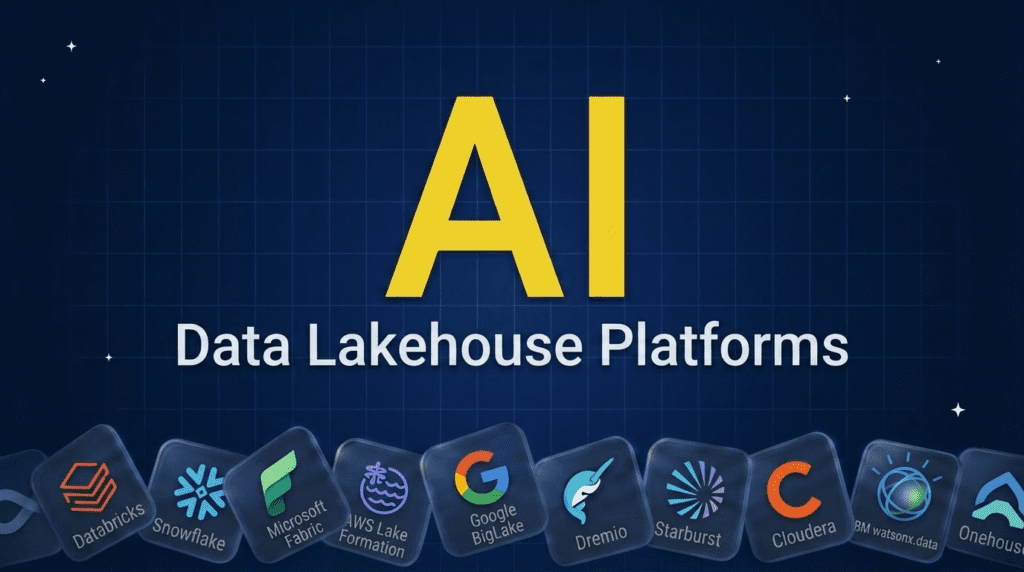
A data lake stores all your raw data, structured and unstructured, in one place, and modern “lakehouse” platforms add the structure and AI-readiness that make it useful for analytics and machine learning. The leaders are Databricks and Snowflake, with the cloud giants Microsoft, AWS, and Google Cloud close behind. Query and analytics engines like Dremio, Starburst, and Cloudera, open platforms like IBM watsonx.data and Onehouse, and enterprise options like Teradata and Oracle round out the field. Pick by your cloud and how AI-ready you need it.Pricing verified June 2026. AI tool pricing changes often, so confirm the current price on each vendor’s site before you subscribe. Inside AI Media is not an AI tool vendor; these picks are ranked on merit, not promotion.
The best AI data lake platforms at a glance
Here is how the leading data lake and lakehouse platforms compare on what they are best for and their category. Most are usage- or quote-based, so confirm pricing with the vendor.| Platform | Best for | Category |
|---|---|---|
| Databricks | AI and ML lakehouse | Lakehouse leader |
| Snowflake | Cloud data + AI | Lakehouse leader |
| Microsoft Fabric | Azure data lakehouse | Cloud platform |
| AWS Lake Formation | Data lakes on AWS | Cloud platform |
| Google BigLake | Lakehouse on Google Cloud | Cloud platform |
| Dremio | Querying the lake directly | Query engine |
| Starburst | Federated lake analytics | Query engine |
| Cloudera | Hybrid and on-prem lakes | Data platform |
| IBM watsonx.data | Open lakehouse for AI | Open lakehouse |
| Onehouse | Managed open lakehouse | Open lakehouse |
| Teradata | Enterprise-scale analytics | Enterprise |
| Oracle | Lakes in the Oracle stack | Enterprise |
What is a data lake (and a lakehouse)?
A data lake is a central repository that stores huge volumes of raw data in any format, structured tables, documents, images, logs, cheaply and at scale, so you can use it later for analytics and AI. The catch with traditional lakes was that raw, ungoverned data became a “data swamp.” The modern answer is the lakehouse, which combines a lake’s low-cost, flexible storage with the structure, governance, and performance of a data warehouse, often using open table formats like Delta Lake, Apache Iceberg, or Hudi. Lakehouses are increasingly the foundation for AI, because models need access to large, varied data in one governed place. The platforms below are mostly lakehouses, grouped by type, since that is where AI-ready data lives today. For getting data in, see our AI data integration platforms guide.How we picked the AI data lakes
We are an independent publisher and do not sell data platforms, so none of these picks is our own product. We grouped platforms by type, then weighed each on scale, AI and analytics capability, openness, cloud fit, and adoption. We focused on platforms organizations actually run their data and AI on, from cloud-native leaders to enterprise and open options.The lakehouse leaders
These are the platforms most associated with modern, AI-ready data lakes.1. Databricks, known for the AI and ML lakehouse
Databricks pioneered the lakehouse concept and remains its leader, built on open Delta Lake and designed from the ground up for data engineering, analytics, and machine learning on one platform. For organizations that want a data lake genuinely built for AI and ML, it is the standout choice.- Known for: The lakehouse, built for AI and ML.
- Best for: Teams doing serious data engineering and ML.
2. Snowflake, known for the cloud data platform
Snowflake started as a cloud data warehouse and has expanded into a full data cloud that handles lake-style workloads, sharing, and increasingly AI, with strong ease of use. For organizations that want a powerful, low-maintenance data platform that now spans warehouse and lake, it is a leading option.- Known for: An easy, powerful cloud data platform.
- Best for: Teams wanting low-maintenance data at scale.
3. Microsoft Fabric, known for the Azure lakehouse
Microsoft Fabric unifies data lake, warehouse, and analytics on Azure around OneLake, with AI through Copilot, giving Microsoft customers an integrated data foundation. For organizations on Azure and Microsoft 365, it brings lakehouse and analytics together in one place.- Known for: Unified data lakehouse on Azure.
- Best for: Microsoft and Azure-aligned organizations.
4. AWS Lake Formation, known for data lakes on AWS
AWS Lake Formation helps build, secure, and manage data lakes on Amazon S3, integrated with the broad AWS analytics and AI ecosystem. For organizations on AWS, it is the native way to stand up governed data lakes that feed the rest of their AWS stack.- Known for: Building governed data lakes on S3.
- Best for: Organizations building on AWS.
5. Google BigLake, known for the lakehouse on Google Cloud
Google BigLake unifies data lakes and warehouses on Google Cloud, letting you analyze data across storage with BigQuery and feed Google’s AI tools. For teams on Google Cloud, it brings lake and warehouse together under one governed, AI-connected layer.- Known for: Unified lake and warehouse on Google Cloud.
- Best for: Google Cloud and BigQuery users.
Query and analytics engines
These let you analyze data in the lake directly, without moving it.6. Dremio, known for querying the lake directly
Dremio is a lakehouse platform that lets you run fast SQL analytics directly on data lake storage, with open table formats, avoiding costly data movement. For teams that want warehouse-like performance on their lake without copying data, it is a strong, open choice.- Known for: Fast SQL directly on the data lake.
- Best for: Querying lakes without moving data.
7. Starburst, known for federated lake analytics
Starburst, built on open-source Trino, lets you query and analyze data across data lakes and many sources from one place, federating access without consolidating everything first. For organizations with data spread across systems, its federated approach is the draw.- Known for: Federated querying across lakes and sources.
- Best for: Analytics across distributed data.
8. Cloudera, known for hybrid and on-prem lakes
Cloudera offers a data platform for building lakes across hybrid and on-premises environments, with strong governance and support for regulated industries. For organizations that cannot go fully cloud or need hybrid data lakes, it is an established leader.- Known for: Hybrid and on-premises data lakes.
- Best for: Regulated or hybrid-cloud organizations.
Open and managed lakehouses
These emphasize open formats and managed simplicity.9. IBM watsonx.data, known for the open lakehouse for AI
IBM watsonx.data is an open, hybrid lakehouse built to make data ready for AI, using open formats and multiple query engines while connecting to IBM’s watsonx AI. For enterprises wanting an open lakehouse tied to a serious AI platform, it is a strong option.- Known for: Open, AI-ready hybrid lakehouse.
- Best for: Enterprises pairing lakehouse with AI.
10. Onehouse, known for the managed open lakehouse
Onehouse provides a fully managed lakehouse built on open-source Apache Hudi, giving teams an open, vendor-neutral foundation without managing the infrastructure. For organizations that want openness and to avoid lock-in but not the operational burden, it is a compelling managed choice.- Known for: Managed, open, vendor-neutral lakehouse.
- Best for: Teams wanting open data without ops overhead.
Enterprise data platforms
These bring data-lake capability within established enterprise stacks.11. Teradata, known for enterprise-scale analytics
Teradata’s VantageCloud brings lake and analytics capabilities to large enterprises with demanding, high-scale workloads and a long heritage in enterprise data. For organizations with serious scale and existing Teradata investments, it extends into modern lakehouse use.- Known for: High-scale enterprise analytics and lakes.
- Best for: Large enterprises with heavy workloads.
12. Oracle, known for lakes in the Oracle stack
Oracle provides data lake and lakehouse capabilities within its cloud and database ecosystem, letting organizations on Oracle keep their lake close to their applications and databases. For Oracle-centric enterprises, it is the natural way to add a data lake.- Known for: Data lakes within the Oracle ecosystem.
- Best for: Oracle-aligned enterprises.
How to choose a data lake platform
Start with your cloud and your goal. For AI and ML, Databricks is purpose-built; for an easy all-round data platform, Snowflake. On a specific cloud, the native option, Microsoft Fabric, AWS Lake Formation, or Google BigLake, keeps your lake close to your stack. If you want to query data in place, Dremio or Starburst; for hybrid or on-prem, Cloudera; and for openness, IBM watsonx.data or Onehouse. Enterprises with existing Teradata or Oracle investments can extend those. Prioritize open formats to avoid lock-in, governance to avoid a data swamp, and AI-readiness if feeding models is your end goal.Frequently asked questions
Databricks and Snowflake lead, with Microsoft Fabric, AWS Lake Formation, and Google BigLake strong on their clouds. Dremio and Starburst excel at querying lakes directly, Cloudera at hybrid, IBM watsonx.data and Onehouse at open lakehouses, and Teradata and Oracle for enterprise stacks. The best depends on your cloud and AI needs.
A data lake is a central store for large amounts of raw data in any format, structured, semi-structured, and unstructured, kept cheaply at scale for later analytics and AI. Unlike a warehouse, it stores data without forcing it into a fixed structure first, giving flexibility at the cost of needing governance.
A data lake stores raw data flexibly and cheaply; a data warehouse stores structured, processed data optimized for analytics; and a lakehouse combines both, the cheap, flexible storage of a lake with the structure, governance, and performance of a warehouse. Lakehouses, like Databricks, are now the common foundation for AI.
Snowflake began as a cloud data warehouse but has expanded into a broader data cloud that supports lake-style workloads, storing and querying varied data and sharing it widely. It blurs the line, which is why many treat it as a lakehouse-style platform rather than strictly a warehouse or a lake.
AI and machine-learning models need access to large, varied datasets, often unstructured, in one governed place, which is exactly what a modern lake or lakehouse provides. Without a solid data foundation, AI projects stall on scattered, messy, or inaccessible data, so the lakehouse has become central to enterprise AI.

Inside AI Media is a global platform that covers what’s happening in AI without the fluff. From breaking news to practical use cases, it keeps professionals, builders, and decision-makers updated on the latest in artificial intelligence, so they can make better, faster decisions and stay ahead.