TL;DR: What You Need to Know
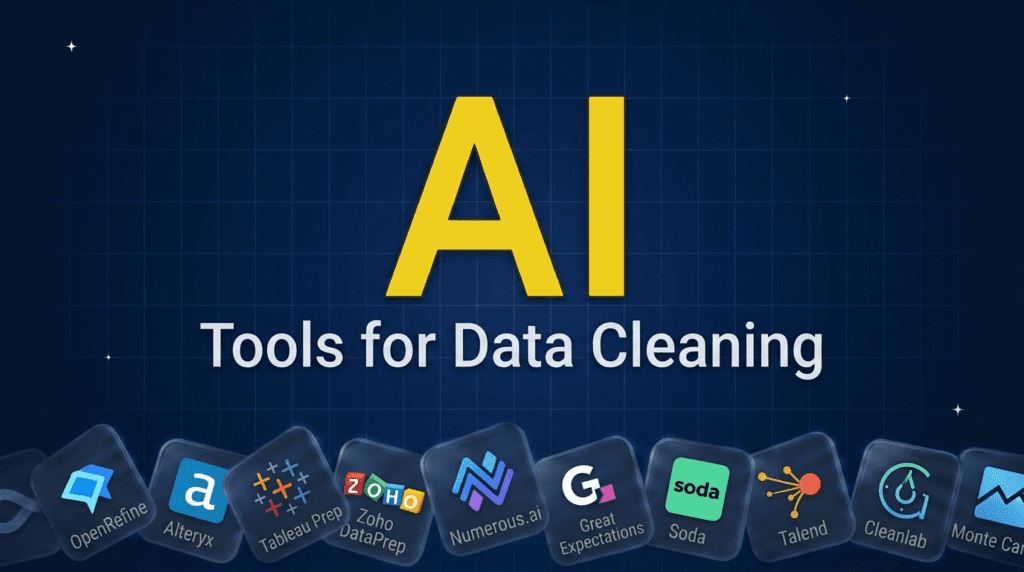
Clean data is the single biggest factor in whether an AI project succeeds, and these tools fix the messy, missing, and mislabeled data that breaks models. For hands-on cleaning, OpenRefine, Alteryx, and Tableau Prep lead, with Zoho DataPrep for AI-assisted prep and Numerous.ai for spreadsheets. For pipeline data quality, Great Expectations, Soda, and Talend; and for ML-specific issues, Cleanlab finds bad labels while Monte Carlo watches for data problems. Pick by where your data lives and how it breaks.Pricing verified June 2026. AI tool pricing changes often, so confirm the current price on each vendor’s site before you subscribe. Inside AI Media is not an AI tool vendor; these picks are ranked on merit, not promotion.
The best data cleaning tools for AI at a glance
Here is how the main tools compare on what they do, the approach, and pricing model. Many have free or open-source options; enterprise tools are quote-based, so confirm with the vendor.| Tool | Best for | Approach | Pricing |
|---|---|---|---|
| OpenRefine | Hands-on data cleaning | Open-source | Free |
| Alteryx | Visual data prep at scale | Platform | Quote |
| Tableau Prep | Prep for analytics | Visual prep | Per user |
| Zoho DataPrep | AI-assisted data prep | Cloud prep | Free / paid |
| Numerous.ai | Cleaning in spreadsheets | Spreadsheet AI | Free / paid |
| Great Expectations | Data validation | Open-source | Free / paid |
| Soda | Data quality monitoring | Quality checks | Free / paid |
| Talend | Enterprise data quality | Platform | Quote |
| Cleanlab | Finding bad labels/data | ML data quality | Free / paid |
| Monte Carlo | Data observability | Monitoring | Quote |
Why data cleaning matters for AI
AI and machine-learning models are only as good as the data behind them, and real-world data is messy: duplicates, missing values, inconsistent formats, outliers, and, for ML, mislabeled examples. Data cleaning fixes all of that so models learn from accurate, consistent data, which is why teams often spend most of their time on it. The tools fall into a few groups: hands-on cleaning and prep tools you work data in, AI-assisted cleaners that automate fixes, data-quality and validation tools that catch problems in pipelines, and ML-specific tools that find bad labels and monitor data health. Cleaning usually happens right before transformation and loading, so it pairs with our ETL tools for AI guide.How we picked these tools for data cleaning
We are an independent publisher and do not sell data tools, so none of these picks is our own product. We grouped tools by how you clean data, then weighed each on capability, ease of use, automation and AI features, fit for analysts versus engineers, and value. We focused on tools data and AI teams actually use, from free open-source to enterprise platforms.Best hands-on data cleaning and prep tools
These let you explore, fix, and shape data directly, the workhorses of cleaning.1. OpenRefine, best free hands-on cleaning
OpenRefine is a powerful, free open-source tool for exploring and cleaning messy data, clustering similar values, fixing inconsistencies, and transforming data at scale. A long-time favorite of data professionals, it is the go-to for hands-on cleaning without cost, especially for one-off datasets.- Best for: Free, powerful hands-on data cleaning.
- Pricing: Free and open-source.
- Skip if: you need automated, repeatable pipeline cleaning.
2. Alteryx, best for visual data prep at scale
Alteryx is an enterprise platform for visually building data-prep and cleaning workflows without heavy coding, with AI features to assist, and it scales to complex, repeatable processes. For teams that prep large volumes of data regularly, its drag-and-drop power and automation are the draw.- Best for: Repeatable, large-scale visual data prep.
- Pricing: Enterprise quote.
- Skip if: you want a free or lightweight tool.
3. Tableau Prep, best for prep into analytics
Tableau Prep provides a visual way to combine, shape, and clean data before analysis, integrating tightly with Tableau for BI and feeding clean data into models and dashboards. For teams in the Tableau ecosystem, it makes cleaning an easy, visual step in the analytics flow.- Best for: Visual cleaning that feeds analytics.
- Pricing: Per-user, with Tableau.
- Skip if: you are not using Tableau.
4. Zoho DataPrep, best for AI-assisted prep
Zoho DataPrep is a cloud data-preparation tool that uses AI to suggest cleaning and transformation steps, detect issues, and standardize data with little manual effort. It is accessible and affordable, making AI-assisted cleaning available to teams without a heavy enterprise budget.- Best for: Affordable, AI-assisted cloud data prep.
- Pricing: Free tier; paid plans.
- Skip if: you need deep enterprise governance.
Best AI tool for cleaning spreadsheets
5. Numerous.ai, best for cleaning in spreadsheets
Numerous.ai brings AI into Excel and Google Sheets, letting you clean, standardize, categorize, and fix data across thousands of rows with a simple function. For the huge amount of data that lives in spreadsheets, it automates tedious cleaning without leaving the tool you already use.- Best for: AI cleaning of spreadsheet data at scale.
- Pricing: Free tier; paid plans.
- Skip if: your data is not in spreadsheets. See our AI tools for Excel guide.
Best data quality and validation tools
These catch bad data in pipelines before it ever reaches a model.6. Great Expectations, best for data validation
Great Expectations is a popular open-source framework for validating data against rules (“expectations”), catching nulls, format errors, and anomalies automatically in your pipelines. For engineering teams that want automated, testable data quality rather than manual checks, it is a widely adopted standard.- Best for: Automated, rule-based data validation.
- Pricing: Open-source; paid cloud.
- Skip if: you want interactive, manual cleaning.
7. Soda, best for data quality monitoring
Soda lets teams define data-quality checks and monitor data for issues continuously, alerting when something breaks so bad data is caught early. It suits teams that want ongoing quality monitoring across their data, not just a one-time clean.- Best for: Continuous data-quality checks and alerts.
- Pricing: Free tier; paid plans.
- Skip if: you only clean static, one-off datasets.
8. Talend, best for enterprise data quality
Talend combines data integration with strong data-quality and cleansing capabilities, profiling, standardizing, deduplicating, and validating data at enterprise scale. For organizations where trustworthy data feeding AI is mission-critical, its quality focus and governance stand out.- Best for: Enterprise-grade data quality and cleansing.
- Pricing: Enterprise quote.
- Skip if: you are a small team wanting something simple.
Best tools for ML data quality
These tackle the data problems specific to machine learning.9. Cleanlab, best for finding bad labels and data
Cleanlab uses AI to automatically find label errors, outliers, and low-quality examples in machine-learning datasets, a major hidden cause of poor model performance. For ML teams, fixing mislabeled training data with Cleanlab often improves models more than tweaking the model itself.- Best for: Detecting mislabeled and low-quality ML data.
- Pricing: Open-source; paid Studio.
- Skip if: you are not training ML models on labeled data.
10. Monte Carlo, best for data observability
Monte Carlo is a leading data-observability platform that uses AI to automatically detect data issues, freshness problems, schema changes, anomalies, before they corrupt analytics or AI. For organizations that need to trust data at scale, it catches problems no one would spot manually.- Best for: Automatically detecting data issues at scale.
- Pricing: Enterprise quote.
- Skip if: you have small, simple, stable data.
How to choose a data cleaning tool for AI
Start with where your data lives and how it breaks. For hands-on cleaning of a dataset, OpenRefine is free and powerful; for repeatable visual prep, Alteryx or Tableau Prep; for spreadsheets, Numerous.ai; and for AI-assisted prep, Zoho DataPrep. If bad data keeps slipping into pipelines, add validation with Great Expectations or monitoring with Soda or Monte Carlo, and Talend for enterprise quality. ML teams should run Cleanlab on training data to catch label errors. Often you combine a cleaning tool with ongoing quality checks, since clean data is not a one-time task but a continuous discipline, and it sets the ceiling on how good your AI can be.Frequently asked questions
OpenRefine, Alteryx, and Tableau Prep are top for hands-on prep, Zoho DataPrep and Numerous.ai for AI-assisted and spreadsheet cleaning, Great Expectations, Soda, and Talend for data quality, and Cleanlab and Monte Carlo for ML data quality and observability. Most teams combine a cleaning tool with ongoing quality checks.
AI models learn from data, so messy data, duplicates, missing values, inconsistent formats, and mislabeled examples, leads directly to inaccurate, biased, or unreliable models. Clean, consistent data is the single biggest factor in model performance, which is why teams spend so much time on it.
Increasingly yes. Tools like Zoho DataPrep and Numerous.ai use AI to suggest and apply fixes, standardize values, and spot issues, and Cleanlab finds bad labels automatically. AI speeds cleaning up a lot, but a human still needs to review the results, since automated fixes can be wrong.
Data cleaning is fixing the data, correcting errors, filling gaps, standardizing formats. Data validation is checking data against rules to catch problems, ideally automatically in a pipeline. Tools like Great Expectations and Soda validate, while OpenRefine and Alteryx clean. Mature teams do both, continuously.
Yes. OpenRefine is fully free and open-source, Great Expectations and Cleanlab have open-source versions, and Zoho DataPrep, Numerous.ai, and Soda have free tiers. Free tools are great for getting started; enterprise platforms add scale, governance, and support.

Inside AI Media is a global platform that covers what’s happening in AI without the fluff. From breaking news to practical use cases, it keeps professionals, builders, and decision-makers updated on the latest in artificial intelligence, so they can make better, faster decisions and stay ahead.