Nvidia commits $100B to OpenAI, 10GW AI buildout

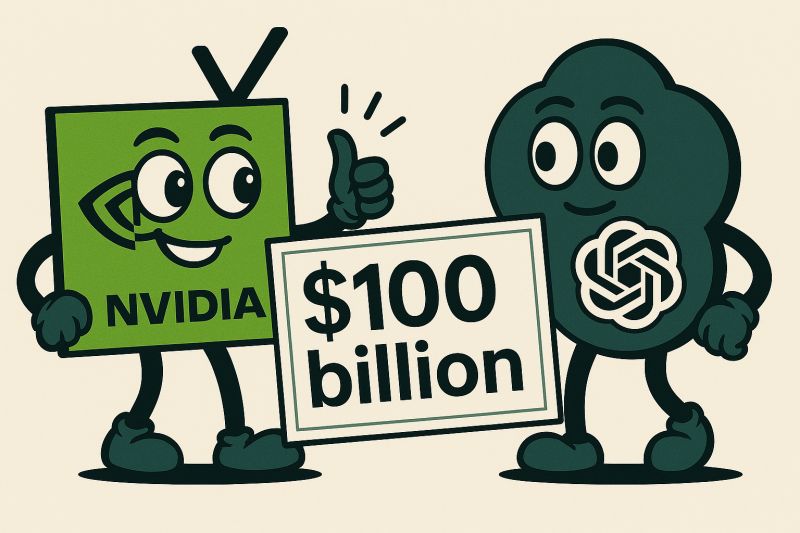
Nvidia commits $100B to OpenAI, 10GW AI buildout
Nvidia will commit $100B in sales credits to OpenAI to build at least 10GW of NVIDIA-powered AI data centers, raising questions over power and partners.
The announcement
Nvidia Pledges $100B to OpenAI for Massive AI Buildout.
Nvidia plans to commit $100 billion to OpenAI as part of a sweeping partnership to scale the ChatGPT maker’s next-generation computing infrastructure. Under the agreement announced Monday, OpenAI aims to deploy at least 10 gigawatts of AI data center capacity built on Nvidia systems. The buildout supports OpenAI’s push toward what it calls artificial general intelligence, which Nvidia refers to as “superintelligence.” Other leading AI vendors are pursuing similar ambitions for human-level AI.
Deal structure: sales credits, not equity
The structure of the deal matters: industry analysts describe the $100 billion as a sales credit or rebate program tied to OpenAI’s purchases of Nvidia hardware and systems, rather than a cash infusion or equity investment. Nvidia effectively secures a long-term customer for its AI infrastructure while OpenAI gains preferred access and pricing as it scales.
“NVIDIA and OpenAI have pushed each other for a decade, from the first DGX supercomputer to the breakthrough of ChatGPT,” said Jensen Huang, founder and CEO of NVIDIA. “This investment and infrastructure partnership mark the next leap forward, deploying 10 gigawatts to power the next era of intelligence.”
“Everything starts with compute,” said Sam Altman, co-founder and CEO of OpenAI. “Compute infrastructure will be the basis for the economy of the future, and we will utilize what we’re building with NVIDIA to both create new AI breakthroughs and empower people and businesses with them at scale.”
Other compute deals and impact on NVIDIA’s leadership
The move follows reports that OpenAI recently struck a roughly $300 billion arrangement with Oracle to acquire compute capacity. It also caps a busy stretch for Nvidia, which last week committed fresh funding to several U.K. AI ventures and said it would invest $5 billion in U.S. chip rival Intel.
Analysts say the OpenAI pact further entrenches Nvidia’s leadership in AI chips and systems. Jack Gold, president of J. Gold Associates, noted that OpenAI is expected to purchase tens of thousands to potentially millions of GPUs to power its models, making a formal partnership logical. If OpenAI’s future models run exclusively on Nvidia GPUs, it would reinforce Nvidia’s position and encourage other model builders to do the same, he added.
Power and partners: The big questions
The scale of the plan also raises questions. David Nicholson, an analyst at Futurum Group, pointed out that neither company has previously delivered deployments at the 10-gigawatt level and asked where that much electricity would be sourced. He also flagged uncertainties around how Nvidia’s cloud partners, sometimes called proxy clouds, such as Massed Compute and CoreWeave would participate, and how hyperscalers like Microsoft might react. Microsoft is both a major investor in OpenAI and a key infrastructure provider for the company.
How does this differ from other OpenAI deals?
Nvidia’s arrangement with OpenAI differs from OpenAI’s deals with other providers, including Oracle, because it focuses on OpenAI buying Nvidia’s own AI systems under a large sales-credit framework. Financially, the contrast between the companies is stark: OpenAI’s revenue has been a small fraction of its spending in recent years, and it has reportedly lost more than $5 billion annually, much of it on infrastructure. Nvidia, by contrast, continues to generate revenue well above its costs, giving it ample capacity to support such programs.
The timeline
Neither Nvidia nor OpenAI disclosed a timeline for deploying the 10 gigawatts or fully drawing down the $100 billion commitment.
Bottom line
If executed, the pact could accelerate OpenAI’s compute roadmap and cement Nvidia’s dominance in AI hardware. But the sheer power requirements and the implications for cloud partners and investors remain open questions.
Inside AI Media is a global platform that covers what’s happening in AI without the fluff. From breaking news to practical use cases, it keeps professionals, builders, and decision-makers updated on the latest in artificial intelligence, so they can make better, faster decisions and stay ahead.