
DeepMind unveils Gemini Robotics 1.5 with reasoning
Google DeepMind has introduced Gemini Robotics 1.5, the latest update to its vision-language-action portfolio, aiming to give robots stronger perception and reasoning so they can plan and carry out complex tasks with greater autonomy.
The Gemini Robotics 1.5 at a glance:
- Two-part system: control model (Gemini Robotics 1.5) plus embodied reasoning layer (Gemini Robotics‑ER 1.5).
- Robots can “think before acting,” explain decisions, plan with tools like web search, and adapt to context.
- Cross-robot skill sharing demonstrated across ALOHA2, Franka bi-arm, and Apptronik’s Apollo.
- ER 1.5 coming to developers via the Gemini API; control model to selected partners first.
A two-layer approach to robot intelligence
The release spans two complementary systems. Gemini Robotics 1.5 converts visual inputs and natural-language instructions into motor commands for physical execution. Gemini Robotics‑ER 1.5 serves as an embodied reasoning layer that can use digital tools, such as web search, to formulate plans and then hand off the steps to the control model.
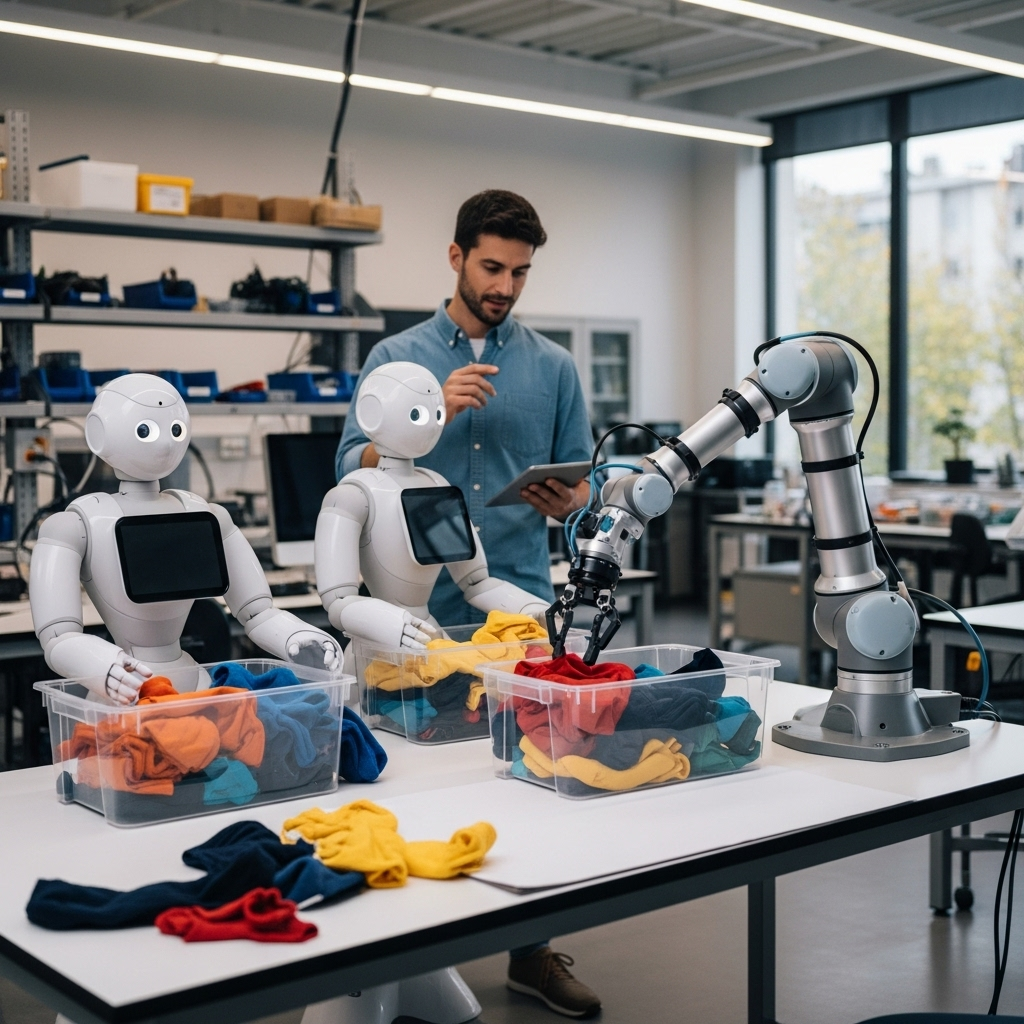
Working together, they enable robots to “think before acting,” explain their choices, and adapt to context-sensitive jobs, from sorting laundry by colour to packing a suitcase based on the weather.
Capabilities that bridge perception, reasoning, and action
- Reasoning and planning: ER 1.5 can break tasks into steps, use external tools to gather context, and justify choices.
- Grounded execution: Robotics 1.5 translates plans into reliable motor control for real-world manipulation.
- Generalization: The combined system adapts to varied tasks and environments without extensive per-task retraining.
In a Sept. 25 blog post, DeepMind described the launch as a foundational step toward artificial general intelligence, saying the work advances agent-like capabilities—reasoning, planning, tool use, and generalization—into the physical world.
Cross-robot skill sharing
A notable addition is cross-robot skill sharing. In internal tests, a behaviour learned by the dual-arm ALOHA2 platform transferred directly to the Franka bi-arm robot and to Apptronik’s humanoid Apollo without retraining.
ALOHA2 is an open-source hardware and software project developed with Stanford University researchers; Franka is produced by Germany-based Agile Robots AG; and Austin-based Apptronik positions Apollo as a rival to Tesla’s Optimus. DeepMind said this transferability speeds up learning new behaviours and makes robots more useful across different forms.
Access and availability
- Gemini Robotics‑ER 1.5: Coming to developers via the Gemini API in Google AI Studio.
- Gemini Robotics 1.5: Initially available only to selected partners.
Why does it matter?
If the approach proves out, pairing embodied reasoning with low-level control could accelerate how quickly robots learn, share competencies, and tackle real-world tasks across diverse hardware.
Edited for clarity and flow. All product names and trademarks are the property of their respective owners.