
Nvidia Highlights Saudi AI Startup Humain in Earnings Call
Nvidia’s CEO praised Saudi AI startup Humain for ambitious infrastructure plans and landmark deals, positioning it as a major global AI data center provider.
At a Glance
- Mentioned three times by Nvidia CEO Jensen Huang during the company’s earnings call
- Targeting 6% of global AI compute by 2034
- Deploying 150,000 Nvidia chips—including Grace Blackwell 300—in Riyadh’s planned AI Zone
- Building a 500 MW data center with xAI, with Nvidia supplying chips
- $10B deal with AMD for an additional 500 MW of AI computing within five years
Humain’s Rapid Rise
Nvidia CEO Jensen Huang brought attention to Saudi Arabian AI company Humain during the chipmaker’s latest earnings call, mentioning the startup three times alongside established industry leaders such as Amazon, Microsoft, Google, OpenAI, Anthropic, and Elon Musk’s xAI.
Despite being only six months old, Humain is quickly emerging as a significant player in the global AI infrastructure arena. Founded by Saudi Crown Prince Mohammed bin Salman and backed by the $1 trillion Public Investment Fund, the company aims to deliver 6% of the world’s AI computing power by 2034. If successful, Humain would become the third largest AI data center provider, trailing only the United States and China.
Strategic Visibility and Landmark Deals
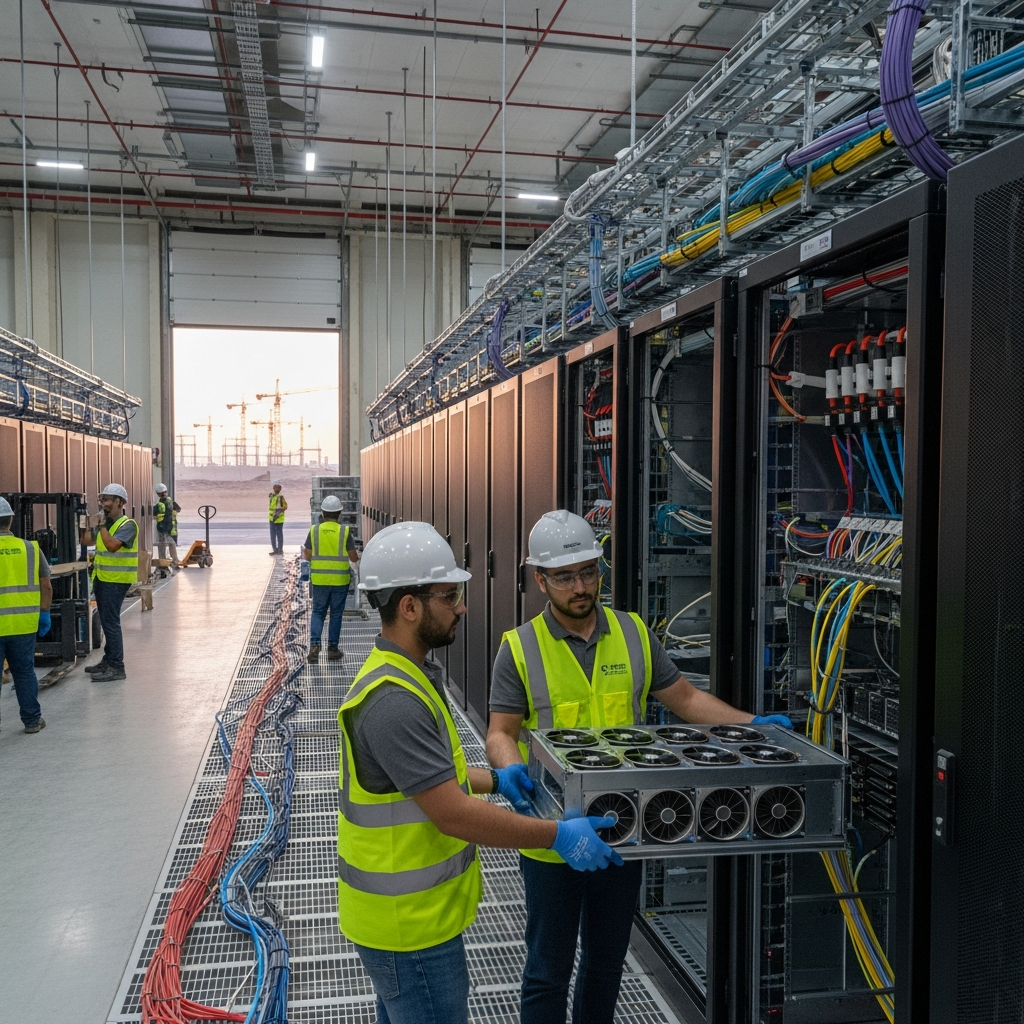
Huang’s repeated mentions coincided with his attendance at a White House dinner for the Crown Prince during his visit to the U.S.—the first since 2018. At the same time, Humain revealed a major deal with Nvidia and Amazon to deploy 150,000 Nvidia chips, including advanced Grace Blackwell 300 models, in new data centers in Riyadh’s planned “AI Zone.”
Humain also signed an agreement with xAI to construct a 500-megawatt data center in Saudi Arabia, with Nvidia supplying the necessary chips. Huang explained on the earnings call that Humain’s partnership with xAI strengthens Saudi Arabia’s position as a host for innovative AI technologies.
Leadership, Products, and End-to-End Ambitions
The company, led by ex-Aramco executive Tareq Amin, plans to provide end-to-end AI solutions, encompassing data center operations and AI model development. Humain has already released its own large language model, ALAM, focusing on Arabic language tasks and cultural sensitivity. Its product lineup also includes an AI-powered laptop and a dedicated AI operating system, Humain One.
Infrastructure Strategy and Cost Advantages
However, Humain’s most substantial contribution may be its role in building scalable AI infrastructure, leasing data centers to hyperscale cloud providers and AI firms. Saudi Arabia is leveraging its ample solar, oil, and gas energy resources, streamlined permitting, and rapid construction capabilities to offer AI services at estimated 30% lower costs than the U.S. The kingdom’s robust fiber optic links further enhance its appeal.
These advantages position Humain as a prospective AI supplier across the Middle East, Asia, and potentially beyond.
Regional Dynamics and Security Considerations
Saudi Arabia is not alone in pursuing AI leadership in the region. The UAE is also investing heavily through its sovereign wealth funds, notably backing G42, another company focused on full-stack AI development. G42, established in 2018, benefited from an early start but faced delays obtaining Nvidia’s advanced chips due to U.S. concerns over links with Chinese firms. Even after a $1.5 billion Microsoft investment designed to ease restrictions, regulatory approvals remained slow.
Questions about national security have also been raised regarding Humain, as Saudi Arabia maintains technology agreements with China and Saudi companies publicly use Chinese AI solutions. Nevertheless, the U.S. Commerce Department recently authorized the export of tens of thousands of Nvidia GPUs to both Saudi Arabia and the UAE.
Diversifying Hardware Partnerships
Further expanding its partnerships, Humain has agreed to a $10 billion deal with AMD to deploy 500 megawatts of AI computing using AMD chips within five years. The company also announced collaborations with Qualcomm and Groq, aiming to diversify its hardware sources for future computing projects.
Why It Matters
As Humain accelerates its growth and influence, its emergence illustrates the shifting landscape in global AI infrastructure—with the Middle East gaining prominence alongside established U.S. and Chinese players.