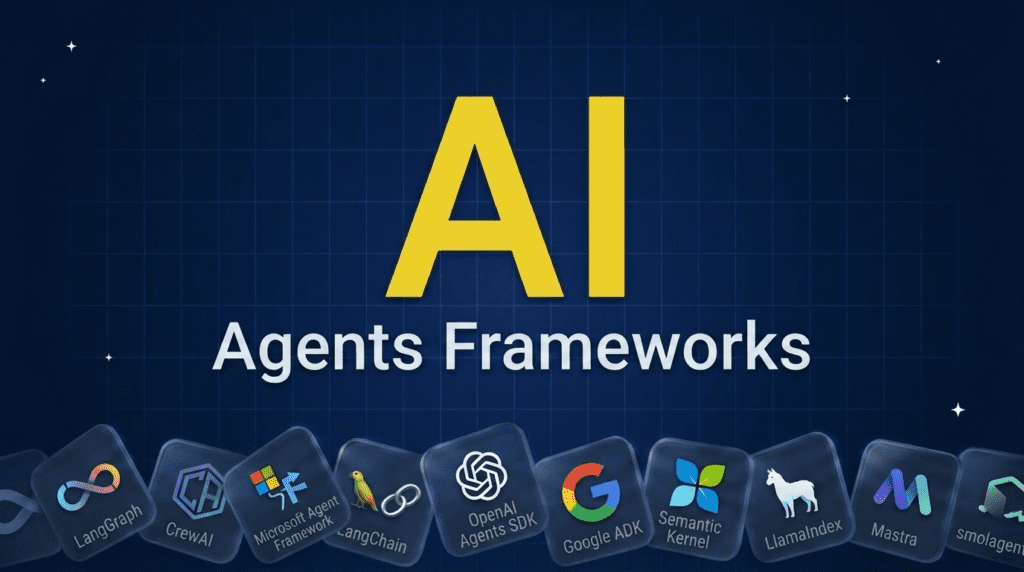
TL;DR: What You Need to Know
LangGraph is the best AI agent framework for most developers building production agents, giving you stateful, graph-based control over how an agent thinks and acts. For multi-agent teams, CrewAI is the fastest way to get a crew of role-based agents working together, and the new OpenAI Agents SDK is the lightest path if you are already on the OpenAI stack. If you work in JavaScript rather than Python, Mastra is the standout choice. The first thing to settle is what kind of agent you are building: a single agent that loops through tools, or a multi-agent system where several agents collaborate, and how much control versus autonomy you want. This guide ranks 10 frameworks across those needs, explains the Microsoft consolidation of AutoGen and Semantic Kernel, and covers the protocols (MCP and A2A) worth knowing before you commit.Pricing verified June 2026. AI tool pricing changes often, so confirm the current price on each vendor’s site before you subscribe. Inside AI Media is not an AI tool vendor; these picks are ranked on merit, not promotion.
Best AI agent frameworks at a glance
Here is the quick comparison, including the language and single-versus-multi-agent split that drives most of the choice. If you want ready-to-use agents rather than a framework to build your own, see our guide to the best AI agents instead.| Framework | Developer | License | Language | Best for |
|---|---|---|---|---|
| LangGraph | LangChain | Open-source (MIT) | Python, JS | Stateful orchestration and control |
| CrewAI | CrewAI | Open-source (Apache 2.0) | Python | Role-based multi-agent teams |
| Microsoft Agent Framework (AutoGen) | Microsoft | Open-source (MIT) | Python, .NET | Conversational multi-agent on Azure |
| LangChain | LangChain | Open-source (MIT) | Python, JS | Largest ecosystem, learning |
| OpenAI Agents SDK | OpenAI | Open-source (MIT) | Python | Lightweight agents with guardrails |
| Google ADK | Open-source | Python | Gemini and Vertex AI apps | |
| Semantic Kernel | Microsoft | Open-source (MIT) | C#, Python, Java | .NET and Java enterprises |
| LlamaIndex | LlamaIndex | Open-source | Python | RAG and data-centric agents |
| Mastra | Mastra | Open-source | TypeScript | JavaScript and TypeScript teams |
| smolagents | Hugging Face | Open-source | Python | Minimal, code-first single agents |
What is an AI agent framework?
An AI agent framework is a developer toolkit for building applications where a language model can plan, call tools, use memory, and act over multiple steps rather than just answering a single prompt. It handles the hard parts: looping the model through reasoning and tool calls, managing state and memory, coordinating multiple agents, and adding guardrails. This is different from a ready-made AI agent or a no-code builder, which gives you a finished assistant. A framework is for engineers building custom agentic systems in code.How we picked these frameworks
We weighed how much control the framework gives over an agent’s flow, its support for single versus multi-agent systems, the quality of memory and tool-calling, language support beyond Python, production features like observability and human-in-the-loop, the size and health of the community, and the license. We focused on actively maintained frameworks with real adoption, and we note where a project is in maintenance mode or being merged, since that matters for a long-term choice.The 10 best AI agent frameworks in 2026
1. LangGraph
LangGraph, from the LangChain team, is the framework most production teams settle on. It models an agent as a graph of nodes and edges with shared state, which gives you precise control over branching, loops, and where a human steps in, rather than hoping an autonomous loop behaves. It handles both single and multi-agent designs and is used by large engineering organizations.- Best for: stateful orchestration and fine control over production agents.
- Developer: LangChain (open-source, MIT); Python with a JavaScript version.
- Pros: graph-based state control, strong human-in-the-loop, LangSmith observability, wide adoption.
- Cons: a learning curve; you write more low-level code than in higher-level tools.
- Best for: complex production workflows. Skip if: you want the simplest possible setup.
2. CrewAI
CrewAI is built from the ground up for multi-agent systems, letting you define a crew of role-based agents that collaborate on a task, either in sequence or under a manager. It is independent of LangChain, needs little code to get a working team, and has seen heavy adoption for automating workflows, which makes it the fastest route to a multi-agent prototype.- Best for: role-based multi-agent teams set up quickly.
- Developer: CrewAI (open-source, Apache 2.0); Python.
- Pros: fast multi-agent setup, role-based design, layered memory, a visual studio option.
- Cons: less low-level control than a graph framework; Python only.
- Best for: agent teams. Skip if: you need a single tightly-controlled agent.
3. Microsoft Agent Framework (AutoGen)
Microsoft’s AutoGen pioneered event-driven, conversational multi-agent systems, and Microsoft has now unified AutoGen and Semantic Kernel into the Microsoft Agent Framework, its strategic agent platform going forward. It suits multi-agent applications on Azure and in .NET shops, with patterns for sequential, concurrent, and group-chat collaboration.- Best for: conversational multi-agent systems on Azure and .NET.
- Developer: Microsoft (open-source, MIT); Python and .NET.
- Pros: strong multi-agent patterns, Azure integration, backed by Microsoft.
- Cons: the original AutoGen is now folding into the Agent Framework, so check which to start on.
- Best for: Microsoft-stack teams. Skip if: you want a stable, single long-lived API today.
4. LangChain
LangChain is the framework that popularized building with LLMs, and it remains the largest ecosystem, with integrations for nearly every model, vector database, and tool. It is the easiest place to learn the concepts and wire up a straightforward agent, though for complex stateful agents most teams graduate to LangGraph, which sits in the same ecosystem.- Best for: the broadest ecosystem and learning the basics.
- Developer: LangChain (open-source, MIT); Python and JavaScript.
- Pros: huge integration library, big community, lots of tutorials, JS support.
- Cons: can feel over-abstracted; complex agents are better served by LangGraph.
- Best for: getting started. Skip if: you need graph-level control from day one.
5. OpenAI Agents SDK
The OpenAI Agents SDK is OpenAI’s lightweight, production-minded framework, the successor to its experimental Swarm project. It keeps the API small while adding the things real agents need, including tracing and guardrails, and it works with many model providers rather than only OpenAI, which makes it a low-friction starting point for new agent projects.- Best for: lightweight agents with built-in tracing and guardrails.
- Developer: OpenAI (open-source, MIT); Python.
- Pros: small learning curve, tracing and guardrails included, works with many LLMs.
- Cons: newer and less battle-tested than LangGraph; Python only.
- Best for: OpenAI-stack teams. Skip if: you need deep graph orchestration.
6. Google ADK
Google’s Agent Development Kit (ADK) is the framework for building agents tied to Gemini and Vertex AI. It supports hierarchical compositions of agents and custom tools with little code, and it integrates with Google Cloud’s agent tooling, which makes it the natural pick for teams already building on Google’s stack.- Best for: agents on Gemini, Vertex AI, and Google Cloud.
- Developer: Google (open-source); Python.
- Pros: tight Gemini and Vertex AI integration, hierarchical agents, concise code.
- Cons: most valuable inside the Google ecosystem; newer project.
- Best for: Google Cloud teams. Skip if: you are not using Gemini or Vertex AI.
7. Microsoft Semantic Kernel
Semantic Kernel is Microsoft’s enterprise SDK for adding AI and agents to applications, with first-class support for C#, Python, and Java. It uses a skill-and-planner model and fits cleanly into .NET and Java codebases. Like AutoGen, it is converging into the Microsoft Agent Framework, so it is best seen as part of that roadmap.- Best for: .NET and Java enterprise integration.
- Developer: Microsoft (open-source, MIT); C#, Python, Java.
- Pros: strong .NET and Java support, enterprise focus, planner and skills model.
- Cons: merging into the Microsoft Agent Framework, so plan for that transition.
- Best for: enterprise .NET/Java. Skip if: you work mainly in Python-first tooling.
8. LlamaIndex
LlamaIndex is the data-centric choice, built around connecting LLMs to your own data and now extended with agentic workflows. If your agent’s main job is retrieving and reasoning over documents, knowledge bases, or databases, LlamaIndex gives you strong RAG primitives plus event-driven multi-agent workflows in one place.- Best for: RAG and data-centric agents over your own content.
- Developer: LlamaIndex (open-source); Python.
- Pros: excellent RAG and data connectors, event-driven workflows, large ecosystem.
- Cons: less focused on general multi-agent orchestration than CrewAI or LangGraph.
- Best for: document and data agents. Skip if: retrieval is not central to your app.
9. Mastra
Mastra is the standout framework for JavaScript and TypeScript developers, an area most agent tooling ignores. Built by the team behind Gatsby, it offers graph-based workflows, multi-agent networks, tiered memory, a local development playground, and native OpenTelemetry tracing, all in a TypeScript-first package that fits web and full-stack teams.- Best for: JavaScript and TypeScript agent development.
- Developer: Mastra (open-source); TypeScript.
- Pros: TypeScript-first, graph workflows, multi-agent networks, built-in tracing and playground.
- Cons: younger ecosystem than the Python leaders; smaller community.
- Best for: JS/TS teams. Skip if: your stack is Python.
10. smolagents
smolagents, from Hugging Face, takes the opposite approach to the big frameworks: keep it tiny. Its CodeAgent has the model write and run Python to act, which is a remarkably compact and capable pattern, and you can build a working single agent in very little code. It runs code in a sandbox and is ideal for fast prototyping rather than large multi-agent systems.- Best for: minimal, code-first single agents and quick prototypes.
- Developer: Hugging Face (open-source); Python.
- Pros: very little code, code-writing agent pattern, sandboxed execution, easy to grasp.
- Cons: not built for complex multi-agent orchestration.
- Best for: lightweight agents. Skip if: you need a full multi-agent platform.
Single-agent vs multi-agent: which do you need?
This choice narrows the field fast. A single agent, one model looping through tools and memory, is enough for most tasks like answering questions over your data, automating a workflow, or operating a few tools, and it is simpler to build and debug. A multi-agent system, where several specialized agents collaborate, helps when a job naturally splits into roles, such as a researcher, a writer, and a reviewer, or when tasks run in parallel. Start with a single agent unless the problem clearly calls for several, since multi-agent systems add coordination complexity and cost. CrewAI and AutoGen lead for multi-agent, while smolagents and the OpenAI Agents SDK shine for single agents.Orchestration and control vs autonomy
Frameworks differ in how much they let the model decide. Orchestration-first tools like LangGraph and Mastra give you a graph or state machine where you define the steps and the model fills them in, which is predictable and easier to debug and the safer default for production. More autonomous designs let agents decide their own next steps and hand off to each other, which is flexible but harder to control and test. The trend in production is toward more control, not less, so favor a framework that lets you constrain the flow when reliability matters.Memory, tool-calling, and MCP
Three capabilities separate a toy agent from a useful one. Memory lets an agent remember context within and across sessions, and frameworks like CrewAI and Mastra offer tiered memory out of the box. Tool-calling is how an agent acts on the world, and most frameworks support both structured JSON tool calls and, in smolagents, code execution. The Model Context Protocol (MCP) has become a common standard for connecting agents to tools and data sources, and agent-to-agent (A2A) protocols are emerging for agents to talk to each other. Favor a framework with MCP support so you can reuse tools across systems rather than rebuilding integrations. To store the embeddings your agents retrieve, pair the framework with one of our best vector databases.Production-readiness: observability and guardrails
Getting an agent working in a notebook is easy; running it reliably in production is the hard part. Look for observability, the ability to trace every step an agent took so you can debug failures, which LangGraph (via LangSmith), Mastra, and the OpenAI Agents SDK provide. Guardrails that validate inputs and outputs keep agents from going off the rails, and human-in-the-loop support lets a person approve risky actions. Before you ship, add evaluation so you can catch regressions, which our best LLM evaluation tools guide covers.Do you even need a framework?
Not always. For a simple agent that calls one or two tools, you can write the loop yourself against a model’s API and avoid a framework’s abstractions entirely, which some teams prefer for full control. A framework earns its place when you need multi-agent coordination, durable memory, reusable tool integrations, observability, and guardrails without building all of it from scratch. If you are prototyping a basic single agent, try plain code or a lightweight option like smolagents first, and reach for a fuller framework as the requirements grow.Best AI agent framework by use case
| Use case | Best picks |
|---|---|
| Production orchestration and control | LangGraph, Mastra |
| Multi-agent teams | CrewAI, AutoGen, OpenAI Agents SDK |
| RAG and data-centric agents | LlamaIndex |
| JavaScript / TypeScript | Mastra |
| Enterprise (.NET / Java / cloud) | Semantic Kernel, Microsoft Agent Framework, Google ADK |
| Beginners and lightweight prototypes | LangChain, OpenAI Agents SDK, smolagents |
The bottom line on AI agent frameworks
The best AI agent framework depends on your stack and how much control you want. LangGraph is the strongest default for production agents, CrewAI is the quickest way to build a multi-agent team, the OpenAI Agents SDK is the lightest start, and Mastra is the answer for JavaScript and TypeScript. Decide between single and multi-agent first, favor orchestration and observability for anything going to production, prefer frameworks with MCP support so your tools are reusable, and remember that for a simple agent you may not need a framework at all.Related Blogs
Frequently asked questions
LangGraph is the best all-round choice for production agents thanks to its stateful, graph-based control, while CrewAI leads for multi-agent teams and the OpenAI Agents SDK is the lightest place to start. The right pick depends on your language, whether you need single or multi-agent, and how much control you want.
Most leading frameworks are open-source, including LangGraph, CrewAI, AutoGen, LangChain, the OpenAI Agents SDK, Semantic Kernel, LlamaIndex, Mastra, and smolagents. LangGraph and CrewAI are the most widely used for production.
LangGraph gives graph-based control over a single or multi-agent workflow and is best for production reliability. CrewAI is built for role-based multi-agent teams set up quickly. AutoGen, now part of the Microsoft Agent Framework, focuses on conversational multi-agent systems, especially on Azure.
Start with a single agent for most tasks, since it is simpler to build and debug. Use a multi-agent system when the job splits naturally into roles or runs in parallel. Multi-agent adds coordination complexity and cost, so only reach for it when the problem calls for it.
LangChain and the OpenAI Agents SDK are the easiest ways for developers to learn agent concepts, and smolagents lets you build a single agent in very little code. CrewAI is a friendly entry point for your first multi-agent project.
Not always. For a simple agent calling one or two tools, you can write the loop against a model’s API yourself. A framework is worth it once you need multi-agent coordination, durable memory, reusable tools, observability, and guardrails without building them from scratch.
Mastra is the standout TypeScript-first agent framework, with graph workflows, multi-agent networks, memory, and tracing. LangChain and LangGraph also offer JavaScript versions if you want their ecosystem.
MCP, the Model Context Protocol, is a common standard for connecting agents to tools and data, and A2A is an emerging standard for agents to communicate with each other. Choosing a framework with MCP support lets you reuse tool integrations across systems rather than rebuilding them.

Inside AI Media is a global platform that covers what’s happening in AI without the fluff. From breaking news to practical use cases, it keeps professionals, builders, and decision-makers updated on the latest in artificial intelligence, so they can make better, faster decisions and stay ahead.