TL;DR: What You Need to Know
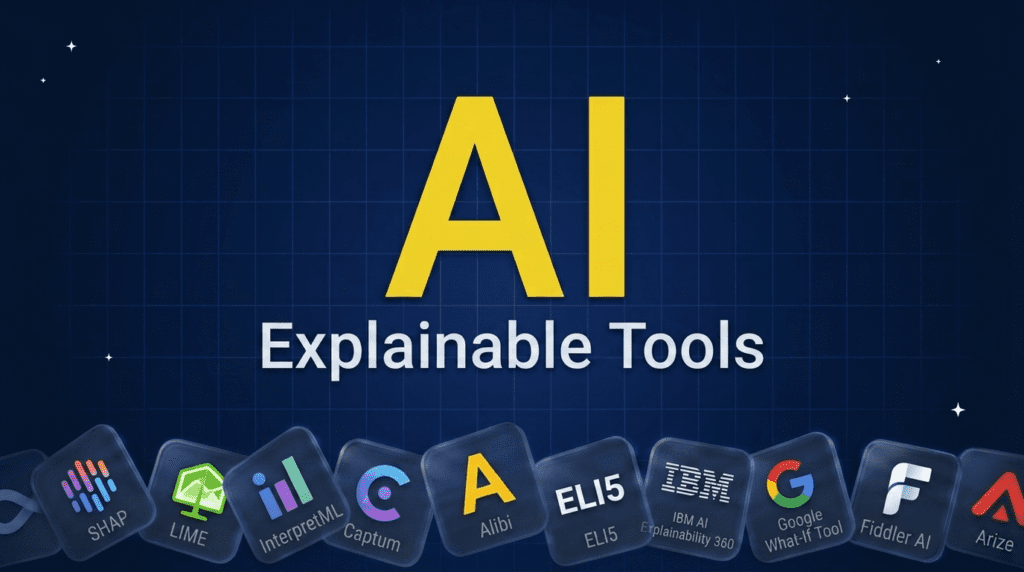
Explainable AI (XAI) tools open up the “black box” of machine-learning models, showing why a model made a prediction, which matters for trust, debugging, fairness, and compliance. The open-source standards are SHAP and LIME, alongside InterpretML, Captum, Alibi, and ELI5, plus toolkits from IBM (AIX360) and Google (What-If Tool). For production monitoring with explainability, the platforms Fiddler AI, Arize, H2O.ai, and DataRobot lead. Pick by whether you need a library for analysis or a platform for production.Pricing verified June 2026. AI tool pricing changes often, so confirm the current price on each vendor’s site before you subscribe. Inside AI Media is not an AI tool vendor; these picks are ranked on merit, not promotion.
The best explainable AI tools at a glance
Here is how the main explainable AI tools compare on what they do and their type. The open-source libraries are free; the platforms are commercial, so confirm pricing with the vendor.| Tool | Best for | Type |
|---|---|---|
| SHAP | Feature attribution | Open-source library |
| LIME | Local explanations | Open-source library |
| InterpretML | Glassbox + blackbox models | Open-source library |
| Captum | PyTorch model interpretability | Open-source library |
| Alibi | Inspection + counterfactuals | Open-source library |
| ELI5 | Debugging ML classifiers | Open-source library |
| IBM AI Explainability 360 | A toolkit of methods | Open-source toolkit |
| Google What-If Tool | Visual model probing | Visual toolkit |
| Fiddler AI | Production explainability | Platform |
| Arize | ML observability + XAI | Platform |
| H2O.ai | Explainability in AutoML | Platform |
| DataRobot | Enterprise AutoML XAI | Platform |
What is explainable AI?
Explainable AI (XAI) is a set of methods and tools that make a machine-learning model’s decisions understandable to humans, answering why the model predicted what it did, rather than leaving it as an opaque “black box.” This matters because many models are too complex to interpret directly, yet people need to trust, debug, and govern them, especially in regulated areas like finance, healthcare, and hiring, and to meet rules like the EU AI Act. Common techniques include feature attribution (which inputs mattered most, via SHAP or LIME), counterfactuals (what would change the outcome), and inherently interpretable “glassbox” models. The tools below range from open-source libraries for analysis to platforms that bring explainability to production, and explainability is a core part of broader AI governance.How we picked these XAI tools
We are an independent publisher and do not sell XAI software, so none of these picks is our own product. We grouped tools by type, then weighed each on capability, adoption, how well it explains different kinds of models, and fit for analysis versus production. We focused on the libraries and platforms data-science and ML teams actually use to interpret and monitor models.Best open-source explainability libraries
These are the free, code-based standards for understanding model behavior.1. SHAP, best for feature attribution
SHAP (SHapley Additive exPlanations) is the most widely used explainability library, using game-theory-based Shapley values to show how much each feature contributed to a prediction, both locally and globally. It is accurate, model-agnostic, and the de facto standard for explaining model outputs.- Known for: Rigorous, model-agnostic feature attribution.
- Best for: Understanding which features drive predictions.
2. LIME, best for local explanations
LIME (Local Interpretable Model-agnostic Explanations) explains individual predictions by approximating the model locally with a simple, interpretable one. It is fast and intuitive for understanding single decisions, and along with SHAP is one of the two foundational XAI techniques.- Known for: Simple, fast local explanations.
- Best for: Explaining individual predictions quickly.
3. InterpretML, best for glassbox and blackbox models
InterpretML, from Microsoft, offers both inherently interpretable “glassbox” models (like Explainable Boosting Machines) and techniques to explain existing blackbox models, in one library. For teams that want accuracy and interpretability together, it is a powerful open-source option.- Known for: Glassbox models plus blackbox explanations.
- Best for: Building interpretable models from the start.
4. Captum, best for PyTorch interpretability
Captum is Meta’s model-interpretability library for PyTorch, providing attribution methods to understand which inputs and neurons drive a deep-learning model’s output. For teams building in PyTorch, especially deep neural networks, it is the native interpretability toolkit.- Known for: Interpretability for PyTorch deep-learning models.
- Best for: Explaining neural networks built in PyTorch.
5. Alibi, best for inspection and counterfactuals
Alibi, from Seldon, focuses on model inspection and explanation, including counterfactual explanations (what would need to change for a different outcome) and other advanced methods. For teams that want richer explanation types beyond feature importance, it is a strong library.- Known for: Counterfactual and advanced explanations.
- Best for: Richer, actionable model explanations.
6. ELI5, best for debugging classifiers
ELI5 (“Explain Like I’m 5”) is a lightweight library for debugging machine-learning classifiers and explaining their predictions, with support for common frameworks. For quick, accessible inspection of simpler models, it is an easy starting point.- Known for: Simple debugging and explanation of classifiers.
- Best for: Quick inspection of traditional ML models.
Best explainability toolkits
These bundle multiple methods, including visual tools, in one place.7. IBM AI Explainability 360, best as a methods toolkit
AI Explainability 360 (AIX360) is IBM’s open-source toolkit bundling a wide range of explanation algorithms and metrics, so teams can choose the right method for their model and audience. For organizations wanting a comprehensive, research-backed set of XAI methods, it is a strong toolkit.- Known for: A broad toolkit of explanation methods.
- Best for: Choosing the right method for each case.
8. Google What-If Tool, best for visual model probing
Google’s What-If Tool lets you visually probe a model’s behavior without code, exploring how predictions change as you tweak inputs, and analyzing fairness across groups. For an interactive, visual way to understand and stress-test a model, it is uniquely accessible.- Known for: Interactive, no-code model exploration.
- Best for: Visually probing model behavior and fairness.
Best explainability platforms for production
These bring explainability to deployed models, with monitoring and governance.9. Fiddler AI, best for production explainability
Fiddler AI is an AI observability platform with explainability at its core, monitoring deployed models and explaining their predictions, drift, and bias in production. For teams that need explainability operationalized, not just used in a notebook, it is a leading platform.- Known for: Explainability and monitoring in production.
- Best for: Operationalizing XAI for live models.
10. Arize, best for ML observability with XAI
Arize is an ML and LLM observability platform that includes explainability, helping teams monitor, troubleshoot, and explain model behavior in production at scale. For organizations running many models and wanting explanation built into observability, it is a strong choice.- Known for: ML/LLM observability with explainability.
- Best for: Monitoring and explaining models at scale.
11. H2O.ai, best for explainability in AutoML
H2O.ai builds explainability into its machine-learning and AutoML platform, offering model-interpretability features so users understand the models it helps create. For teams using H2O to build models, explanation comes built in rather than bolted on.- Known for: Interpretability within an AutoML platform.
- Best for: Explaining models built with H2O.
12. DataRobot, best for enterprise AutoML XAI
DataRobot includes strong explainability in its enterprise AutoML platform, providing feature impact, prediction explanations, and bias checks so business users can trust automated models. For enterprises operationalizing AutoML, its built-in explanations support trust and governance.- Known for: Explainability in enterprise AutoML.
- Best for: Enterprises wanting explainable automated models.
How to choose an explainable AI tool
Start with what you are doing. For analyzing and debugging models in code, the open-source libraries lead: SHAP and LIME are the must-knows, with Captum for PyTorch, InterpretML for interpretable models, and Alibi for counterfactuals. For a visual, no-code look, Google’s What-If Tool; for a broad method toolkit, IBM AIX360. If you need explainability in production with monitoring and governance, a platform like Fiddler AI or Arize, or the built-in explainability of H2O.ai or DataRobot if you build models there. Match the tool to your model type and whether your need is one-off analysis or ongoing, governed production use.Frequently asked questions
They are libraries and platforms that make machine-learning models’ decisions understandable, showing why a model predicted what it did. Open-source ones like SHAP and LIME explain models in code, while platforms like Fiddler AI and Arize bring explainability to production with monitoring. They support trust, debugging, fairness, and compliance.
A common example is using SHAP to show that a loan-approval model weighted income and credit history most heavily for a given applicant, making the decision transparent. Techniques like SHAP, LIME, and counterfactual explanations are typical examples of explainable AI in practice.
Not really. Large language models like ChatGPT are extremely complex and not inherently explainable, you cannot easily see why they produced a specific output. There is active research into explaining LLMs, and observability platforms are adding LLM tracing, but they are far less interpretable than traditional ML models.
It builds trust, helps debug and improve models, surfaces bias and fairness issues, and is increasingly required for compliance with regulations like the EU AI Act. In high-stakes areas, finance, healthcare, hiring, being able to explain an AI decision is essential for accountability and often legally necessary.
Both explain individual predictions, but SHAP uses game-theory-based Shapley values for consistent, theoretically grounded feature attributions, while LIME approximates the model locally with a simpler one for fast, intuitive explanations. SHAP is more rigorous and popular; LIME is simpler and quicker. Many teams use both.

Inside AI Media is a global platform that covers what’s happening in AI without the fluff. From breaking news to practical use cases, it keeps professionals, builders, and decision-makers updated on the latest in artificial intelligence, so they can make better, faster decisions and stay ahead.