TL;DR: What You Need to Know
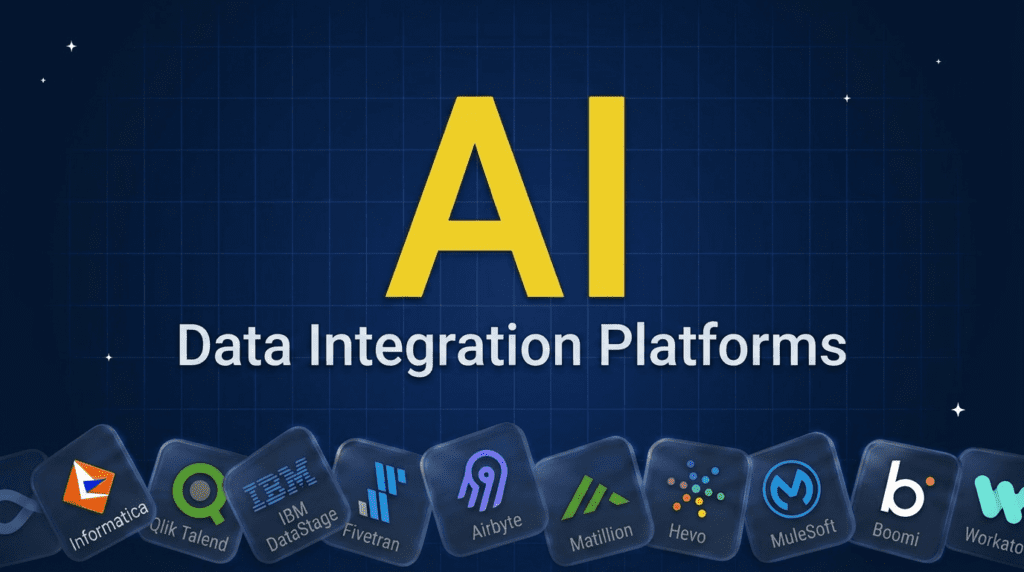
AI data integration platforms connect and unify data across your systems, increasingly using AI to build and maintain those connections. For enterprise data integration, Informatica, Qlik Talend, and IBM lead. For automated cloud pipelines, Fivetran, Airbyte, Matillion, and Hevo. And for connecting apps as well as data (iPaaS), MuleSoft, Boomi, Workato, SnapLogic, and Celigo. Pick by whether you need enterprise data integration, simple cloud pipelines, or broad app-and-data integration.Pricing verified June 2026. AI tool pricing changes often, so confirm the current price on each vendor’s site before you subscribe. Inside AI Media is not an AI tool vendor; these picks are ranked on merit, not promotion.
The best AI data integration platforms at a glance
Here is how the leading platforms compare on what they are best for and their category. Most are enterprise and quote-based, so confirm pricing with the vendor.| Platform | Best for | Category |
|---|---|---|
| Informatica | Enterprise data integration | Enterprise |
| Qlik Talend | Integration + data quality | Enterprise |
| IBM DataStage | Large-scale integration | Enterprise |
| Fivetran | Automated ELT pipelines | Cloud pipeline |
| Airbyte | Open-source connectors | Cloud pipeline |
| Matillion | Cloud integration + AI | Cloud pipeline |
| Hevo | No-code pipelines | Cloud pipeline |
| MuleSoft | API-led integration | iPaaS |
| Boomi | App and data integration | iPaaS |
| Workato | Integration + automation | iPaaS |
| SnapLogic | AI-powered integration | iPaaS |
| Celigo | Accessible iPaaS | iPaaS |
What are AI data integration platforms?
Data integration platforms connect data from many sources, databases, apps, files, APIs, and combine it into a unified, usable form, whether in a warehouse, across applications, or in real time. AI increasingly powers this: suggesting how to map and connect data, automating transformations, detecting schema changes, and fixing pipeline errors. The category spans a few types. Enterprise data integration platforms handle complex, governed integration at scale. Cloud data-pipeline tools (often ELT) move data into warehouses simply. And integration platforms as a service (iPaaS) connect applications as well as data, automating workflows between systems. ETL is one part of this; for the pipeline-stage view, see our ETL tools for AI guide. The right platform depends on whether you are integrating data, apps, or both.How we picked these AI data integration tools
We are an independent publisher and do not sell integration software, so none of these picks is our own product. We grouped platforms by type, then weighed each on connectivity, AI capabilities, scalability, ease of use, and fit for both modern cloud stacks and enterprises. We focused on platforms organizations actually run in production.Enterprise data integration platforms
These handle complex, governed integration at large scale.1. Informatica, known for enterprise data integration
Informatica’s Intelligent Data Management Cloud is a comprehensive enterprise platform for data integration, quality, and governance, with its CLAIRE AI engine automating much of the work. For large, complex organizations that need scale, governance, and AI-assisted integration, it is an established leader.- Known for: AI-assisted enterprise data integration at scale.
- Best for: Large enterprises needing governed integration.
2. Qlik Talend, known for integration plus data quality
Qlik’s data integration, built on Talend, combines integration with strong data quality and governance, helping ensure the data you unify is also trustworthy, with AI assisting throughout. For organizations where data accuracy matters as much as movement, its quality focus stands out.- Known for: Integration with built-in data quality.
- Best for: Teams prioritizing trustworthy, governed data.
3. IBM DataStage, known for large-scale integration
IBM’s DataStage and broader data-integration portfolio handle high-volume, complex integration for large enterprises, increasingly enhanced with IBM’s AI. For organizations with demanding, large-scale integration needs and a preference for an established enterprise vendor, it is a robust choice.- Known for: High-volume enterprise data integration.
- Best for: Enterprises with complex, large-scale needs.
Cloud data-pipeline platforms (ELT)
These move data into warehouses simply, the backbone of the modern data stack.4. Fivetran, known for automated ELT pipelines
Fivetran automates extracting and loading data from hundreds of sources into your warehouse with fully managed, maintenance-free connectors. For teams that want reliable data ingestion without building and fixing pipelines, it is the leading managed ELT platform.- Known for: Hands-off, reliable data pipelines.
- Best for: Teams wanting managed warehouse ingestion.
5. Airbyte, known for open-source connectors
Airbyte is the leading open-source data integration tool, with a vast connector library and the option to self-host for control and cost savings. For teams that want flexibility, custom connectors, or to avoid managed-tool pricing, it is the open standard.- Known for: Open-source, flexible data integration.
- Best for: Teams wanting control and custom connectors.
6. Matillion, known for cloud integration with AI
Matillion is a cloud-native data integration platform for ingestion and transformation, with AI to help build pipelines and work with data in natural language. For organizations on cloud warehouses wanting a powerful, increasingly AI-driven platform, it is a strong choice.- Known for: Cloud-native, AI-enhanced integration.
- Best for: Cloud-warehouse teams wanting AI features.
7. Hevo, known for no-code pipelines
Hevo offers no-code, real-time data pipelines that move data from sources to your warehouse with minimal setup and automatic schema handling. For smaller teams or those without dedicated data engineers, it makes reliable integration accessible without code.- Known for: No-code, real-time data pipelines.
- Best for: Lean teams wanting easy integration.
Integration platforms as a service (iPaaS)
These connect applications as well as data, automating workflows between systems.8. MuleSoft, known for API-led integration
MuleSoft, part of Salesforce, is a leading platform for connecting applications and data through APIs, with a pioneering API-led approach and AI to accelerate integration. For enterprises that want to integrate systems via reusable APIs, it is a dominant choice.- Known for: API-led application and data integration.
- Best for: Enterprises building reusable API integrations.
9. Boomi, known for app and data integration
Boomi is a leading iPaaS for connecting applications, data, and processes across cloud and on-premises systems, with AI to suggest and build integrations. For organizations integrating many SaaS and legacy systems, its breadth and low-code approach are the draw.- Known for: Broad, low-code app and data integration.
- Best for: Companies connecting many SaaS and legacy systems.
10. Workato, known for integration plus automation
Workato combines enterprise integration with workflow automation, connecting systems and automating processes between them, increasingly with AI. For organizations that want to both integrate data and automate the workflows around it in one platform, it is a powerful option.- Known for: Integration unified with automation.
- Best for: Teams integrating and automating together.
11. SnapLogic, known for AI-powered integration
SnapLogic is an iPaaS built around AI, with its Iris AI assisting integration design and accelerating how teams connect apps and data. For organizations that want AI woven through the integration experience itself, it is a strong, AI-forward platform.- Known for: AI-assisted integration design.
- Best for: Teams wanting AI-driven integration building.
12. Celigo, known for accessible iPaaS
Celigo is an iPaaS focused on making integration accessible to both IT and business teams, with prebuilt integrations and AI to connect common SaaS apps quickly. For mid-sized organizations that want practical, fast app integration without heavy complexity, it is a popular choice.- Known for: Accessible, prebuilt SaaS integration.
- Best for: Mid-sized teams connecting SaaS apps fast.
How to choose an AI data integration platform
Start with what you are integrating. If you need to move data into a warehouse simply, a cloud pipeline tool, Fivetran, Airbyte, Matillion, or Hevo, is the easiest path. If you need to connect applications and automate workflows between them, an iPaaS like MuleSoft, Boomi, Workato, SnapLogic, or Celigo fits. For complex, governed, large-scale data integration, the enterprise platforms, Informatica, Qlik Talend, or IBM, lead. Weigh the connectors you need, AI capabilities, governance, and whether your priority is data, apps, or both, and pilot on a real integration before committing.Frequently asked questions
Informatica, Qlik Talend, and IBM lead for enterprise data integration; Fivetran, Airbyte, Matillion, and Hevo for cloud data pipelines; and MuleSoft, Boomi, Workato, SnapLogic, and Celigo for connecting apps and data (iPaaS). The best depends on whether you integrate data, apps, or both.
They are tools that connect data from many sources, databases, apps, files, and APIs, and unify it into a usable form, in a warehouse, across applications, or in real time. AI increasingly helps by mapping data, automating transformations, and maintaining the connections.
ETL (extract, transform, load) is one method of data integration, focused on moving and transforming data into a destination. Data integration is broader, also covering real-time integration, app-to-app connection via iPaaS, and data virtualization. ETL tools are a subset of the wider data integration landscape.
iPaaS, integration platform as a service, is a cloud platform for connecting applications, data, and processes across systems, often with low-code tools and prebuilt connectors. MuleSoft, Boomi, and Workato are leading examples, used to integrate SaaS and legacy systems and automate workflows between them.
AI assists by suggesting how to map and connect data, automating transformations, detecting and adapting to schema changes, recommending integrations, and fixing pipeline errors, reducing the manual engineering integration traditionally requires. Most leading platforms now build AI into the integration experience.

Inside AI Media is a global platform that covers what’s happening in AI without the fluff. From breaking news to practical use cases, it keeps professionals, builders, and decision-makers updated on the latest in artificial intelligence, so they can make better, faster decisions and stay ahead.