TL;DR: What You Need to Know
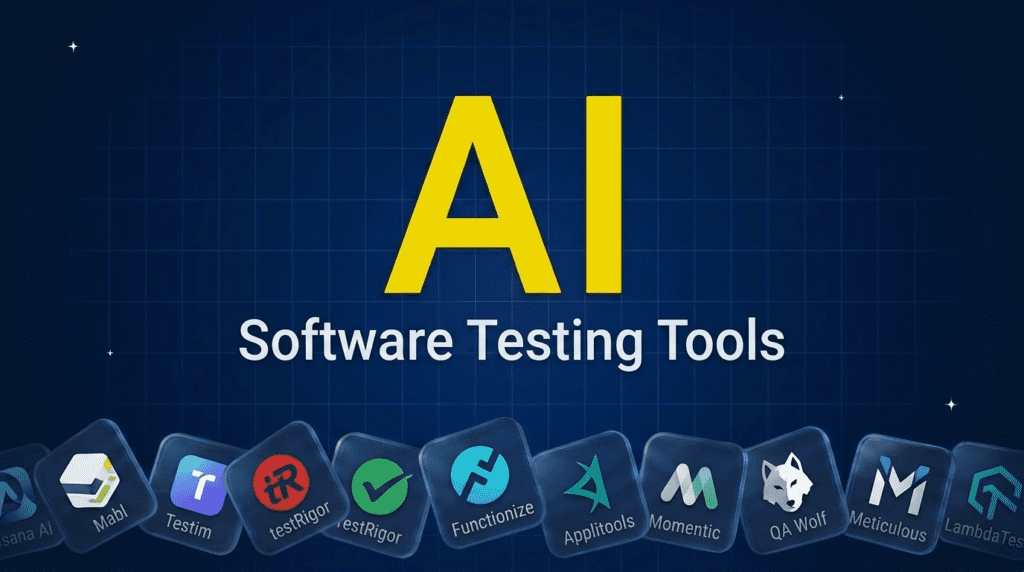
The best AI tools for software testing create, run, and maintain tests with far less manual effort, and many heal themselves when the app changes. For low-code, self-healing automation, Mabl, Testim, and testRigor lead. For maintenance-heavy suites, Functionize; for visual checks, Applitools; and for AI-native end-to-end testing, Momentic. QA Wolf runs QA as a managed agentic service, Meticulous auto-generates tests from usage, and LambdaTest adds an AI agent across browsers. Pick by whether you want a tool your team runs or a service that runs it for you.Pricing verified June 2026. AI tool pricing changes often, so confirm the current price on each vendor’s site before you subscribe. Inside AI Media is not an AI tool vendor; these picks are ranked on merit, not promotion.
The best AI tools for software testing at a glance
Here is how the main tools compare on what they suit, the testing type, the free option, and pricing model. Testing tools are often quote-based or tiered by usage, so confirm with the vendor before committing.| Tool | Best for | Testing type | Free option | Pricing |
|---|---|---|---|---|
| Mabl | Low-code intelligent automation | E2E / regression | Trial | Quote |
| Testim | Self-healing UI tests | Functional / UI | Trial | Quote |
| testRigor | Plain-English test creation | E2E / functional | Yes | Quote |
| Functionize | Low-maintenance test suites | E2E / functional | Trial | Quote |
| Applitools | Visual UI testing | Visual | Yes | Quote |
| Momentic | AI-native web and mobile | E2E | Trial | Quote |
| QA Wolf | Managed agentic QA | E2E (service) | No | Quote |
| Meticulous | Auto-generated tests | Regression | Trial | Quote |
| LambdaTest | Cross-browser + AI agent | Cross-browser | $15/mo | $15/mo |
How is AI used in software testing?
AI takes on the slowest, most brittle parts of QA. It creates tests from plain English or from watching how people use an app, heals tests automatically when selectors or layouts change so they stop breaking on every release, catches visual bugs a human might miss, and prioritizes which tests to run. Some tools now act as agents that explore an app and generate and maintain whole suites on their own. The result is broader test coverage with far less maintenance, freeing QA engineers from rewriting flaky scripts to focus on harder testing. A human still defines what “correct” means and reviews what the AI flags.How we picked this AI tools for software testing
We are an independent publisher and do not sell testing software, so none of these picks is our own product. We grouped tools by how you test, then weighed each on how well its AI creates and maintains tests, integration with CI/CD and existing stacks, the balance between control and automation, and value. We focused on mostly US-based tools teams actually use, and we left out the IDE copilots that write code and tests inside the editor, which our coding guide covers.Best AI tools for test automation
These create and maintain functional and end-to-end tests with low code and self-healing.1. Mabl, best for low-code intelligent automation
Mabl is a low-code test automation platform that uses AI to create, run, and auto-heal end-to-end tests across web, mobile, and APIs, integrating cleanly into CI/CD. Its self-healing and maintenance reduction make it a favorite for teams that want broad coverage without a script breaking on every UI change.- Best for: Low-code, self-healing end-to-end automation.
- Pricing: Trial; quote-based.
- Skip if: you want a fully managed QA service.
2. Testim, best for self-healing UI tests
Testim, part of Tricentis, uses AI to author and stabilize functional and UI tests, with smart locators that adapt when the app changes so tests stay reliable. It suits teams that want fast test creation and resilient UI automation that does not crumble with each release.- Best for: Stable, self-healing UI and functional tests.
- Pricing: Trial; quote-based.
- Skip if: your testing is mostly API or unit level.
3. testRigor, best for plain-English test creation
testRigor lets you write tests in plain English, describing behavior the way a user would, and its AI turns that into executable, low-maintenance tests across web, mobile, and desktop. It is a strong pick for teams that want manual QA and non-engineers to build automated tests without code.- Best for: Codeless tests written in plain English.
- Pricing: Free tier; paid quote-based.
- Skip if: your team prefers code-based test frameworks.
4. Functionize, best for low-maintenance test suites
Functionize uses AI to build and, crucially, maintain large test suites, adapting tests automatically as the application evolves to cut the maintenance burden that sinks many automation efforts. For enterprises with sprawling, fast-changing apps, its self-maintenance is the main draw.- Best for: Large suites where maintenance is the bottleneck.
- Pricing: Trial; quote-based.
- Skip if: you have a small, stable test suite.
Best AI tools for visual and AI-native testing
One catches what users see, the other was built AI-first from the ground up.5. Applitools, best for visual UI testing
Applitools pioneered visual AI testing, using computer vision to detect visual bugs, layout breaks, and rendering issues across browsers and devices that functional tests miss entirely. For teams where how the product looks matters as much as how it works, it is the leading visual testing tool.- Best for: Catching visual and layout bugs across devices.
- Pricing: Free tier; paid quote-based.
- Skip if: visual correctness is not a priority.
6. Momentic, best for AI-native end-to-end testing
Momentic is a newer, AI-native testing tool for web and mobile that lets teams build and run reliable end-to-end tests quickly, using AI to author and stabilize them. It appeals to engineering teams that want a modern, fast tool built around AI rather than retrofitted onto an older framework.- Best for: Modern, AI-first end-to-end testing.
- Pricing: Trial; quote-based.
- Skip if: you need a long-established enterprise vendor.
Best agentic and managed AI QA
These hand more of the work to AI, or to a service that runs it for you.7. QA Wolf, best for managed agentic QA
QA Wolf runs end-to-end testing as a managed service, using AI agents plus a team to build, run, and maintain your test suite and triage failures, aiming for high coverage without you staffing QA. For teams that want results rather than another tool to manage, the done-for-you model is the appeal.- Best for: Outsourcing E2E QA to an AI-plus-human service.
- Pricing: Quote-based.
- Skip if: you want to own and run testing in-house.
8. Meticulous, best for auto-generated tests
Meticulous records real usage of your app and uses AI to automatically generate and maintain tests from it, so you get regression coverage without writing tests at all. For teams that struggle to find time to write tests, generating them from actual behavior is a clever shortcut to coverage.- Best for: Regression coverage with no test writing.
- Pricing: Trial; quote-based.
- Skip if: you need scripted, highly specific test cases.
Best AI tool for cross-browser testing
9. LambdaTest, best for cross-browser testing with an AI agent
LambdaTest is a cloud platform for testing across thousands of browser and device combinations, now with KaneAI, an AI agent that authors, manages, and debugs tests from natural language. For teams that need wide cross-browser coverage plus AI-driven test creation in one place, it is a practical, accessible choice.- Best for: Cross-browser and device testing with AI authoring.
- Pricing: Free (limited minutes); Virtual Live $15/mo; ChromeOS Live $29/mo; Real Device Plus Live $39/mo; Enterprise custom. Now branded TestMu AI.
- Skip if: you only test a single browser or platform.
How to choose the right AI testing tool
Start with how much you want to own. If your team runs testing, a low-code self-healing tool like Mabl, Testim, or testRigor fits, with Functionize for maintenance-heavy suites. If looks matter, add Applitools; if you want a modern AI-first tool, Momentic; and for wide browser coverage, LambdaTest. If you would rather not staff QA at all, QA Wolf runs it as a service, and Meticulous generates tests from real usage. Decide whether you want deterministic, code-owned tests or adaptive AI behavior, check the CI/CD integration, and pilot on a real part of your app, since reliability and maintenance are what make or break test automation.Frequently asked questions
Common ones include Mabl, Testim, testRigor, and Functionize for test automation, Applitools for visual testing, Momentic for AI-native E2E, QA Wolf as a managed service, Meticulous for auto-generated tests, and LambdaTest for cross-browser. Most teams pick based on whether they run testing themselves or want it managed.
Yes, extensively. AI creates tests from plain English or recorded usage, heals them automatically when the app changes, detects visual bugs, prioritizes test runs, and increasingly acts as an agent that explores and tests an app on its own. It cuts the manual maintenance that makes traditional automation hard to sustain.
Self-healing means the tool automatically updates a test when the application changes, like when a button’s location or code changes, instead of the test failing and needing a manual fix. It is one of AI testing’s biggest benefits, because test maintenance is the main reason automation efforts fail over time.
No. AI automates test creation, maintenance, and execution and makes QA far more efficient, but engineers are still needed to decide what to test, define correct behavior, design strategy, and judge complex cases. The role shifts from writing and fixing scripts toward higher-value quality work.
Some tools like testRigor, Applitools, and LambdaTest offer free tiers, and many vendors provide trials. The most capable enterprise and managed options are quote-based, since their value is in automation, scale, and maintenance. Trying a free tier on a real flow is the best way to judge reliability.

Inside AI Media is a global platform that covers what’s happening in AI without the fluff. From breaking news to practical use cases, it keeps professionals, builders, and decision-makers updated on the latest in artificial intelligence, so they can make better, faster decisions and stay ahead.