TL;DR: What You Need to Know
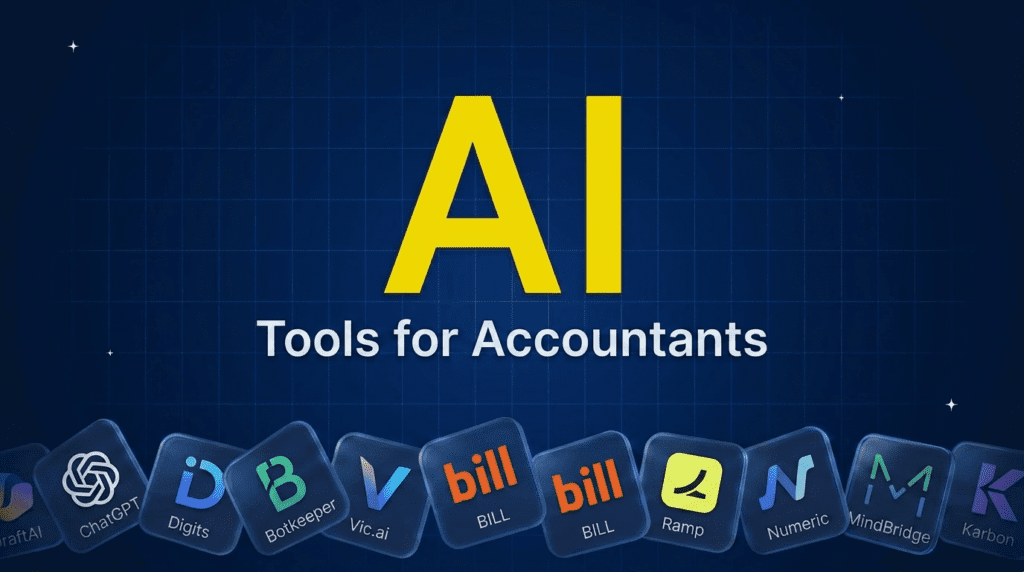
The best AI tools for accountants depend on the task. For research, drafting, and explaining, ChatGPT is the cheapest win. For automated bookkeeping, Digits and Botkeeper lead. For accounts payable, Vic.ai and BILL process invoices with little manual work, and Ramp handles expenses. For the month-end close, Numeric is the standout, and MindBridge brings AI to audit. For firms, Karbon adds AI to practice management. Whatever you use, you stay responsible for accuracy and compliance, so review the numbers before they are filed.Pricing verified June 2026. AI tool pricing changes often, so confirm the current price on each vendor’s site before you subscribe. Inside AI Media is not an AI tool vendor; these picks are ranked on merit, not promotion.
The best AI tools for accountants at a glance
Here is how the main tools compare on the job they do, who they suit, the free option, and where paid plans start. Accounting software is often quote-based or tiered by usage, so confirm with the vendor before committing.| Tool | Best for | Function | Free option | Starting price |
|---|---|---|---|---|
| ChatGPT | Research, drafting, explaining | All-purpose | Yes | $20/mo |
| Digits | AI-native bookkeeping | Bookkeeping | $65/mo | See site |
| Botkeeper | Automated bookkeeping for firms | Bookkeeping | $53/user/mo | Quote |
| Vic.ai | Autonomous invoice processing | Accounts payable | No | Quote |
| BILL | AP and AR automation | Accounts payable | $49/user/mo | $45/user/mo |
| Ramp | Expense management + AI | Expenses | Free | Free / paid |
| Numeric | Month-end close | Close | $30/user/mo | Quote |
| MindBridge | AI audit and anomaly detection | Audit | No | Quote |
| Karbon | AI practice management | Firm ops | $59/user/mo | $59/user/mo |
How is AI used in accounting?
AI takes on the repetitive, high-volume work that fills an accountant’s day. It automates data entry and bookkeeping, codes and approves invoices, matches transactions and speeds up the month-end close, flags anomalies and risk in audits, drafts client communications, and answers technical questions in plain language. It does not replace professional judgment, and it should not file anything unchecked: accountants remain responsible for accuracy, compliance, and the advice they give. Used well, AI clears the grunt work so accountants spend more time on analysis and clients, with a human reviewing every number that matters.How we picked AI tools for accountants
We are an independent publisher and do not sell accounting software, so none of these picks is our own product. We grouped tools by the accounting job they do, then weighed each on how well it does that job, integration with common ledgers and systems, data security for sensitive financial information, and value for both solo accountants and firms. Because accounting is compliance-sensitive, we treated accuracy and human oversight as essential, not optional.Best all-purpose AI tool for accountants
ChatGPT, best for research, drafting, and explaining
ChatGPT is the fastest, cheapest AI win for accountants. It explains a tricky standard in plain English, drafts client emails and engagement letters, summarizes long documents, and helps with spreadsheet formulas and analysis. It is not a source of authoritative tax or accounting rulings, so verify anything technical against primary guidance, and never paste confidential client data into a public tool.- Best for: Research, drafting, and explaining concepts.
- Pricing: Free tier; Plus around $20/mo.
- Skip if: you need a tool connected to your ledger and data.
Best AI tools for bookkeeping
This is where AI removes the most manual data entry.Digits, best for AI-native bookkeeping
Digits is accounting software built around AI from the ground up, automating categorization, reconciliation, and reporting while giving real-time visibility into the books. It suits modern firms and businesses that want bookkeeping that largely runs itself, with accountants reviewing and advising rather than keying in transactions.- Best for: Firms wanting AI-native, largely automated books.
- Pricing: No free tier (30-day trial); Essentials $65/mo; Core $100/mo; Pro $250/mo (firm per-client plans from $35/client/mo).
- Skip if: you are committed to a traditional ledger you will not leave.
Botkeeper, best for automated bookkeeping at firms
Botkeeper combines AI with human support to handle bookkeeping at scale for accounting firms, automating data entry, categorization, and reporting across many clients. It is built specifically for firms that want to grow their bookkeeping capacity without hiring proportionally, keeping accountants in a review-and-advise role.- Best for: Accounting firms scaling client bookkeeping.
- Pricing: No free tier; per-license pricing falls with volume: $134/user/mo (1 to 4 licenses) down to $53/user/mo (25+), billed annually.
- Skip if: you are a solo accountant with a few clients.
Best AI tools for accounts payable and expenses
Processing bills and expenses is repetitive, rule-based work AI handles well.Vic.ai, best for autonomous invoice processing
Vic.ai uses AI to process invoices autonomously, reading, coding, and routing them for approval with little human input, and learning your patterns over time. For organizations drowning in accounts payable, it cuts processing time dramatically while keeping an approval step for control.- Best for: High-volume, largely autonomous accounts payable.
- Pricing: Quote-based.
- Skip if: your invoice volume is low.
BILL, best for AP and AR automation
BILL, formerly Bill.com, automates both accounts payable and receivable, using AI to enter bills, route approvals, and schedule payments, and it syncs with major accounting systems. It is a widely adopted, well-integrated choice for small and mid-sized businesses that want payables and receivables handled in one place.- Best for: End-to-end AP and AR automation for SMBs.
- Pricing: AP and AR: Essentials $49/user/mo; Team $65/user/mo; Corporate $89/user/mo; Enterprise custom. Spend and Expense is free.
- Skip if: you need enterprise-grade autonomous processing.
Ramp, best for expense management with AI
Ramp pairs corporate cards with AI-driven expense management, automatically categorizing spend, flagging savings, and closing expenses faster, with a genuinely useful free tier. For businesses that want to control and automate employee spending, it removes a lot of manual expense admin.- Best for: Automating corporate cards and expense management.
- Pricing: Free ($0, core cards, expenses, AP, budgets); Plus $15/user/mo plus a platform fee; Enterprise custom.
- Skip if: you only need bookkeeping or AP, not cards.
Best AI tools for the close and audit
Month-end and audit are where errors hide, and AI is good at catching them.Numeric, best for the month-end close
Numeric uses AI to speed up the month-end close, automating reconciliations, flux analysis, and flagging issues so teams close the books faster and more accurately. For controllers and accounting teams who dread the close, it turns a stressful scramble into a more controlled, repeatable process.- Best for: Faster, more accurate month-end closes.
- Pricing: No free tier; Essentials $30/user/mo; Growth and Enterprise custom.
- Skip if: your close is already simple and fast.
MindBridge, best for AI audit and anomaly detection
MindBridge applies AI to analyze entire ledgers rather than samples, scoring transactions for risk and surfacing anomalies that manual testing would miss. It is a leading tool for auditors and finance teams who want deeper assurance and to focus their attention where the real risk is.- Best for: Auditors wanting full-ledger risk analysis.
- Pricing: Quote-based.
- Skip if: you do not perform audits or risk analysis.
Best AI tool for accounting firm operations
Karbon, best for AI practice management
Karbon is a practice management platform for accounting firms that now uses AI to draft client emails, summarize threads, and automate workflow admin, keeping work and communication organized in one place. For firms, it tackles the operational overhead around the accounting itself, freeing staff for billable work.- Best for: Accounting firms streamlining workflow and client comms.
- Pricing: No free tier; Team $59/user/mo ($79 monthly); Business $89/user/mo ($99 monthly); Enterprise custom.
- Skip if: you are a solo accountant without a team to coordinate.
How to choose AI tools for accountants (and use them responsibly)
Start with your biggest time drain and check what your current accounting software already offers, since many ledgers now bundle AI. Then add specialist tools where they clearly help: a bookkeeping automation tool if data entry dominates, an AP tool if invoices pile up, a close tool if month-end is painful, or an audit tool for assurance work. Throughout, treat accuracy and security as non-negotiable: never put confidential client data into public AI tools, verify AI output against authoritative guidance, especially on tax and compliance, and keep a qualified human reviewing and signing off on anything filed or advised. AI should speed up the work, not own the judgment.Frequently asked questions
It depends on the task. ChatGPT is best for research and drafting, Digits and Botkeeper for bookkeeping, Vic.ai and BILL for accounts payable, Numeric for the close, and MindBridge for audit. Most accountants combine a couple across different parts of their workflow rather than relying on one.
Accountants use AI to automate bookkeeping and data entry, process invoices and expenses, speed up the month-end close, detect anomalies in audits, draft client communications, and research technical questions. It handles repetitive work so accountants can focus on analysis, advisory, and client relationships.
No. AI automates routine tasks like data entry and reconciliation, but professional judgment, compliance, advisory, and accountability for the numbers still require qualified accountants. The likely shift is accountants doing less manual processing and more analysis and advising, with AI as an assistant.
Yes, partly. ChatGPT’s free tier handles a lot of research and drafting, and Ramp’s core platform is free. Most dedicated accounting tools for bookkeeping, AP, close, and audit are paid, since their value is in automation, integrations, and handling sensitive financial data.
It can be, with care. Keep confidential client data out of public tools, use reputable software with proper security, and never rely on AI for final tax or compliance positions without verifying against authoritative guidance. A qualified accountant must review and take responsibility for anything filed, since errors carry real legal and financial consequences.

Inside AI Media is a global platform that covers what’s happening in AI without the fluff. From breaking news to practical use cases, it keeps professionals, builders, and decision-makers updated on the latest in artificial intelligence, so they can make better, faster decisions and stay ahead.