MLB to Roll Out AI Ball-Strike Challenges in 2026

MLB to Roll Out AI Ball-Strike Challenges in 2026

Major League Baseball will introduce an Automated Ball-Strike (ABS) challenge system across the majors in 2026, bringing AI-enhanced pitch calls to the big leagues after years of trials in the minors.

The league confirmed the move this week, noting on X that the technology will run on T-Mobile’s 5G network. Using Hawk-Eye pitch-tracking, the ABS setup serves as a compromise between fully robotic umpires and traditional officiating, giving players a quick way to contest borderline calls.

At a glance

  • Leaguewide rollout in 2026
  • Powered by Hawk-Eye on T-Mobile 5G
  • Challenge-based system, keeps human umpires on the field

How will the ABS challenge system work?

  • Each team gets two challenges per game and retains them if the call is overturned.
  • Extra challenges will be added in extra innings.
  • Only the pitcher, catcher, or batter can initiate a challenge.
  • Challenges must be made immediately after the pitch.

What informed the decision

ABS has been tested since 2019 in the Atlantic League and Triple-A. MLB says feedback from those trials, along with fan surveys during Spring Training, helped shape the format.

  • In league polling, 72% of fans reported that the challenge system improved their viewing experience.
  • 69% said MLB should proceed with ABS, while 31% preferred sticking solely with human umpires.

Players and league perspective

Commissioner Rob Manfred said fan acceptance and player input both influenced the decision, adding that players strongly favoured the challenge model over having every pitch called by technology.

AI officiating beyond baseball

By committing to ABS for the entire 2026 season, MLB joins other sports that are leaning on AI and real-time tracking to support officiating and enhance engagement. Similar tools have been used at Wimbledon, the U.S. Open, and the Tour de France.

Bottom line

The challenge system aims to blend accuracy with the tradition of on-field umpiring, offering a faster, transparent check on crucial strike-zone calls without removing human officials from the game.

Oracle’s $300B OpenAI deal could reshape AI cloud

Oracle’s $300B OpenAI deal could reshape AI cloud

Oracle’s $300B OpenAI bet tests the AI boom

A five-year, $300B pact to power OpenAI

Oracle and OpenAI have struck a five-year, $300 billion agreement that would put Oracle in charge of delivering the compute capacity OpenAI needs to train and run its next wave of AI models. First reported by The Wall Street Journal, the deal is audacious in scope and risk, and could be transformative if it works.

High stakes and market uncertainty

The stakes are high on both sides. The pact assumes that today’s extraordinary demand for AI processing power will continue through 2030. If the market cools, or if more efficient, lower-cost models like those from China’s DeepSeek gain traction, the need for massive compute could ease, undermining the bet.

Analyst skepticism and bubble signals

Some analysts see bubble dynamics. Tracy Woo of Forrester called the deal “aspirational” and “a little ridiculous,” framing it as evidence of an AI boom and part of OpenAI’s effort to diversify beyond Microsoft, its longtime backer.

Oracle’s push into hyperscale leadership

For Oracle, the agreement signals its bid to join the top tier of hyperscale cloud providers. Long known for databases and enterprise applications, the company has been investing heavily in Oracle Cloud Infrastructure and building out data center capacity. Its 2010 purchase of Sun Microsystems helped establish the Exadata hardware-software platform that could underpin Oracle’s AI compute buildout. The company has also taken a prominent role in Stargate, a proposed $500 billion multi-party data center project involving OpenAI, SoftBank and others.

OpenAI’s enterprise path, and profitability quest

For OpenAI, the prize is enterprise adoption at scale and a path to profitability. Despite an unmatched consumer footprint, around 630 million people use ChatGPT, most on the free tier, the company is still losing money, with estimated losses of $5.4 billion in 2024 and a potential additional $16 billion by 2026. Winning enterprises remain a challenge for OpenAI and rivals such as Google, Anthropic and Mistral.

Nvidia’s $100B compute pledge

OpenAI’s finances got a potential lift when Nvidia said it would invest $100 billion in the company in the form of compute resources, described as 10,000 gigawatts of capacity, to train and run future models. If finalized, and with workloads slated to run on Oracle’s infrastructure, that would cover roughly a third of the Oracle deal’s value.

Why may the demand hold?

“OpenAI just has this voracious appetite for more compute,” said Anshel Sag of Moor Insights & Strategy. He argued the near-term challenge is cash flow and GPU availability, not demand. Nvidia’s pledge matters, he said, because “the company that’s committed to you is the company that makes those GPUs.” While Sag questioned the precision of the $300 billion figure given the uncertainty beyond a year or two, he said sustained growth could make the target achievable.

What are the environmental and community impacts?

Environmental and community impacts loom over the buildout. The mega-scale data centers required for generative AI are drawing scrutiny for heavy energy and water use, particularly in the U.S. and the Middle East, where new sites are planned. Even so, some observers believe Oracle is positioned to scale.

Michael Ni of Constellation Research, a former Oracle executive, said the company has mitigated some risk by phasing investment and could keep pace with AWS, Microsoft and Google. He suggested the contract terms may be back‑weighted, making early years less onerous if OpenAI’s revenue, estimated around $12 billion annually, doubles year over year as the company expects.

What will decide the outcome?

Whether the partnership thrives will hinge on three variables:

  • The trajectory of AI compute demand
  • OpenAI’s progress in the enterprise market
  • Oracle’s ability to rapidly expand capacity amid a constrained GPU supply chain

If the boom fades or costs fall faster than expected, the deal could underperform. If demand holds and OpenAI monetizes effectively, Oracle could vault into the top rank of AI infrastructure providers, and OpenAI could secure the scale it needs.

Oracle and OpenAI declined to comment.

Nvidia and Intel’s $5B AI chip partnership

Nvidia and Intel’s $5B AI chip partnership

Nvidia will invest $5B in Intel to co-design AI chips for data centers and PCs, integrating x86 CPUs with Nvidia GPUs. The pact pressures AMD and may draw scrutiny.

Inside the partnership

Nvidia and Intel have struck a $5 billion deal that pairs fresh investment with deep technical collaboration, signalling a tighter alignment between two longtime rivals as AI computing reshapes data centers and PCs.

Under the agreement, Nvidia will invest $5 billion in Intel and the companies will co-design custom products for servers and personal computers. Intel will build tailored x86 CPUs designed to work closely with Nvidia’s AI GPUs and NVLink interconnect. The partners also plan a system-on-a-chip that combines an Intel CPU with an Nvidia GPU on a single package, an approach aimed at boosting performance and energy efficiency for AI-heavy workloads.

The actual workloads market is going to shift dramatically to inference-based systems and smaller edge-based systems,” said Jack Gold, analyst and president at J. Gold Associates.

Why now: inference and the edge

Industry analysts say the timing reflects a shift from massive training clusters to inference and smaller, edge-focused systems, a trend pushing tighter CPU–GPU integration. Closer coupling can reduce latency and improve throughput for AI tasks, especially where CPU-side pre-processing and data orchestration are critical.

The market shift could drive new cooperation between Nvidia and Intel. It also gives Nvidia access to customers it lacked before, such as in the PC market. They have long shown a desire to gain a foothold in this market with its GPUs,” said Gaurav Gupta, an analyst at Gartner. “That’s a big opportunity.”

Gold noted another opportunity for Nvidia lies in Intel’s CPU market share, which remains strong even though Intel trails Nvidia in GPUs.

Nvidia needs to have connectivity into CPUs where a lot of pre-processing for AI happens, and so having that relationship is a big deal,” he said.

The deal also brings Intel fresh capital and a chance to regain market share. But the 57-year-old company is under pressure. It announced plans in July to cut 25,000 jobs and reported a $18.8 billion loss in 2024. Intel has been struggling with its legacy, like the x86 architecture, which had been dominant for years, and they have been using market share,” Gupta said.

Nvidia is not the only investor in Intel. Last month, the U.S. government took a 9.9% stake, becoming Intel’s largest investor. The Nvidia-Intel partnership also poses risks for AMD.

AMD is doing some good stuff,” Gold said. “They have good CPUs and GPUs, but now they have two big players getting together. Ultimately, it can’t help them.”

How does the partnership profit NVIDIA and Intel?

What Nvidia gains

Beyond the data center, the tie-up opens a more direct path for Nvidia into PC designs, an area where it has long sought broader influence. Closer integration with Intel’s dominant CPU lineup could help Nvidia embed its AI accelerators deeper into mainstream systems and expand its software ecosystem across more endpoints.

What Intel gains

For Intel, the deal brings capital and a chance to reassert itself in higher-growth AI segments. The 57-year-old chipmaker has faced financial strain, reporting a $18.8 billion loss in 2024, and in July said it plans to cut about 25,000 jobs by year-end. The partnership offers a route to win back share through custom silicon while leveraging Nvidia’s momentum in AI accelerators. Adding to the complex backdrop, the U.S. government last month acquired a 9.9% stake in Intel, becoming its largest investor.

Competitive pressure on AMD

The alliance heightens pressure on AMD, which competes with both companies in CPUs and GPUs. Although AMD has strengthened its AI portfolio, a combined Nvidia–Intel push could make design wins more challenging, particularly in enterprise data centers and OEM PCs where Intel has longstanding relationships.

Motivations and scrutiny

The deal arrives as Nvidia faces restrictions on selling some advanced AI chips to China, a constraint that could be mitigated by diversified product pathways and partnerships. Meanwhile, Nvidia’s rapid spending and deal-making have customers and competitors watching closely. Some industry observers warn that growing influence over AI infrastructure choices could limit buyer flexibility and draw regulatory attention, especially as policymakers scrutinize concentration across the tech supply chain.

What to watch next

  • Product roadmaps: Details on the co-developed SoC, memory architectures, and NVLink integration will show how far and how fast the stack can be unified.
  • OEM adoption: Wins in tier-one servers and PC platforms will indicate whether the partnership translates into volume deployments.
  • Regulatory reaction: Scrutiny of market power and customer choice could shape how aggressively the companies scale joint offerings.

The bottom line

The $5 billion partnership marries Nvidia’s leadership in AI acceleration with Intel’s CPU scale and manufacturing reach. If successful, it could redefine standard system designs for AI across data centers and PCs, while intensifying competition and inviting closer oversight from regulators.


xAI launches Grok4 Fast with 98% price drop

xAI launches Grok4 Fast with 98% price drop

xAI debuts Grok4 Fast, a quicker, cheaper variant matching Grok4’s performance, using 40% fewer reasoning tokens and cutting price by 98%, plus web/X search.

Headline

xAI unveils Grok4 Fast with 98% price cut

Overview of the Grok4 launch

Elon Musk’s AI startup xAI has introduced Grok4 Fast, a speed-optimized and lower-cost version of its flagship Grok4 model.

Performance and pricing of Grok4

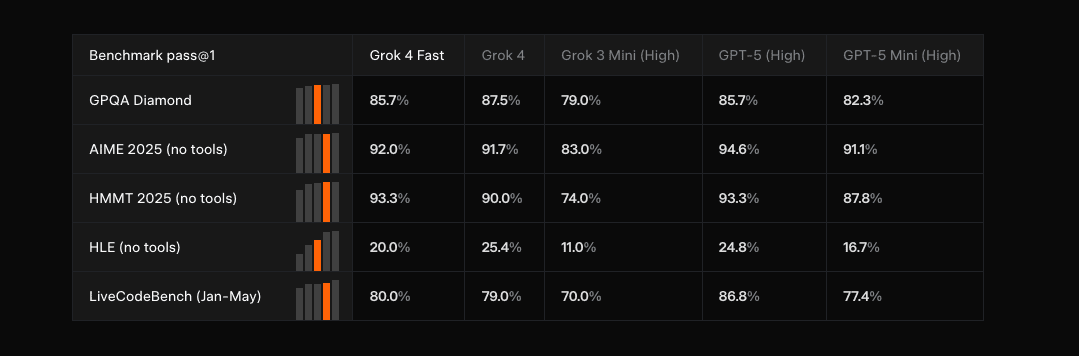
Built on the same infrastructure that powers xAI’s most advanced systems, Grok 4 Fast is already reshaping cost/performance charts across the AI ecosystem, as shown in new analyses by researchers such as University of Pennsylvania Wharton School of Business Professor Ethan Mollick and third-party AI benchmarking firm Artificial Analysis.

According to the company, Grok4 Fast delivers performance on par with Grok4 while consuming 40% fewer reasoning tokens and reducing price by 98%.

Grok 4 Fast benchmarks
  • Parity-level performance with Grok4
  • Uses 40% fewer reasoning tokens
  • 98% price reduction aimed at broader access

Features and use cases of Grok4

The model targets both enterprise and consumer scenarios, supporting tasks that benefit from speed and cost efficiency.

  • Code generation and iteration
  • Rapid information lookups
  • Built-in web search and X (formerly Twitter) search

Architecture and approach

xAI says Grok4 Fast uses a unified architecture that combines reasoning and non-reasoning pathways, allowing the system to switch between deeper analytical responses and instant answers based on context. This strategy mirrors approaches cited in rival systems such as OpenAI’s GPT-5 and Anthropic’s Claude Opus.

The roadmap

The company plans further enhancements to the Grok lineup, including multimodal features and agentic AI. xAI says future updates will be guided by user feedback gathered on X.

Context and recent developments

The launch follows a series of rapid updates to Grok. Recently, Musk said he believes xAI now has a credible path to artificial general intelligence, stating that Grok 5 could be capable of achieving AGI.

Safety and governance

The optimism arrives amid heightened scrutiny of Grok’s safety and behaviour. The chatbot has faced criticism for generating offensive or misleading content during testing, including extremist remarks, and for the sexually suggestive presentation of its avatar, Ani. xAI has apologized for what it called the model’s “horrific behaviour,” said it has implemented fixes, and announced plans for a child-friendly version of Grok.

The bottom line

With Grok4 Fast, xAI is aiming to broaden access to higher-quality reasoning while competing on speed and cost, even as it works to address ongoing concerns about content safety and model governance.

Nvidia commits $100B to OpenAI, 10GW AI buildout

Nvidia commits $100B to OpenAI, 10GW AI buildout

Nvidia will commit $100B in sales credits to OpenAI to build at least 10GW of NVIDIA-powered AI data centers, raising questions over power and partners.

The announcement

Nvidia Pledges $100B to OpenAI for Massive AI Buildout.

Nvidia plans to commit $100 billion to OpenAI as part of a sweeping partnership to scale the ChatGPT maker’s next-generation computing infrastructure. Under the agreement announced Monday, OpenAI aims to deploy at least 10 gigawatts of AI data center capacity built on Nvidia systems. The buildout supports OpenAI’s push toward what it calls artificial general intelligence, which Nvidia refers to as “superintelligence.” Other leading AI vendors are pursuing similar ambitions for human-level AI.

Deal structure: sales credits, not equity

The structure of the deal matters: industry analysts describe the $100 billion as a sales credit or rebate program tied to OpenAI’s purchases of Nvidia hardware and systems, rather than a cash infusion or equity investment. Nvidia effectively secures a long-term customer for its AI infrastructure while OpenAI gains preferred access and pricing as it scales.

NVIDIA and OpenAI have pushed each other for a decade, from the first DGX supercomputer to the breakthrough of ChatGPT,” said Jensen Huang, founder and CEO of NVIDIA. “This investment and infrastructure partnership mark the next leap forward, deploying 10 gigawatts to power the next era of intelligence.”

Everything starts with compute,” said Sam Altman, co-founder and CEO of OpenAI. “Compute infrastructure will be the basis for the economy of the future, and we will utilize what we’re building with NVIDIA to both create new AI breakthroughs and empower people and businesses with them at scale.”

Other compute deals and impact on NVIDIA’s leadership

The move follows reports that OpenAI recently struck a roughly $300 billion arrangement with Oracle to acquire compute capacity. It also caps a busy stretch for Nvidia, which last week committed fresh funding to several U.K. AI ventures and said it would invest $5 billion in U.S. chip rival Intel.

Analysts say the OpenAI pact further entrenches Nvidia’s leadership in AI chips and systems. Jack Gold, president of J. Gold Associates, noted that OpenAI is expected to purchase tens of thousands to potentially millions of GPUs to power its models, making a formal partnership logical. If OpenAI’s future models run exclusively on Nvidia GPUs, it would reinforce Nvidia’s position and encourage other model builders to do the same, he added.

Power and partners: The big questions

The scale of the plan also raises questions. David Nicholson, an analyst at Futurum Group, pointed out that neither company has previously delivered deployments at the 10-gigawatt level and asked where that much electricity would be sourced. He also flagged uncertainties around how Nvidia’s cloud partners, sometimes called proxy clouds, such as Massed Compute and CoreWeave would participate, and how hyperscalers like Microsoft might react. Microsoft is both a major investor in OpenAI and a key infrastructure provider for the company.

How does this differ from other OpenAI deals?

Nvidia’s arrangement with OpenAI differs from OpenAI’s deals with other providers, including Oracle, because it focuses on OpenAI buying Nvidia’s own AI systems under a large sales-credit framework. Financially, the contrast between the companies is stark: OpenAI’s revenue has been a small fraction of its spending in recent years, and it has reportedly lost more than $5 billion annually, much of it on infrastructure. Nvidia, by contrast, continues to generate revenue well above its costs, giving it ample capacity to support such programs.

The timeline

Neither Nvidia nor OpenAI disclosed a timeline for deploying the 10 gigawatts or fully drawing down the $100 billion commitment.

Bottom line

If executed, the pact could accelerate OpenAI’s compute roadmap and cement Nvidia’s dominance in AI hardware. But the sheer power requirements and the implications for cloud partners and investors remain open questions.

Anthropic’s Claude Reveals Where AI Is and Isn’t Taking Off

Anthropic’s Claude reveals where AI is and isn’t taking off

Claude’s usage maps widening the AI gap

Anthropic’s latest Economic Index suggests AI adoption is clustering in wealthier, knowledge-driven economies, both across countries and within the United States, raising concerns about a growing digital and economic divide. Read the full report here.

Global usage patterns

The company analyzed about one million August conversations with its chatbot, Claude, to understand where and how people use the tool. On raw volume, the U.S. accounts for the largest share of global usage at 21.6%, followed by India at 7.2%, with Brazil, Japan, and South Korea each at 3.7%.

Share of global usage
United States, 21.6%
Share of global usage
India, 7.2%
Share of global usage
Brazil, Japan, South Korea, 3.7% each

Population-adjusted leaderboard

Adjusting for each country’s share of the global working-age population reveals a different leaderboard. Smaller, high-income nations dominate on a population-adjusted basis: Singapore and Israel top the rankings, with Estonia, Malta, Luxembourg, and Switzerland also appearing prominently. Emerging economies such as India, Indonesia, and Nigeria lag by this measure.

  • Leaders: Singapore, Israel, Estonia, Malta, Luxembourg, Switzerland
  • Laggards (by population-adjusted usage): India, Indonesia, Nigeria

What’s driving the divide?

Anthropic links the pattern to income levels, reliable internet access, and the prevalence of knowledge work over manufacturing. The company cautions that if AI’s benefits accrue most to richer nations, the technology could deepen global economic divergence, echoing the unequal gains seen after earlier general-purpose innovations like electrification and the combustion engine.

Key takeaway: where wealth, connectivity, and knowledge industries concentrate, new tools spread fastest, risking a wider gap in productivity and opportunity.

A similar pattern inside the U.S.

A similar divide appears within the U.S. Northeastern states (New York, Massachusetts, Vermont, and the District of Columbia) and West Coast states (California, Washington, and Oregon) rank in the top quartile, while several southern states (Oklahoma, Louisiana, Mississippi, and Alabama) fall into the bottom quartile.

While higher per-capita GDP correlates with greater usage nationally, Anthropic notes that state-level results vary more than the global pattern, suggesting other forces are at work. The nature of local economies appears to matter: Washington, D.C., which leads the U.S. index, sees unusually frequent requests for document editing and information retrieval, while California, ranked third, generates a high share of coding tasks.

Top quartile (population-adjusted)
NY, MA, VT, DC, CA, WA, OR
Bottom quartile
OK, LA, MS, AL

How are people using Claude?

The report also examines how people are using AI, what types of tasks they submit, the balance between automation and augmentation, and which professions are most engaged. Beyond its warning about uneven uptake, Anthropic strikes a cautiously optimistic tone: usage patterns are still taking shape, and early signs point to growing comfort with AI tools like Claude.

Task patterns by region

  • Washington, D.C.: Unusually frequent requests for document editing and information retrieval
  • California: A high share of coding tasks

Implications for policy and business

The findings underscore a familiar theme in technology adoption: where wealth, connectivity, and knowledge industries concentrate, new tools spread fastest. Policymakers, educators, and businesses may need to address access and skills gaps to ensure the economic gains from AI do not become more uneven over time.

  • Invest in reliable, affordable internet infrastructure
  • Expand digital literacy and AI skills training
  • Support adoption in SMEs and public services
  • Encourage responsible, inclusive AI deployment

The bottom line

AI’s economic upside is real. However, without intentional action, its benefits may concentrate where they already accrue, widening both digital and income divides.